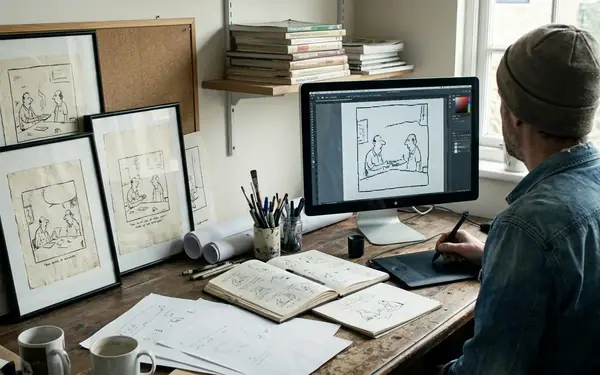
A folder of press clippings about Michael Leunig can deceive you. Open it and you find an arts-page profile sitting beside a furious opinion column, a gentle book review pressed against a letters-page complaint, a recent retrospective filed next to a cartoon-page item from the early 1970s. Each one looks like evidence. None of them carries the same evidentiary weight.
This guide exists to slow that first reading down.
Why Leunig's Press Record Needs Context Before Judgment
The central problem is conflation. Press items about Leunig routinely blend artistic appreciation, interview fragments, public controversy, book promotion, and cultural commentary into a single impression. A reader who treats every article, profile, review, or column as interchangeable will reach conclusions the sources cannot actually support.
Consider the difference between a cartoon-page appearance and a controversy report. One is Leunig's published work; the other is the press reacting to it. Logging them as the same kind of record collapses a distinction that matters enormously when you later try to describe what Leunig said, drew, or believed.
So before interpretation, separate the evidence types. A cartoon item, an arts profile, a review, a controversy report, and a retrospective each demand a minimum set of fields: date, publication name as printed, section or page context, byline status, article type, and whether Leunig is quoted directly or merely discussed by others. His newspaper and magazine presence stretches from the late 1960s and early 1970s across later decades, and now includes retrospective material published after December 2024 — a span no single reading habit handles well.
Curly Flat sits in a particular position here. It is an independent media archive and appreciation guide. It is not the Leunig estate, not his publisher, and not a comprehensive legal record. That boundary shapes everything that follows.
The Australian Press Landscape Around Leunig
Map the environment before you interpret any single item. The Australian media contexts where Leunig appears are varied and serve different editorial purposes:
- Newspaper cartoon pages
- Arts pages and arts profiles
- Literary review pages
- Interview features
- Opinion columns
- News reports
- Festival or exhibition coverage
- Letters pages
- Later retrospective features
The same masthead can publish several of these in a single period. A newspaper might run an interview, then a review of the same book, then an editorial response to a cartoon — all within weeks. Each item should be catalogued separately, because each was commissioned for a different reason.
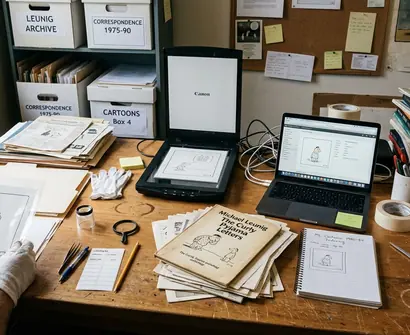
This guide uses a source-first method. The decision sequence runs in order: identify where the item appeared, identify its stated genre, identify its occasion, and only then attempt analysis. Prioritise dated items, named publications, named authors where present, section labels, and page images. For work spanning the late 1960s through post-December 2024 coverage, search both full-name and surname-only references, then verify against page images where they exist.
How to Tell an Interview From a Profile, Review, or Reaction Piece
A practical taxonomy is built by asking one question of each item: what can it actually prove?
The article-type categories
- Interview — supports claims about attributed, quoted speech.
- Profile, shows public framing and how a writer presents Leunig.
- Review, documents critical reception of a book or exhibition.
- News report, records events and public statements.
- Opinion column, argues a position, often the columnist's, not Leunig's.
- Letters-page response, shows a selected, edited sample of published reader reaction.
- Obituary-style retrospective, captures later memory and reputation.
- Archive note, a catalogue or contextual record.
Before interpreting any of these, inspect the textual furniture: headline, standfirst, pull quote, image caption, byline, opening paragraphs, the publication section, and any editor's note or correction. These elements frame a piece, and they often promise more than the body delivers.
A promotional headline on a book review is not proof of Leunig's own stated belief. Check whether the article contains a direct quotation before you treat the headline as his voice.
Risk Factor: Treating a letters-page response as representative of national opinion is a common error. The letters page is curated and edited; it shows what an editor chose to publish, not the spread of public feeling.
Recurring Themes: Innocence, Dissent, Faith, Domestic Life, and Discomfort
Press discussion of Leunig keeps returning to a recognisable cluster of themes. Tag each item consistently using a stable vocabulary: gentleness, melancholy, innocence, spirituality, ordinary domestic life, political unease, dissent, public discomfort, and cultural memory.
Tagging is only half the work. Beside each theme, mark the source type: a published cartoon or poem, a direct interview quotation, a reported paraphrase, a critic's interpretation, or a later retrospective judgment. The same theme — say, dissent, reads very differently when it comes from Leunig's own drawing versus a columnist's summary of what they think he meant.
Australian coverage has long treated Leunig as two figures at once: a beloved cultural presence and a contested public voice. Which one dominates depends on the period, the publication, and the specific issue at hand. Resist the temptation to reduce that tension to a single episode. Controversy around Leunig is better understood as a reading challenge that recurs across time, tone, editorial placement, and audience expectation.
When a disputed item triggers a press response, compare the immediate reports and reactions — those published within the first few weeks, against later retrospective accounts. An arts-page discussion, an opinion-page argument, a news report, and a letters-page reply are not interchangeable, even when they all reference the same cartoon or comment.
A Date-First Method for Reading Leunig in the Press
The method is chronological before it is interpretive. Record the facts first; reason from them second.
- Date — as printed on the page.
- Publication, the masthead name exactly as it appears.
- Section, arts, news, opinion, letters, review.
- Author, named byline or unsigned status.
- Article type, drawn from the taxonomy above.
- Triggering occasion, what prompted the piece.
- Direct quotations, Leunig's attributed words.
- Paraphrased claims, what others report him as saying.
- Wider cultural context, the national conversation around the date.
Ask what triggered the item. The usual categories are: a new book, an exhibition, an interview series, a public controversy, an anniversary, an award, a broader cultural debate, or retrospective coverage after December 2024. Knowing the trigger explains the framing.
Critical Insight: A direct quotation carries different evidentiary value from a columnist's summary, a reviewer's interpretation, or a later memory piece. Keep primary evidence visibly separate from interpretation in your notes.
One quality-control habit matters more than it sounds. When you work in searchable newspaper archives, OCR and transcription errors are common, especially in names, dates, captions, and quoted phrases. Check anything suspect against the original page image. Services like Trove, the National Library of Australia's discovery service often provide those images alongside the transcribed text.
Scope and Limitations of This Context Guide
State the boundary plainly, before anyone mistakes this for something it is not.
This is an interpretive framework for reading Australian press coverage of Michael Leunig. It is not a complete list of every article, cartoon-page appearance, review, interview, or letter. It is designed to help you read coverage well, not to deliver a definitive biography, a legal assessment, or an exhaustive media audit.
Archives impose their own constraints, and honesty about them is part of the method. Expect missing newspaper issues, incomplete digitisation, OCR errors, paywalled databases, library-only access, rights restrictions, and inconsistent metadata for older pages. Coverage from the late 1960s and early 1970s often needs different verification steps from born-digital or post-December 2024 retrospective material.
The honest qualifier specific to this work: a reading framework can sharpen how you interpret a source, but it cannot confirm that every relevant press item has been found or that every archive record is complete. Revise your understanding when substantial new archive batches, major interviews, significant retrospectives, or newly accessible page images change the available evidence.
Build Your Own Leunig Press Reading File
Turn all of this into a working practice. Build a simple file with one row per item and these fields:
- Date
- Title
- Publication
- Section or page context
- Author or unsigned status
- Article type
- Triggering occasion
- Direct quotation from Leunig
- Reported or paraphrased claim
- Theme tag
- Reception signal
- Archive citation or page image reference
- Interpretive caution
Group by purpose, not by opinion. Keep interviews with interviews, reviews with reviews, controversy reports with controversy reports, letters-page responses with letters-page responses, and retrospectives with retrospectives. This grouping resists a subtle mistake: merging post-December 2024 retrospective coverage with contemporaneous reporting from earlier decades without labelling the difference in time and purpose.
Recommendation: Beside each item, add one sentence explaining why it matters — whether for artistic context, reception history, public debate, biographical relevance, or later cultural memory. That single annotation does more for future re-reading than any amount of highlighting.
Keep the first pass bounded. Choose one calendar year, one publication month around a book or exhibition such as a Penguin Books Australia Ltd release, or the immediate weeks after a public controversy. A small, well-documented set teaches the method better than a sprawling, half-recorded one. The discipline scales; the impatience does not.