How can a researcher build a useful record of a Leunig cartoon without reproducing the cartoon itself? The question sounds almost paradoxical, yet it sits at the centre of daily archival practice. A clipping rests on the desk, a notebook waits open beside it, and somewhere in the future a reader needs to identify that same drawing without ever seeing a copy attached to your record.
This article walks through a seven-day method for descriptive cataloguing, attribution, publication context, and reference handling. It is not legal advice, and it does not replace the process of seeking permission from a rights holder.
Day 1: Departure — What Can Be Catalogued When the Image Stays Ashore?
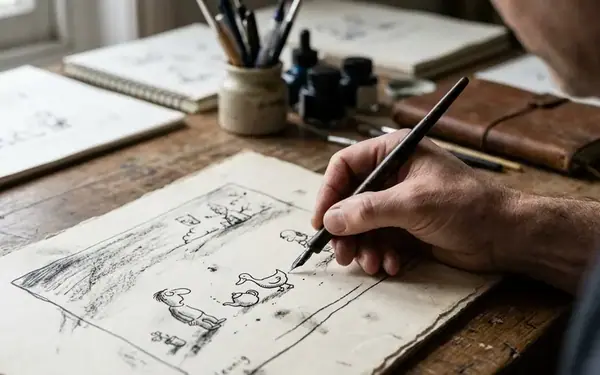
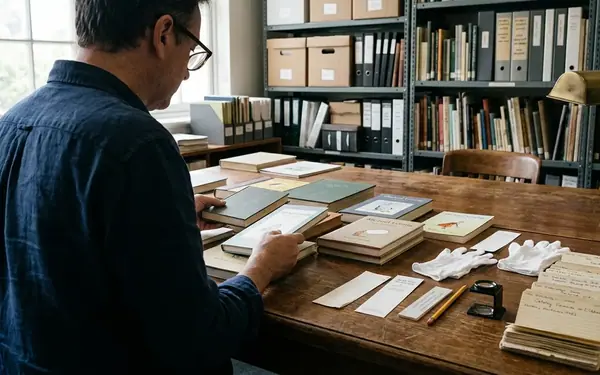
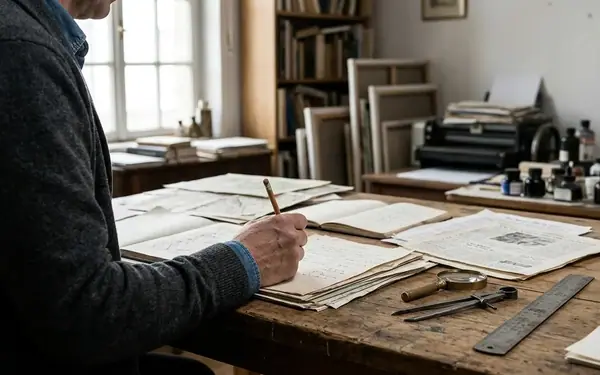
Start at the desk, not at theory. The first decision I make when handling a clipping is to capture the record in the same session as the review, while the physical object is in front of me and details remain fresh.
The first draft record needs only a handful of anchoring fields:
- Working title
- Creator name
- Publication title
- Issue date
- Page or section
- Physical source type
- Repository or owner
- Rights note
If the source date or page number is incomplete, leave a verification window of a few working days rather than guessing. An empty field marked as unresolved is more honest than a confident error, and a future reader can see exactly where certainty stops.
Day 2: Weather Report — The Copyright Front Before Description Begins
A Leunig cartoon rarely means one thing through image alone. Meaning gathers across the drawing, the caption, the line work, the spatial arrangement of a duck beside a kettle, and the publication that framed it. This density is precisely why description demands restraint.
There is a working distinction between describing a cartoon and reproducing it. Catalogue language should identify and contextualise the work so a reader can find it. It should not attempt to recreate the visual experience in substitute form.
For general orientation, the Australian Government copyright guidance and the wider Copyright Act 1968 framework offer a starting point rather than a verdict. This guidance supports descriptive cataloguing and reference handling; it does not decide whether a particular reproduction, classroom use, quotation, scan, or online display is lawful in your specific case.
A short rights-status phrase belongs in every record. Something plain: image not reproduced; permission not held; rights holder not verified.
Day 3: Charting the Fields — The Minimum Record That Still Helps
The template stays lean because the record's job is discovery, not replacement. Every field earns its place by helping someone locate the work; nothing more.
A minimum record for a Leunig cartoon holds these fields:
- Working title
- Creator
- Publication source
- Date
- Page or section
- Format
- Caption-as-printed field
- Cataloguer-description field
- Subjects
- Recurring motifs or characters
- Provenance note
- Rights note
Titles: supplied, bracketed, or generated
Record the title as supplied when one is printed or otherwise documented. When no title appears, create a bracketed working title on the record date, then review it during a later editorial pass. The bracket signals to a future reader that the phrase is the archive's convenience, not the artist's wording.
Keep caption as printed separate from cataloguer description. This one separation prevents a slow drift where later readers can no longer tell what belonged to the original publication and what an archivist added afterward.
Day 4: The Long Look — Writing Visual Description Without Rebuilding the Cartoon
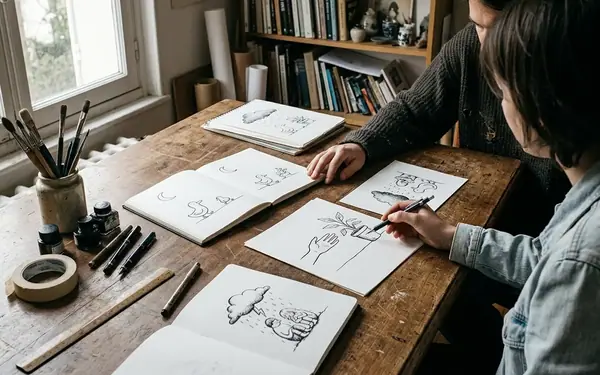
Description works best in three ordered passes. First, inventory the visible elements in plain language. Second, describe the relationships among them, figure to object, caption to image, setting to mood. Third, state interpretive possibilities cautiously, marked as reading rather than fact.
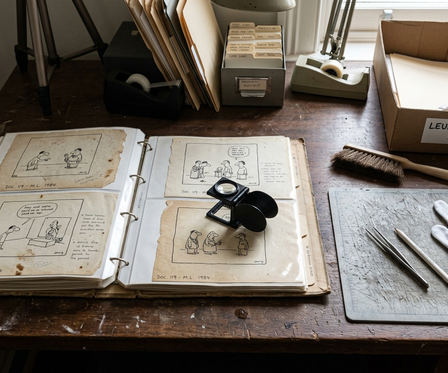
The failure case is instructive. A record that describes every figure, line, caption placement, gesture, and punchline in sequence can become a substitute for the cartoon, even though no image file is attached. At that point the description has quietly crossed from identification into reproduction by other means.
A few sentence patterns keep description proportionate:
- The cartoon depicts…
- A recurring Leunig motif appears…
- The setting appears domestic…
- The publication context suggests…
When a description is revised, note the reviewer's initials or role, the change date in YYYY-MM-DD format, and whether the edit touched observation, transcription, subject terms, or interpretation. The audit trail costs seconds and saves later confusion.
Day 5: Harbour Notes — Publication, Provenance, and Attribution
Treat publication history as evidence, not decoration. A Leunig cartoon can shift in meaning between its newspaper appearance, its gathering into a Penguin Books Australia Ltd collection, an exhibition wall, and a later republication. The same image carries different weight in each harbour.
The provenance fields worth capturing:
- Publication title
- Issue date
- Page and section
- Clipping source
- Collection owner
- Accession number
- Donor note
- Physical condition
- Verification status
Certainty labels matter
A cartoon seen in a clipping is recorded as first observed publication unless another source confirms something earlier. Reserve confirmed first publication for cases with real evidence, and keep later republication and unverified web lead as distinct categories.
The distinction has practical teeth. A newspaper clipping with a printed date, a page number, and a visible masthead supports a far stronger publication citation than an unattributed web copy, which should travel no further than an unverified lead until something confirms it.
Day 6: The Reference Compass — Pointing to the Image Without Showing It
Access comes through pointers, not embedded pictures. The public record's task is to guide a reader toward a lawful viewing path while the image itself stays out of the file.
Public access pathways may include:
- Repository name
- Call number
- Box or folder label
- Publication citation
- Issue date and page
- Exhibition catalogue entry
- Rights-contact status
A thumbnail, scan, or screenshot should stay out of a public record whenever permission or licence terms are not established. The absence is deliberate, and it should read as care rather than omission.
Recommendation: keep private handling notes separate from public-facing records. Internal file names work well as stable neutral identifiers — a pattern such as creator-source-date-recordID, with dates in YYYY-MM-DD where the issue date is known. The public record stays concise and rights-aware; the workflow detail lives behind it.
Day 7: Landfall — The Final Record Check Before Release
Frame the final review from the future researcher's vantage. Before a record goes public, run a single editorial pass, dated in YYYY-MM-DD format, and mark any unresolved fields explicitly rather than leaving them blank.
The release checklist is short by design:
- Facts verified
- Source named
- Image not reproduced
- Uncertainty marked
- Description proportionate
- Attribution clear
- Rights note present
Curly Flat's editorial approach favours cautious description precisely because Leunig's work leans so heavily on nuance, tone, and visual restraint. A record that shouts every detail betrays the very quiet it is trying to preserve.
So read your own record one last time as a stranger would. Can that reader identify the work, locate the source, and see clearly where your knowledge runs out — or have you handed them a paraphrase dressed up as a finding aid?