
Most readers meet Michael Leunig through a single cartoon — a duck, a teapot, a small bewildered figure under a large moon, and assume the work is gentle whimsy. That assumption is the first interpretive mistake. Leunig is a satirical political cartoonist, a poetically inclined social commentator, and a philosophical observer, and the meaning of any given piece often sits below its disarmingly simple surface.
Why Leunig Rewards Slow, Contextual Reading
Treat this page as an independent appreciation and archive guide. It is not an official biography, an authorized catalogue, a rights index, or a final verdict on Leunig's reputation. That distinction matters, because the temptation with a famous cartoonist is to flatten everything into either reverence or grievance.
The reader problem is concrete. A Leunig image may look minimal, yet its sense depends on handwritten captions, small human figures, animals, empty space, domestic settings, and — crucially, the publication context where it first appeared. Strip those away and you are left holding a fragment.
Many readers arrive here through political or democratic commentary, having encountered Leunig as a voice in public argument. That is a legitimate entry point. This guide widens it: the cartoons share a creative world with his poems, books, interviews, and the cultural reception that has grown around all of them.
Map the Career Before Reading the Symbols
Chronology should come before symbolism. Before decoding ducks and moons, set down what is documented.
Leunig was born in 1945. His professional cartooning career begins in the 1960s rather than on any single tidy launch date. Early publication anchors include Newsday and the London-based Oz magazine, and those venues are not incidental. They place the work inside countercultural print culture and a tradition of newspaper satire, during a period when Australian public debate was shifting quickly.
The Age became a key professional home. The format matters here as much as the masthead: a daily broadsheet gives a cartoon a civic visibility that a gallery wall or a later book collection cannot replicate. A drawing printed beside the news enters the day's argument. The same drawing reprinted in a book enters a curated sequence instead.
That movement into book form has its own anchor. The Penguin Leunig, published by Penguin Books Australia Ltd in 1974, marks the point where the cartoons begin to live as collected objects rather than disposable daily commentary.
Learn the Creative Language: Figures, Silence, and Unease
The recurring elements are best understood as observable features, not a locked symbol code. Resist the checklist instinct.
Name what is visibly on the page: small human figures, animals, handwritten captions, empty space, domestic scenes, and sparse landscapes. These are devices you can point to, not interpretations you have to take on faith.
Read in three passes
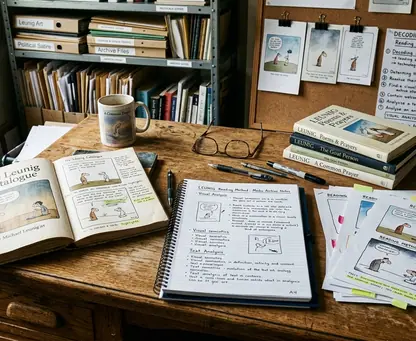
A workable order is to inspect the image first, read the caption second, then check the publication or collection context third. Reverse that sequence and you tend to import meaning before you have actually looked.
Hold the cartoon, the caption, the poem, the fable-like reflection, and the interview statement apart as genres. They are not interchangeable. Leunig's voice moves between visual joke, moral fable, lament, and something close to prayer, and a poem does not function like a single-panel gag.
What you can verify on the page are contrasts: innocence beside cruelty, playfulness beside political anger, ordinary household life beside civic or spiritual unease. A small figure in empty space may signal loneliness, innocence, spiritual searching, civic anxiety, or comic absurdity — which one depends entirely on the caption and the setting.
Read the Politics Without Flattening the Art
Because so many readers find Leunig through democracy-related discussion, the political work earns its own treatment. The risk is reading a cartoon as a slogan.
His political cartoons function as civic interventions more than as plain arguments. They operate through satire, discomfort, moral pressure, and ambiguity, and they often work on public feeling rather than delivering a thesis. That is a different mode of persuasion from an op-ed, and it should be read as such.
Setting changes everything. A daily broadsheet cartoon enters public debate immediately and at scale; a poem in a collection or a remark in a retrospective interview does not. Each carries its meaning into a different room.
Treating a broadsheet political cartoon as a standalone slogan can erase the role of publication date, news climate, caption tone, and satirical ambiguity — the very things that gave it force.
Critical Insight: Keep documented career facts separate from interpretive claims about tone, audience, and reception. Reception language, admiration, disagreement, controversy, debate, is all part of the public record, but each claim should be tied to a specific work, period, or publication.
Risk Factor: This method helps you interpret political tone and public context, but it cannot prove the artist's private intention unless a direct interview, a dated statement, or documented editorial context supports the claim.
Use the Archive as a Reading Path, Not a Verdict
Think of the archive as a sequence of checks rather than a destination. The goal is to stop a cartoon from being read in isolation from the poems and interviews that share its register.
- Begin with a short bio carrying fixed anchors: born 1945, career emerging in the 1960s, Newsday, Oz magazine, The Age, and The Penguin Leunig in 1974.
- Identify the medium before you interpret: newspaper cartoon, collected cartoon, poem, interview, book preface, or retrospective commentary.
- Compare The Penguin Leunig against newspaper-era context to see what shifts when a drawing moves from daily publication into a curated book sequence.
Reading a collected cartoon as though it carried the same charge as its first newspaper appearance ignores that shift from live public debate to bound retrospective.
Slow Reading Path for a Leunig Work
- Identify the medium: daily cartoon, collected cartoon, poem, interview, or book text.
- Record the known date or period — the 1960s career emergence, or the 1974 publication of The Penguin Leunig.
- Read the image first, then the handwritten caption, then place both against their publication setting.
- Note the emotional register and any visible contrast before reaching for a meaning.
Recommendation: Educators and researchers do better with questions than conclusions. What is being satirized? What emotional register is in play? What cultural assumption is being tested? What changes when the same work is read outside its first publication setting?
Scope, Limits, and Responsible Interpretation
This is a reader's guide. It is not a comprehensive biography, an official archive, a legal rights catalogue, or a final judgment on Leunig's public standing — and it should not be mistaken for one.
The orienting anchors stay deliberately modest: 1945 as birth year, professional emergence in the 1960s, Newsday, the London-based Oz magazine, The Age, and The Penguin Leunig in 1974. They exist to position your reading, not to claim exhaustive coverage of a long creative life.
Some wording here is time-sensitive and worth revisiting in future editorial updates: descriptions of employment, publication-status language, the availability of collected works, and any claim about current public reception. Leunig's work continues to attract admiration, disagreement, and debate in roughly equal measure, and that ongoing conversation outpaces any single guide.
So the aim is orientation, not instruction. Move through the sequence — cartoon, poem, interview, and book, and let the context inform the conclusion you reach rather than the other way around. The work rewards a reader willing to slow down; it resists one in a hurry to be certain.