A Verified Quote Reveals More Than a Memorable Line
Demanding provenance does not diminish a Leunig line. It deepens it.
A quotation card gives you words floating in white space. Restore the date, the medium, the speaker and the passage sitting either side, and a portable slogan often turns back into a cartoon exchange, a stanza with a shape, or an interview answer shaped by the question that prompted it. The setting carries meaning that cropping strips away.
Leunig attributions detach unusually easily because his words arrive through so many channels. A phrase might begin as a cartoon caption, a line of dialogue inside a panel, a poem, a book passage, a newspaper column, an edited interview or a later paraphrase written by someone else entirely. Each origin behaves differently under scrutiny, and a card that says only "Leunig" tells you none of it.
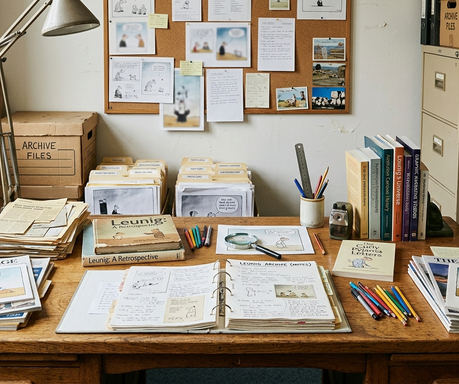
The goal here is narrower than a verdict. Rather than forcing every attribution into true or false, the work is to establish what can responsibly be claimed. Confirming that wording and publication history hold does not, on its own, settle whether an ironic, fictional or deliberately ambiguous passage expresses Leunig's own position. Provenance answers one set of questions and leaves another honestly open.
First Decide What the Attribution Is Claiming
Reposts collapse four separate questions into one. Pull them apart before you search.
- Did Leunig create these words at all?
- Is the wording exact, or has it drifted?
- Where did the words first appear?
- Is the surrounding context represented fairly?
Write the claim down before opening any archive. Then classify the item, because the class changes where you look: cartoon dialogue, cartoon caption, poem, aphorism, prose passage, interview answer, reported remark, or an unattributed graphic that arrived with no citation at all.
Not Everything Beside His Name Is His
Editorial furniture sits close to an artist's work without being written by him. A headline, a standfirst, an image caption and an interviewer's summarising prompt can all appear on the same page as Leunig's cartoon while carrying different authors. Transcribe each of those elements separately. When a date is missing, typography, publication design and upload history suggest a rough decade; take that ten-year interval and split it into two five-year searches rather than guessing at a single year.
Build an Evidence Chain, Not a Collection of Reposts
Rank every source by its proximity to publication.
At the top sits the original artifact: a dated newspaper page, an identified book edition, a complete audio or video recording, or a full interview transcript. Below that, reliable reproductions, contemporaneous reports and later anthologies each establish something partial. A reputable anthology can confirm wording while telling you little about first appearance; a contemporaneous review can place a work in time without reproducing it exactly.
For a newspaper item, preserve the masthead, issue date, page number and archive URL. For a recording, keep the program title, interviewer, release date and a timestamp to the nearest second. These fields are what let another reader retrace your steps.
Repetition Is Not Confirmation
Quotation sites, social posts, unattributed graphics and search snippets are leads, not proof. Consider the common failure: ten quote-card accounts repeat identical punctuation, and it feels overwhelming until you notice all ten descend from one uncited upload. The repetition documents a single transmission chain, not ten independent confirmations. Volume measures circulation. Only an artifact establishes attribution.
Trace the Words from Exact Phrase to Original Artifact
Copy the attribution exactly, then choose one unusual fragment of five to eight words. Normalize the curly quotation marks, apostrophes and line breaks that email and social platforms introduce, and run that fragment as a phrase search.
If the exact phrase returns nothing, shorten it in stages. Test the variants that transcription tends to create: singular against plural, Australian spelling against American, an omitted line break, an obvious optical-character-recognition slip where an "rn" becomes an "m". Genuine matches often hide behind one small substitution.
Add context in measured amounts — Michael Leunig, the words interview, cartoon, poem, column or book, a suspected publication and an approximate year. Pile on too many assumptions and you filter out the real variant before it can surface. In newspaper archives, search the suspected year first, widen to a five-year range, then inspect the full page plus one page on either side of any promising hit. You can search digitised Australian newspapers in Trove; note the date of your search, since records, corrections and links change over time.
Keep a Search Log
A compact log holds the exact query, the database or catalogue, the date range, the filters, the result, the artifact URL or shelf reference, and the next action. For books, capture title, publisher, edition statement, year and page, and compare at least two editions whenever punctuation or pagination is in dispute.
Compare Versions Without Flattening the Context
Set the circulated wording beside the earliest verified form and read them line by line.
Build a two-column transcription with one row per sentence, speech balloon or poetic line. Bracket any word you supply; use an ellipsis only where the source itself was deliberately shortened. Now mark what differs: punctuation, deleted words, reordered clauses, modernised spelling, reconstructed line breaks.
Some of these changes are harmless. Others reverse the sentence. Losing a negative, a question mark or a speaker label can flip agency, irony or certainty — the difference between a doubt voiced and a doubt resolved.
Punctuation and line breaks shift naturally when hand-lettered cartoon text becomes typed prose, and that alone rarely matters. Deleting a "not" matters enormously. For prose, read at least the paragraph before and after; for cartoons, read every panel on the page; for recordings, compare a minimum of thirty seconds either side.
Who Is Actually Speaking?
Ask whose voice sits inside the work. Leunig's own prose voice, an interviewer's prompt, a cartoon character or a third party quoted within the piece all read very differently once the frame is restored. A line delivered by a comic figure is not automatically the artist's declared belief.
Treat Social-Media Quote Cards as Clues
Attribution drifts fastest when words are laid over a cartoon, a portrait or a Leunig-style drawing with no publication reference attached. The image lends borrowed authority; the citation is nowhere.
Treat the card as evidence of circulation and nothing more. Save its URL and your access date. Capture the full post — account name, upload date, caption, any visible edits and the earliest archived copy, rather than only the cropped picture. Then trace backward. Compare uploads in chronological bands, the first week against the following weeks against the months after, to see whether later accounts simply copied one wording and one crop. Read the captions and comments for a source that an early poster may have supplied and later ones dropped.
Visual resemblance proves nothing about authorship. A signature-like mark, a familiar drawing style, a share from a large and trusted account: none of these establish who wrote the words. Popularity measures reach; provenance settles attribution.
Cite What You Found—and State What Remains Uncertain
Draft the finding from the strongest artifact outward.
The verified pattern names the creator, the work or interview title, the publication or book, the full date, the page or timestamp, and the edition where it matters, followed by a stable archive or catalogue location: Michael Leunig, work or interview title, publication or book title, day month year, page or timestamp.
Language for Partial and Failed Searches
Honesty about what you could not find is part of the citation. Two patterns carry most cases:
- Partial finding: "Attributed to Michael Leunig; no primary publication located after searches of [archives or catalogues], covering [start]–[end], conducted [access date]."
- Variation: "Wording varies from the version published in [source], [date], p. [page]; the circulated form omits or changes [specific words]."
Reserve misattributed for the demonstrable cases: another creator is identified, or dated transmission evidence shows the wording was attached to Leunig after first appearing under a different name. The word carries weight, so spend it only where the evidence earns it.
Let the Evidence Determine the Label
Five decisions, in order. Identify the kind of statement. Locate the strongest artifact. Compare the wording. Inspect the context. Record the trail. Then assign the narrowest status the evidence will defend.
Picture the moment it pays off. An educator stands at a library reference desk with a printed quote card in one hand and a bound Leunig collection open on the counter. She reads the card, then reads the page, and stops: one clause present in the book is missing from the card, and that clause holds a hesitation the shorter version had smoothed away. She keeps the card's access date, notes the collection's title, edition, year and page, and rewrites the classroom handout. "Leunig said" becomes a cited passage with the omitted sentence restored.
The corrected line is longer and less shareable. It is also truer to the drawing it came from — which is precisely the point.