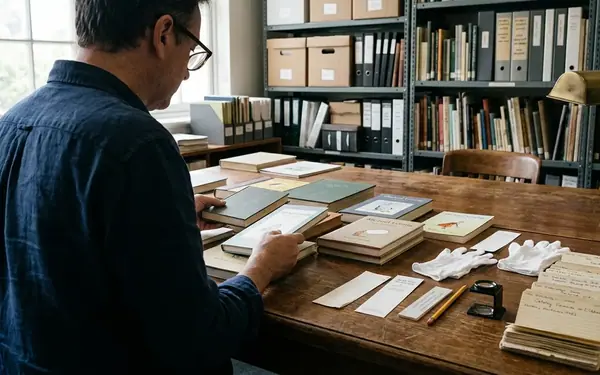
A Leunig chronology is easy to start and hard to trust. Anyone can paste a run of quotations into date order; the harder work is proving that each line belongs to a real exchange, on a real date, in a source another reader can pull up independently. What follows is the working sequence I use to turn a shoebox of cuttings, catalogue hits and half-remembered broadcasts into a timeline that survives scrutiny.
What Makes an Exchange Count as an Interview Record
An interview record is a traceable exchange in which Michael Leunig's words can be tied to an identifiable publication or broadcast. Four identifiers are the minimum: source title or programme, publication or broadcast date, interviewer where credited, and a retrievable item or archive record. Miss one and the entry is a lead, not a record.
The output of this workflow is a chronological list whose every row can be checked by someone who has never seen your files. That test governs everything else. It is why the questions below are sequenced the way they are, from classification through dating to transcription.
Press clippings alone will mislead you. A single conversation can leave three or four paper traces: the bylined original, a syndicated copy in a sister masthead, an edited extract trimmed for space, and a much later feature that lifts one sentence. Counted carelessly, one afternoon in a studio becomes four interviews in your timeline.
Holding-List Discipline
Park uncertain discoveries in a holding list rather than admitting them provisionally to the chronology. Recheck each one within 7–14 days, after you have searched for fuller copies and compared wording against items already verified. Half of a holding list usually resolves into duplicates of records you already hold.
Original, Syndicated Copy, or Later Quotation?
Consider three items that all appear, at a glance, to be interviews. Item A carries an interviewer byline and a full question-and-answer sequence. Item B surfaces two to ten days later with identical answers and an attribution line crediting another outlet. Item C turns up anywhere from one to fifteen years afterwards and quotes a single passage inside a longer essay. Those patterns point cleanly to original, reprint/syndication and later quotation respectively, and the reasoning holds without asserting anything about a particular Leunig exchange.
So give every entry a status label and one or two sentences naming the decisive clue. The clues worth weighing are few and visible: interviewer byline, masthead or programme title, the printed date, the wording of the introduction, the copyright line, and any acknowledgement of prior publication. An introductory sentence that begins by summarising what Leunig "once told" someone is doing your classification work for you.
This is the source-chain split that catches most compilers: one apparent interview resolves into a bylined exchange, a near-date syndicated copy, and a much later quotation. Three items, one conversation, one timeline row with three citations beneath it.
Indexing-Date Trap
The earliest database result is not automatically the earliest publication. Archive coverage is uneven and indexing dates reflect when a record was created, not when ink hit paper. Record both the date printed on the item and the database indexing date whenever they diverge.
Working Outward From One Clipping
Where should a search actually begin? With whatever you already hold, mined for its distinctive features. Pull out a quoted phrase of six to twelve unusual words, the interviewer's name, the outlet or programme, any book title mentioned, and the approximate date the item implies.
- Run separate searches for "Michael Leunig" and for "Leunig" alone; surname-only indexing is common in older newspaper records.
- Search the interviewer's surname, then the outlet or programme title, then any referenced book — a collection issued by Penguin Books Australia Ltd, for instance, often anchors a promotional interview cluster.
- Search the quoted phrase verbatim, then with one word removed, to catch transcription variants.
- Open with a date window of thirty days either side of the date your clipping suggests. Widen to six to eighteen months only if the first pass returns nothing.
- Follow each discovery record toward the fullest surviving item: catalogue metadata to scan, transcript to recording.
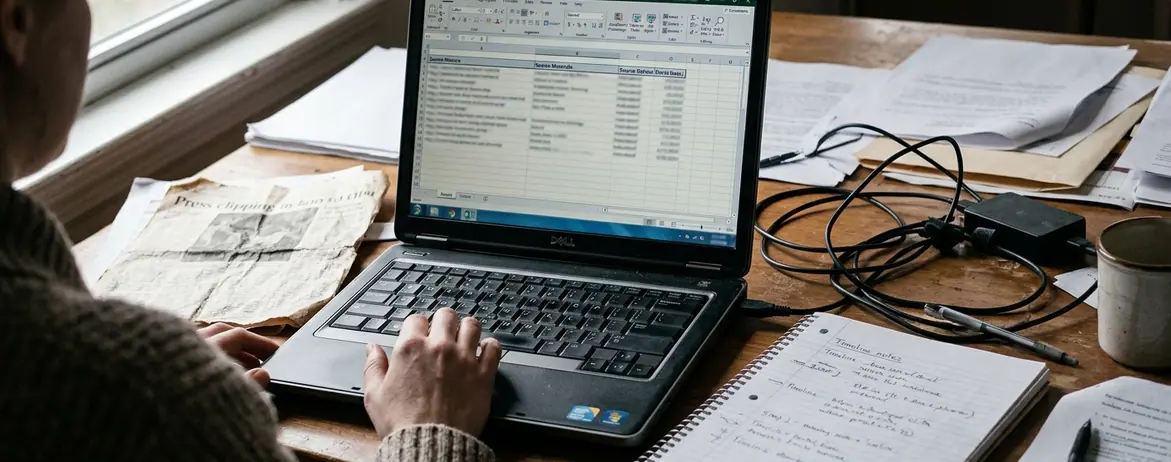
A catalogue result is a signpost, never the interview. Capture outlet or broadcaster, displayed date, page number or programme segment, interviewer, archive identifier, item format and your access date in ISO form such as 2026-02-14. When metadata and the source image disagree, keep both and describe the conflict plainly: "Catalogue: 12 May; issue masthead: 13 May." Flattening that disagreement is how errors become permanent.
Dating a Cutting That Lost Its Masthead
A nine-day evidence window is a legitimate published date. Insisting on a single day you cannot support is not.
Dating moves from broad clues to checkable ones. A mention of an identifiable book phase — say, the period around a collection such as State of Bewilderment — might place an undated cutting inside a three-to-five-year span. Employment records for the interviewer can compress that to fourteen months. An adjacent issue reference on the reverse of the cutting can narrow it to nine days. Where a publisher's own release record corroborates the internal book reference, the range tightens further; where it contradicts it, the contradiction gets written down.
Store publication date, recording or interview date, and broadcast date in separate fields. They are frequently different moments, and collapsing them creates phantom chronology. Use YYYY-MM-DD where the day is known, YYYY-MM or an explicit start–end range where it is not.
Then label the confidence, tied to evidence rather than an unexplained score:
- Confirmed — the item displays a date corroborated by an issue or programme record.
- Probable — two independent clues converge on the same day or short range.
- Approximate — only a month, season or broader interval can be supported.
Keep a research log: search date, exact query, archive searched, result inspected, evidence found, unresolved question. Revisit unresolved date fields within 14–30 days. It is worth saying that this method verifies only what surviving print, catalogue, transcript, audio or video records disclose; an unrecorded interview date or a stripped interviewer credit stays lost, and the honest entry says so.
Transcription That Keeps the Seams Visible
Assign every passage to its function before you copy a word of it: interviewer question, Leunig answer, editorial introduction, caption, later annotation. Cartoon captions and editorial framing drift into quotation sets with remarkable ease, and once a caption is attributed as an answer it circulates that way.
Preserve legible wording, punctuation and printed omissions exactly. Mark an uncertain reading with square brackets and a question mark, as in "[word?]"; mark supplied text with square brackets; reproduce the ellipsis form actually printed, or state "[ellipsis in source]". Silent repair feels tidy and destroys evidence.
Broadcasts need one extra line of honesty. Cite quotation locations as HH:MM:SS–HH:MM:SS and state whether your evidence is complete audio, an official excerpt, a transcript or a later report — four very different grades of proof. Where a second editor is available, complete a comparison pass within two to seven working days of first transcription, checking every quoted passage against the scan or recording and rechecking all displayed dates.
Use identical fields throughout: date or range, title, interviewer, outlet, format, source status, quotation location, a concise context note, and an evidence-based confidence note.
Five Elements Before the Timeline Goes Live
An entry is publication-ready when it carries five things: a date or qualified range, source identity, format, source-status label, and enough citation detail for a stranger to find the item again. Four out of five means the entry waits.
Sort chronologically without inventing precision. A confirmed day precedes an approximate month only when the supported evidence permits that order; otherwise keep the explicit range and explain the overlap in the confidence note. Run the final citation and ordering review three to ten working days before release, then record the public revision date as YYYY-MM-DD.
Timeline Workflow Recap
Discovery from a distinctive phrase, classification into original, reprint or later quotation, dating from broad clue to checkable record, faithful transcription with marked uncertainty, and a context note that states what the source is. Five stages, one auditable row each.
Here is the rule I would defend against any editor who wants a cleaner-looking page: publish the gaps. Show the nine-day range, the missing interviewer credit, the syndicated copy whose original has not surfaced. A Leunig chronology that admits what it cannot prove is useful for decades; one that smooths incomplete evidence into tidy single dates will be quietly corrected by someone else, and you will deserve it.