Why Leunig's Collections Need More Than a Title List
A Michael Leunig book is rarely just a book. Open one and you are often holding a republication of cartoons that first appeared in a newspaper, sequenced and bound into something slower and more deliberate. The object in your hands carries at least two histories at once.
This is where readers stumble. Titles such as The Curly Pyjama Letters, Goatperson, Why Dogs Sniff Each Other's Tails, and THE STICK resist easy placement. Without knowing the format, the publication date, the original source, and the career stage they belong to, a reader cannot tell whether they are looking at a topical anthology, a hardbound retrospective, or a character-centred work.
So I read each collection through five checks: binding or format, the publisher or publication record, the original source where it is supplied, the recurring characters, and the period context. Apply those consistently and a confusing shelf becomes a navigable map.
One clarification before we begin. Curly Flat is an appreciation and archive guide. It does not replace the physical copy, the library catalogue, or the publisher's own record — it orients you toward them.
A Working Map of the Main Collections
Where the supplied facts permit, I organize the collections chronologically; where dates are incomplete, I organize them by function. Launch-dated titles come first, dated Penguin hardbound editions next, and earlier retrospectives serve as reference points.
Begin with Why Dogs Sniff Each Other's Tails, launched in Melbourne in late September 1998 with ABC Radio personality Terry Laidler as host. A documented launch date and host gives this title a fixed anchor that many collections lack.
Goatperson sits nearby as a 1999 anthology reference point. Short Notes from the Long History of Happiness works differently — I treat it as an earlier hardbound retrospective, useful for placing later releases, without assigning it a month or year the record here does not supply.
Then comes The Curly Pyjama Letters, a hardbound Penguin Books Australia Ltd publication from November 2001. It uses shiny paper and centres Vasco Pyjama, Mr. Curly, and the fictional amphibious club armchair. THE STICK follows as a November 2002 hardbound edition with a dust jacket, published by Penguin Books Australia Ltd and drawing from The Melbourne Age.
How Format Shapes the Reading Experience
Format is evidence. The way you physically handle a book changes how you read it, and that difference matters to readers, collectors, and educators alike.
Consider THE STICK. A hardbound anthology with a dust jacket signals a durable collected edition — something built for the shelf and for reference, not a disposable newspaper reprint. The binding itself makes an argument about how the publisher wanted the work to endure.
The Curly Pyjama Letters makes a different case through material presentation. Its hardbound format and shiny paper support an intimate, almost gift-book reading experience, well suited to its epistolary contents. A paperback Melbourne Age anthology, by contrast, reads as an accessible copy meant to be handled freely.
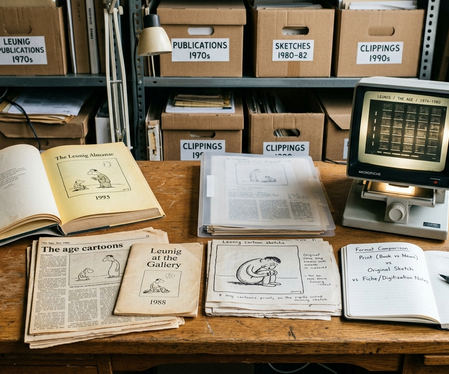
For cataloguing, I record five fields: binding, publisher, publication month and year, source newspaper, and whether the volume is a retrospective or a recent anthology. Keep in mind that describing a paperback as an accessible reading copy is a statement about use, not about scarcity or market value.
From The Melbourne Age to the Bookshelf
Several Leunig collections gather cartoons previously published in The Melbourne Age rather than presenting entirely new book-only work. This is not a flaw to hide; it is a structural fact that shapes interpretation.
A newspaper cartoon's first context is topical, civic, and immediate. It responds to a particular week. The book anthology lifts that same image out of its daily setting and invites a slower, thematic reading across pages and years.
THE STICK is the clearest case. Michael Leunig is author and illustrator, Penguin Books Australia Ltd is the publisher, and The Melbourne Age is the identified original source. To call it "a 2002 book" and stop there would erase its hardbound dust-jacket format, its publisher, and its newspaper origin — three facts that together define what kind of object it is.
Researchers should keep three records separate: the original newspaper appearance, the book republication, and the later online circulation of individual images such as thestick.gif. And a recent-years anthology can preserve the mood of a period without being a complete archive of every cartoon. No collection should be described as complete unless its specific edition states so.
Characters, Restlessness, and the Leunig Imagination
Recurring figures are the most practical navigation aid across Leunig's collections. They let you move from book to book by following a presence rather than a publication date.
Mr. Curly recurs as a mentor-like figure. Vasco Pyjama appears as the adventurous traveller. Goatperson works at the title level as a signal of Leunig's hybrid, fable-like mode — you can predict the register before opening the cover.
This is why The Curly Pyjama Letters serves as such a useful entry point. It offers a narrative and epistolary frame rather than only one-panel observation, giving newer readers a thread to follow through Leunig's imaginative world.
The amphibious club armchair deserves its own mention. It is ordinary domestic comfort made absurdly mobile and mythic — a comic vehicle that carries the reader between the familiar and the fabulous. Small details like this reward the cross-book reading that characters make possible.
Reading the 1970s Material Without Flattening It
What does it mean to read Leunig's earliest work fairly? The question matters because retrospective collections sometimes reprint material whose original charge is easy to overlook.
The 1970s context is the answer's starting point. Early Leunig work is linked here to legal challenges connected with depictions of male genitalia — visual risks that a later, comfortably bound anthology can quietly smooth over.
London Oz provides the counter-cultural reference point, with Richard Neville identified as an editor and censorship challenger of that era. I raise this not to retell it sensationally but to keep the interpretive emphasis where it belongs: on visual risk, sexual frankness, and anti-authoritarian pressure.
The point of this context is interpretation, teaching, and archival description — not a dramatic re-staging of old controversies.
For retrospective collections, this means early cartoons may still carry the pressures of their moment. Reading them without that context flattens them into something tamer than they were.
How to Choose, Teach, or Catalogue a Leunig Collection
The workflow moves from verifiable book facts toward interpretation, in that order.
- Identify the exact title as printed, including capitalization such as THE STICK.
- Confirm the publisher and the publication month and year where supplied.
- Note the physical format: hardbound, hardbound with dust jacket, or paperback.
- Determine whether the volume is a retrospective or a newspaper anthology.
- Read for recurring characters and period context.
Recommendation: Educators should pair a book excerpt with its publication context rather than presenting it as timeless commentary detached from newspaper culture. A teacher will often prioritize that civic origin and the 1970s censorship history.
Collectors work from a different priority. Record condition details such as dust jacket presence for hardbound editions, while avoiding price claims. Researchers, meanwhile, should keep primary book facts, interpretive notes, and later web-circulation signals in separate records.
Critical Insight: Leunig collections are layered objects — newspaper work, book design, cultural record, and a recurring imaginative world, all at once.
Scope, Limitations, and Editorial Caution
This guide uses the supplied publication facts and does not claim to be a complete bibliography of every Michael Leunig book. It is an orientation, not an inventory.
One date tension deserves open acknowledgement. THE STICK is supplied here as a November 2002 publication while also being described as covering cartoons through 2003. I have not resolved that discrepancy, and I flag it rather than smoothing it over — this particular collection is where I would most want a reader to check the physical copy before citing a date with confidence.
Risk Factor: When exact edition priority, collectible condition, or legal chronology matters, verify the article against the physical book, library catalogue records, and publisher data.
Curly Flat's role here is appreciation, orientation, and archival context. It does not authenticate collectible value, and it does not expand legal history beyond the named contextual facts.