Why Leunig’s motifs need more than quick definition
A reader opens a newspaper or a copy of State of Bewilderment and immediately spots the familiar visual anchors. A duck waddles across the frame, a teapot sits on a barren table, a waning crescent moon hangs in the sky, or a gentle wanderer figure observes the scene. We recognize these shapes instantly. Yet, stopping at mere recognition often means missing how these images actively work across decades of cartoons, books, and poems.
Approaching Michael Leunig’s official site and his broader body of work requires an appreciation guide rather than a fixed decoding key. Michael Leunig operates as an artist and cartoonist whose visual language demands and rewards slow reading. His recurring motifs function as structural elements of mood rather than simple punchline delivery mechanisms.
Criteria for selection: what earns a place in this glossary
What elevates a simple drawing to the status of a core motif?
In mapping this visual lexicon, the selection process prioritized entries based strictly on their concrete role within the supplied archive notes. A motif earns its place if it functions as a named character, anchors a specific book context, illustrates a distinct drawing method, or operates as a recurring symbolic anchor. We focus on elements that illuminate Leunig’s shift toward a whimsical, absurd, and spiritually suggestive style. This requires examining specific publication contexts, including Introspective, A Bag of Roosters, and The Second Leunig. We also look at technique, specifically the inside-out drawing method described as beginning with the pupil of the eye.
Every selected item must answer three fundamental questions. We must define what it is, locate where it appears in the known context, and explain how it helps a reader interpret a specific cartoon or poem.
Scope and limitations: a glossary, not a final verdict
This analysis makes multiple interpretive claims about Leunig’s characters, books, and artistic transitions.
The scope relies entirely on specific chronological and thematic anchors found in the archive notes. We trace the lineage through core figures like Vasco Pyjama and Mr. Curly, alongside objects like the teapot, the duck, and the waning crescent moon. We anchor the stylistic timeline to 1969, the year attached to Leunig’s first absurd cartoon of a man on a duck. While this semiotic mapping provides a robust framework for reading Leunig's recurring visual vocabulary, these interpretations remain strictly bounded by the provided archival notes and cannot account for unpublished sketches or private correspondence outside this specific dataset.
These meanings serve as reading aids grounded in the supplied archive notes, rather than definitive claims about the creator's private intent.
Risk Factor: Claiming the waning crescent moon proves a doctrinal system of belief would overstate the evidence; the safer reading is that it suggests a nocturnal, feminine, or intuitive atmosphere.
The glossary: recurring Leunig motifs and how to read them
To understand the vocabulary, we must move from the creator and his stylistic hinge, through the core motifs, and finally to the characters and techniques. This sequence allows us to grasp the visual grammar before applying it to complex scenes.
1. Michael Leunig — the artist behind the visual vocabulary
Michael Leunig is the artist and cartoonist who built this distinct lexicon. A proper glossary must attend to his use of line, character, and mood rather than focusing solely on punchlines. His work published by Penguin Books Australia Ltd demonstrates a consistent dedication to emotional resonance over simple gag mechanics.
2. The 1969 absurd duck cartoon — a hinge in style
The year 1969 serves as a critical stylistic hinge. This year marks the publication of his first absurd cartoon featuring a man on a duck. It introduces the definitive move away from traditional political cartooning toward his signature whimsical mode.
3. The Duck
The duck frequently represents primal freedom, playfulness, and comic release. It acts as a natural resistance to adult seriousness. However, treating every duck as a fixed symbol of freedom flattens scenes where the duck’s absurdity may instead unsettle adult order, release tension, or shift the cartoon into comic strangeness.
4. The Teapot
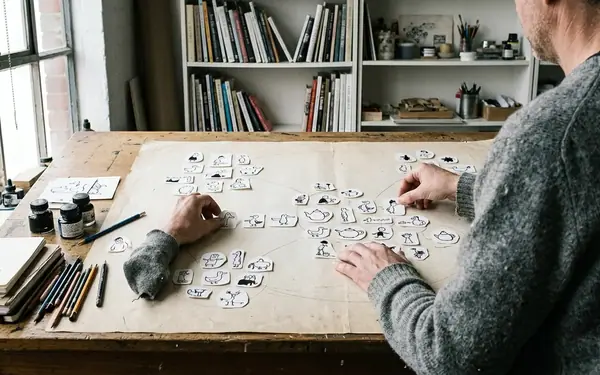
Usually, the teapot signals warmth, nourishment, hospitality, and domestic ritual. It points toward a restorative interior life. Yet, context dictates variation. The teapot reads as hospitality in a domestic scene, but in a lonelier or more surreal drawing, it functions more as a fragile sign of care than as simple comfort.
How to use the glossary while reading a Leunig cartoon
Consider the act of reading a newly discovered panel.
Understanding the definitions requires a deliberate reading sequence. First identify the recurring object or character, then note the emotional setting of the scene. Test whether the motif comforts the figures in the frame, unsettles the established order, or releases the scene's built-up tension.
Resist the urge to close the meaning too quickly. A cumulative reading principle applies here. One appearance of a motif is far less reliable than observing its repeated behavior across various cartoons, poems, and book contexts.
Recommendation: When a duck, teapot, or moon appears in a panel, ask yourself what specific kind of seriousness the image is attempting to soften or challenge.
What this glossary adds to Leunig appreciation
Why map these motifs so rigorously?
This analysis serves as a foundational reference for readers, educators, cartoon enthusiasts, and researchers of Australian culture. Leunig’s visual language clearly requires active participation from the reader. By tracking how a simple line drawing of a wanderer or a teapot evolves across decades, we gain deeper access to the underlying emotional currents of the work.
It moves beyond casual observation to treat these recurring images as working parts of a sophisticated artistic vocabulary, rather than mere decorative quirks.
Critical Insight: Leunig’s recurring images are best read as open invitations into mood, moral feeling, play, and inward attention, rather than rigid symbols to be decoded.