Why Vasco Pyjama Needs a Motif-Led Reading
Vasco Pyjama often appears to the casual reader as a whimsical wanderer drifting through an ink-washed landscape. To read the character properly, we must separate immediate visual description from broader interpretation. The voyage motif gives this recurring figure a structural role that anchors the surrounding surrealism. I approach Michael Leunig’s work as both art and cultural record, requiring a rigorous semiotic framework to map these intersections.
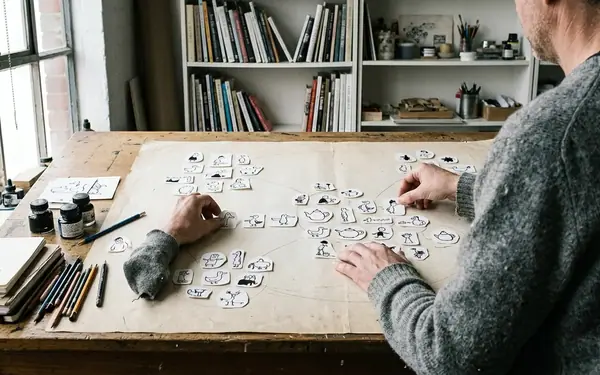
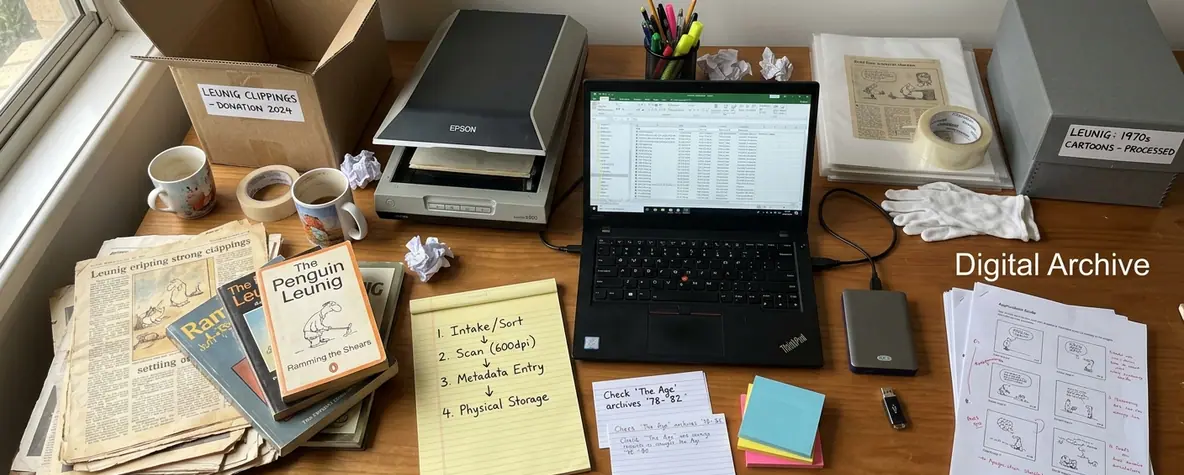
We treat the 1969-2024 period as the broad public-career context for Leunig’s cartooning, rather than attempting a verified Vasco Pyjama chronology. I use an item-level archive worksheet to log what is visible before assigning any allegorical weight. The fields isolate specific elements: source type, visible date, page or strip location, caption text, character design, travel object, threshold or home marker, and return cue.
This archival standard demands strict categorization of evidence. Claims must be explicitly marked as visible textual evidence, visible visual evidence, or interpretation drawn from repeated formal features. We do not claim that every Leunig boat or path is automatically a Vasco Pyjama reference. The character design, caption, or publication context must actively support the connection.
What the Voyage Motif Does Before It Means Anything
Consider a drawing of a small figure sitting in a bed that doubles as a boat beneath a crescent moon. The physical objects—the bed, the moon, the empty space, the doorway, must be logged before we assign words like exile, hope, or tenderness to the scene. Voyage operates first as a repeated condition on the page. It manifests as movement, departure, drifting, exposure, and uncertain return.
I code a voyage instance when at least one visible condition appears: a vehicle or vessel, a path or horizon, a crossing or threshold, or explicit departure or return wording. When original publication dates are known, we compare items in decade brackets such as 1970-1979, 1980-1989, and 1990-1999. Anthology-only items are strictly labeled as reprints rather than original chronological evidence.
The implication of this coding is that Leunig consistently makes travel feel modest, handmade, and vulnerable rather than heroic in a conventional adventure sense. A boat may signal tenderness in one cartoon, comic helplessness in another, and spiritual uncertainty elsewhere. The motif must be read through its page-specific companions and return structure.
Vasco as Traveller: Innocence, Exposure, and Comic Scale
How does a name dictate a character's relationship to the physical world? The name 'Vasco Pyjama' acts as a comic pressure point within the visual lexicon. 'Vasco' carries heavy exploratory associations, echoing the Portuguese maritime exploration of the 1497-1499 period. This is a cultural echo rather than a claim of direct historical retelling.
'Pyjama' immediately undercuts this maritime grandeur. It renders the traveller domestic, unarmoured, and slightly absurd. We see this exposure through visible design features across the archive. The character wears nightclothes, possesses a small body scale, and adopts an unarmoured posture. He navigates sparse settings in fragile vehicles, entirely lacking conventional heroic equipment.
This tension creates a distinct comic scale. The grandeur implied by exploration language clashes with page-level details like handmade craft and simple lines. The character appears to move through the world without the usual social armour, reducing grand existential movement to small, fragile gestures.
How Departures and Returns Carry Ethical Weight
Departures and returns function as ethical tests rather than automatic adventure beats. The movement tests whether gentleness can survive confusion, conflict, and distance. We must ask what movement does to belonging, bewilderment, and ordinary domestic life before assuming the journey is a simple escape.
Archival mapping confirms that movement patterns must be classified strictly: departure, transit, drift, arrival, return, failed arrival, or unresolved movement. Crucially, failed arrival and return are not collapsed into the same category. Emotional interpretation requires page evidence. A waiting figure, a home marker, companion separation, a storm, an empty horizon, or a visibly fragile craft provides this grounding.
These broader cultural claims tie directly to published cartoons, poems, interviews, and books circulating between 1970 and 2024. We avoid unsourced assumptions about authorial psychology. Vasco’s movement exposes the fragility of ordinary life rather than promising conquest or certainty.
Critical Insight: Context-dependent variation means a boat may signal tenderness in one cartoon, exile in another, comic helplessness in another, and spiritual uncertainty elsewhere. The motif must be read through its page-specific companions, setting, caption, and return structure.
Scope Limits: What This Review Can and Cannot Claim
When examining a collection like State of Bewilderment, it is tempting to read the sequence of pages as a chronological narrative. However, we cannot infer original publication order from anthology order. Collected books published by Penguin Books Australia Ltd often rearrange cartoons outside their first-publication sequence.
This principle requires strict archival discipline to preserve interpretive value while preventing overreach. I use three draft labels for every claim: 'visible on page', 'published context', and 'interpretive inference'. When date evidence is incomplete, the status is recorded as exact date, month-year, year-only, decade-only, or undated. We do not smooth uncertainty into a false chronology.
While this methodology supports a rigorous motif-led interpretation of Vasco Pyjama, it cannot establish a complete bibliography, a definitive sequence of appearances, or a final statement of the author's intention. The review avoids diagnosing authorial intention unless supported by primary material or clearly presented as interpretation.
A Practical Reading Method for Educators and Collectors
How can we translate this archival rigor into a usable method for the classroom or the private collection? The solution is to convert the analytical framework into a reader-facing process. For each Vasco-related item, record five specific voyage fields: threshold, vehicle, horizon, companion, and return point. If the page does not provide evidence, leave the field blank.
A classroom sequence can run systematically to build visual literacy. Begin with a few minutes of silent viewing. Follow this with around five minutes listing concrete features. Set aside roughly ten to fifteen minutes to discuss the emotional journey. Formulate a final theme statement only after evidence is visible to the group. This prevents students from jumping to allegorical conclusions before observing the ink on the page.
For collectors navigating Michael Leunig’s official archive or secondary markets, notes should separate source type, visible date, page position, caption transcription, motif tags, and physical condition. Always note any uncertainty about whether the item is an original appearance or a reprint. This keeps the focus on what the movement performs emotionally, rather than treating every boat as an identical symbol.