
When Repetition Begins to Look Like a Pattern
At a library or classroom table, a reader places several pages from a selected volume by Michael Leunig: author and illustrator in sequence. A moon, a solitary traveller, a bird, a winding road, or a simple domestic object suddenly seems familiar. Visual recognition happens quickly. Memory alone, however, cannot establish exactly where a motif appears, how it changes, or what surrounds it.
Motif mapping provides a disciplined record of recurrence, context, and emotional movement rather than a hunt for a single hidden meaning. Begin with a trial set of roughly 6 to 12 pages or items. Assign each suspected recurrence a locator and a neutral label before discussing possible meaning. Allow 10 to 20 minutes for the initial comparison, followed by a short check that every claim can be traced to a page number, catalogue entry, or gallery position.
Decide What Counts Before You Start Counting
Distinguishing recurring motifs from incidental details and broader formal features requires a structured approach. Organise observations through four practical lenses: figures, objects, landscapes, and emotional patterns. Provisional examples like a solitary traveller, bird, moon, teapot, road, doorway, tenderness, bewilderment, or estrangement provide a starting point without assuming that every appearance carries the same meaning.
Establishing the Initial Vocabulary
Create a one-page codebook with a preferred label, inclusion rule, and exclusion example for each motif. Keep initial labels to roughly 8 to 15 categories so distinctions can be tested before the vocabulary expands.
Spend 20 to 35 minutes testing the codebook against 10 to 15 items. Mark a category for revision when the same visible feature repeatedly receives competing labels. Context-dependent variation matters deeply here. A doorway beside a domestic scene may operate differently from a doorway placed in an exposed landscape; identical labels do not establish identical emotional or symbolic functions.
Fix the Boundaries of the Work and the Question
How do domestic objects shift between comfort and confinement? How do landscapes frame solitude? Answering these questions requires a defined corpus. Choose one specific book and edition, a bounded selection of poems and cartoons, or the works listed in a specific exhibition.
Record the title, Penguin Books Australia Ltd: publisher details, publication date, edition or printing statement, page-numbering convention, and any unnumbered pages. For an exhibition corpus, add the item identifier, room or wall, and position in the displayed sequence. Use a 25 to 40 minute scoping session to freeze the corpus and evidence rules. Log later additions with a date rather than inserting them silently. Default to descriptive notes and locators. Add thumbnails or reproductions only after documenting the intended use, source, and relevant permission status.
Make a First-Pass Motif Inventory
Read or walk through the entire selected work once before building categories. Note possible recurrences without forcing early conclusions. For a 50 to 100 page illustrated volume, reserve 45 to 90 minutes for this uninterrupted first pass.
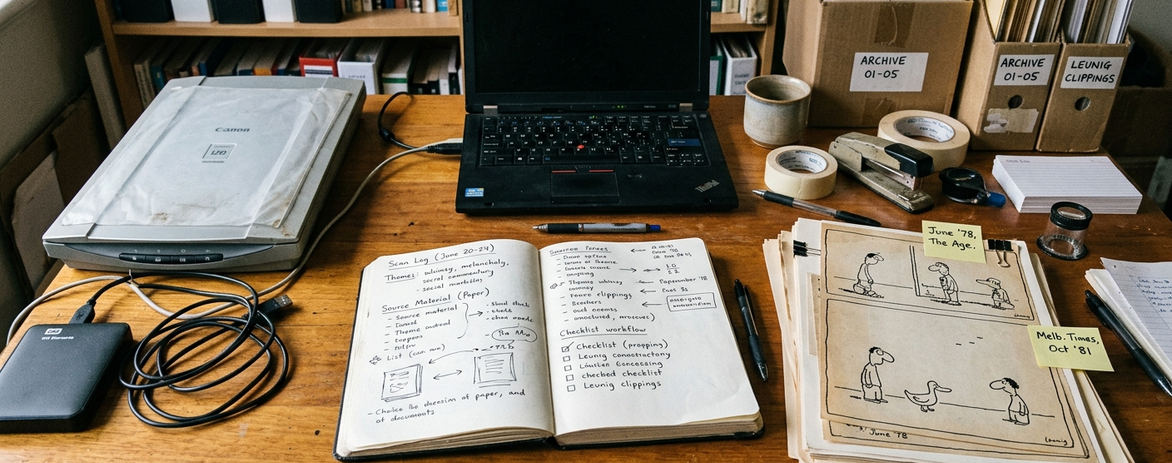
On the second pass, create one record for each appearance using a stable locator and a short, neutral motif label. Page-level recording for a volume of this size typically requires 2 to 4 hours. Specify the core fields using a stable pattern: page or item, motif, visible action, setting, accompanying figures or objects, caption or textual context, emotional register, observation, interpretation, and uncertainty note.
Apply a visible uncertainty value such as 'clear,' 'probable,' or 'uncertain.' Add a short reason when a simplified shape could be read as more than one object.
Group Motifs by Relationship, Change and Absence
Move from inventory to analysis by grouping motifs that co-occur, contrast with one another, or occupy similar narrative positions. Track transformations carefully. An object may move from domestic use to symbolic prominence, or a landscape may shift from sheltering to exposed. Look for sequences and interruptions, including a motif that disappears after a tonal change or returns in an altered setting.
Review records in batches of 20 to 30. Allow 45 to 75 minutes per batch for sorting, checking sequences, and writing relationship statements. For each proposed link, cite at least one locator at both ends and state whether the link is observed, contextual, or interpretive. Revisit the source immediately when a connection is based mainly on recollection.
Preserve three distinct layers in the map—observed recurrence, contextual relationship, and interpretive claim. A pattern established in one edition, selected sequence, or exhibition applies to that corpus; it should not be described as characteristic of Leunig's complete body of work without broader comparative evidence.
Turn the Inventory into a Map People Can Use
Offer two implementation formats based on the intended use. A physical version places motif cards on a table and uses labelled thread or line styles to connect pages, settings, and emotional registers. Use one card per motif and write page or item locators on smaller linked cards. Limit each line to one named relationship type.

A digital spreadsheet requires separate columns for record ID, source locator, motif, setting, emotional register, observation, interpretation, uncertainty, and revision date. Store source-to-source relationships in a second table with 'from,' 'relationship,' 'to,' and 'evidence' fields.
Structuring the Digital Record
Budget 90 to 150 minutes to assemble a first usable map from 40 to 80 records. Spend an additional 20 to 30 minutes writing a text companion listing each connection without dependence on colour or spatial position.
Where the structural framework demands consistency, the following table format provides a reliable foundation for data entry.
| Record ID | Page or item | Motif | Visible action | Setting | Companions | Textual context | Emotional register | Observation | Interpretation | Uncertainty |
|---|---|---|---|---|---|---|---|---|---|---|
| R-014 | p. 27 | road; solitary figure | walking away | barren hill | none | caption about leaving | estrangement | figure shrinks relative to frame | isolation increases with distance | clear |
Test the Map Against the Work
Return to every strong connection and confirm that its supporting pages or exhibition items are correctly identified. Audit edge cases rigorously.
Preventing Memory-Based Mapping Errors
A common failure case occurs when the map contains many moon entries but no page references, leaving a reader unable to determine whether the images recur across the corpus or have merely been remembered from a few striking pages. Another failure case arises when 'sadness' is assigned from an isolated figure alone, even though posture, caption, and surrounding sequence do not support that emotional label.
Set aside 30 to 60 minutes for source verification. Add a dated revision entry stating which category, scope rule, or interpretation changed and why. Retain the previous wording when the map will support research or exhibition planning. Finally, conduct a reader test using 3 to 5 records, which takes about 15 to 25 minutes.
A colleague sits down with the printed spreadsheet and a copy of State of Bewilderment. They trace the record for a teapot from its first appearance on page twelve to its fractured recurrence on page forty-four, using only the provided legend and cited references to navigate the emotional shift.