From Published Page to Classroom Slide
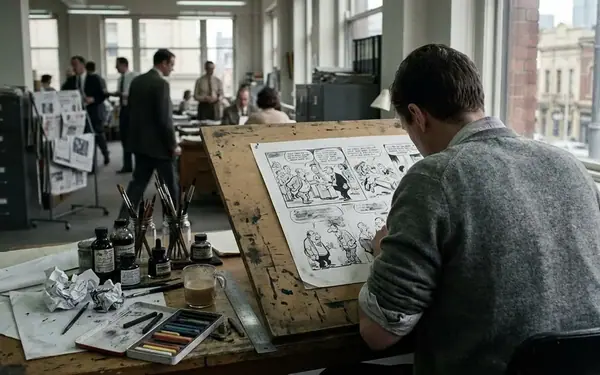
Readers typically encounter Michael Leunig’s cartoons and poems on newspaper pages and within collected books. Moving one of those works from its original printed page into a lecture slide, a seminar handout, or a public blog post initiates a chain of practical decisions regarding copying, audience reach, and visual context. A single drawing featuring recurring characters—such as Mr Curly or Vasco Pyjama—might circulate widely online, yet its presence on a digital screen does not place it in a permissions vacuum.
A classroom slide projected in a physical room, a printed handout distributed to enrolled students, and a public website accessible to any browser involve fundamentally different copying acts and audience scopes. You must record the intended delivery format and define who will receive or access the material before selecting a reuse route.
Treating reproduction as a single administrative step creates avoidable confusion. In practice, sharing a work within the Australian cultural context requires separating three distinct operational tasks: identifying the exact work and its source container, establishing a valid legal basis for the proposed use, and acknowledging the creator and publication accurately. Curly Flat operates as an independent appreciation and reference publication; it is neither an affiliated archive nor an organisation authorised to grant reproduction permission for Michael Leunig’s output.

Trace the Leunig Work Before Tracing Its Rights
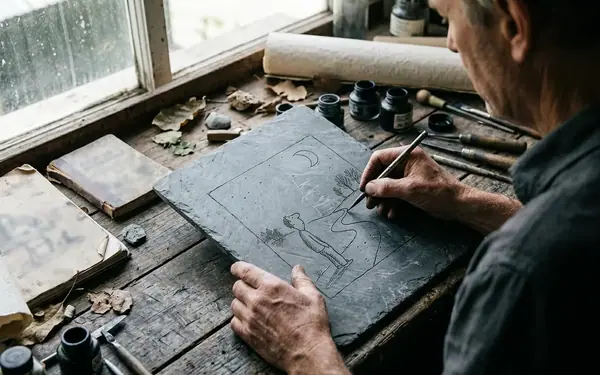
Consider a concrete scenario: you locate a photograph of a printed page circulating on social media that pairs a whimsical ink drawing with a four-line stanza. Before you can write a single credit line or draft an inquiry, you must deconstruct that file. The drawing, its accompanying verse, the photographed page design, and your planned classroom upload are distinct components to identify before any clearance begins.
Why does a single page require this degree of granular separation? A photographed page can combine a cartoon, an accompanying poem, an archival photograph, and a publisher’s typographical arrangement. Similarly, if you are working with interviews and press materials, quoting Michael Leunig’s spoken words is distinct from reproducing the interviewer’s questions or biographical prose, and both differ from copying an audio or video recording or staging adaptations and performances. Rather than treating a found clipping as a single undifferentiated asset, specify which exact elements your proposed reproduction includes and trace the circulating image back to a verified publication record.
The same drawing frequently appears across several containers: an initial newspaper appearance, a subsequent anthology or collected book edition, a digital repost, or a reader's snapshot of a physical page. Record the specific edition you actually consulted and continue tracing its publication context. Copyright notices, book acknowledgements, and publisher contact pages serve as investigation leads; possessing a physical book, publishing a collected edition, or hosting an image online does not by itself establish authority to license every underlying component. When you compile your source record, follow this verification sequence and mark any missing fields as unverified rather than supplying guesses:
- Work identifier: Record the formal title or, for untitled cartoons, other visual works, poems, and reflections, the exact opening words or visual description.
- Creator and contributors: Name Michael Leunig and, if applicable, any interviewer, photographer, or co-contributor attached to the specific component you plan to use.
- Publication container: Note the newspaper title, journal, or book title, alongside the publisher name, specific edition, publication date, and exact page number.
- Discovery locator: Document the URL, library catalogue record, or physical archive location where you found the item, keeping this distinct from the original publication record.
Match the Proposed Use to an Australian Copyright Route
How does an educator, researcher, or cultural commentator move from a verified source record to a lawful reproduction? You begin by defining the exact acts of copying, distribution, and access, and then determine which of the three primary routes applies: an applicable statutory exception, an existing institutional or collective licence, or express written permission covering the proposed use.
Within Australia, the primary legislative framework governing these decisions is the Copyright Act 1968. The Act sets out specific fair dealing exceptions, including provisions for the purposes of research or study and for criticism or review. Attaching a purpose label to a project is not a complete assessment: the dealing itself must satisfy the relevant statutory factors, and any reliance on criticism or review carries a statutory requirement for sufficient acknowledgement of the work and its author. Please note that this overview provides general Australian copyright information; you should seek advice specific to your proposed use if you intend to rely on a legal exception.
Educational intent alone does not establish a uniform basis for copying across different teaching activities. Compare three distinct academic scenarios: a university student copying a cartoon into personal, private research notes; a secondary teacher distributing printed copies of a poem to a classroom cohort; and a department publishing an openly accessible teaching resource on a public web server. Each scenario changes the nature of the copying and the scope of the audience.
Furthermore, copyright analysis evaluates the quality and entirety of the material copied. There is no universal safe word count or pixel dimension across all copyright contexts. Reproducing a short poem in full or duplicating a complete single-panel cartoon copies an entire work, demanding closer scrutiny than extracting a brief phrase from a lengthy prose essay. For any educational distribution, ask the person administering your institution’s copyright arrangements to confirm coverage before you settle on a delivery format. Discuss the particular work, the copying method, the recipient group, password or access controls, required statutory notices, and any recordkeeping obligations, then log which specific arrangement was checked and the date of that confirmation. Where a collective licence or direct permission is time-limited, record its actual start and end dates—using the format [YYYY-MM-DD] through [YYYY-MM-DD] when proposing an access window—rather than assuming a standard clearance duration.
Separate a Leunig Credit from Permission to Reproduce
Naming Michael Leunig beneath a reproduced image or stanza acknowledges authorship, but attribution does not itself authorise copying, uploading, or public distribution. Treating a credit line as a substitute for clearance is a common error in public commentary and informal educational sharing. You must establish the legal basis for reuse first, then prepare the credit so that both checks remain visible in your production record.
When constructing an attribution line, include only details you have directly verified from the source container, omitting unverified placeholders rather than guessing at dates or editions. Use this structural pattern for your credit line:
Michael Leunig, [verified work title or opening words], [publication title], [edition or publication date], p. [verified page].
Append permission wording—such as "Reproduced with permission"—only when an actual licence or written grant supports that statement, and follow any specific credit phrasing mandated by the rights-holder in that agreement.
Beyond economic reproduction rights, Australian law recognises moral rights, which require practical attention to accurate attribution, the avoidance of false attribution, and the preservation of the work’s artistic integrity. In Michael Leunig’s body of work, meaning often arises from the delicate tension between handwritten verse and sparse line work. Cropping a frame, removing a caption, translating a phrase, or separating a poem from its accompanying drawing alters how the reader interprets the piece. While an alteration is not automatically a moral-rights infringement, its contextual impact warrants careful examination. Distinguish a faithful quotation from an adaptation or altered graphic, and disclose any proposed cropping, layout modification, or text separation inside your permission request rather than leaving it in an internal production note.
Write a Permission Request Someone Can Answer
When neither a statutory exception nor an existing institutional licence covers your planned distribution, you must seek express permission. A clear request identifies a single work (or a clearly bounded set of works) and a single defined use, giving the recipient enough technical detail to confirm their authority to license the component and to state any applicable fees or conditions. Never insert an assumed rights-holder, an unverified contact address, a fabricated approval outcome, or a guessed standard permission fee into your planning documents.
In the permission inquiry, the verified title and publication details sit alongside the proposed classroom use, its access window, and a description of any cropping or separation of verse from drawing.
Subject: Permission request — [verified work title or opening words] — [proposed use]

Dear [verified permissions contact],

I am writing to request permission to reproduce the following material by Michael Leunig:

- Work component: [Specify: complete cartoon / complete poem / prose quotation / interview passage / page photograph]
- Title or opening words: [Insert verified title or opening line]
- Source publication: [Insert publication title, publisher, edition, and publication date]
- Page or item locator: [Insert verified page number, catalogue ID, or URL]

Proposed Use and Distribution Details:
- Format and placement: [Specify: printed classroom handout / restricted learning management system / academic journal article / exhibition panel / public website]
- Audience and access controls: [Specify exact recipient group, print run quantity, or whether online access is public or password-restricted to a defined cohort]
- Context and territory: [Specify commercial or non-commercial context and geographical territory of distribution]
- Proposed availability period: [YYYY-MM-DD] through [YYYY-MM-DD]
- Proposed alterations: [Specify any cropping, resizing, transcription of handwritten text, translation, or separation of text from image; or state "Unaltered reproduction"]
- Proposed credit line: Michael Leunig, [verified work title or opening words], [publication title], [edition or publication date], p. [verified page]. [Add requested permission phrasing if required].

Please confirm whether you hold the authority to license this specific component for the use described above, and advise of any applicable licence fee, required attribution wording, archival removal deadlines, or other conditions.

Thank you for your time and assistance.

Sincerely,
[Your name, role, and institutional or publication affiliation]
If you wish to show how the cartoon or poem will sit alongside your commentary, describe the placement in text or attach a private mock-up for the reviewer without first uploading the work to a public server. Once sent, wait for an explicit written reply and verify that its scope matches your request before scheduling publication. Silence is not permission; if approval does not arrive and no other legal basis applies, revise your publication plan.
Test the Plan: A Lesson, a Research Essay and a Public Post
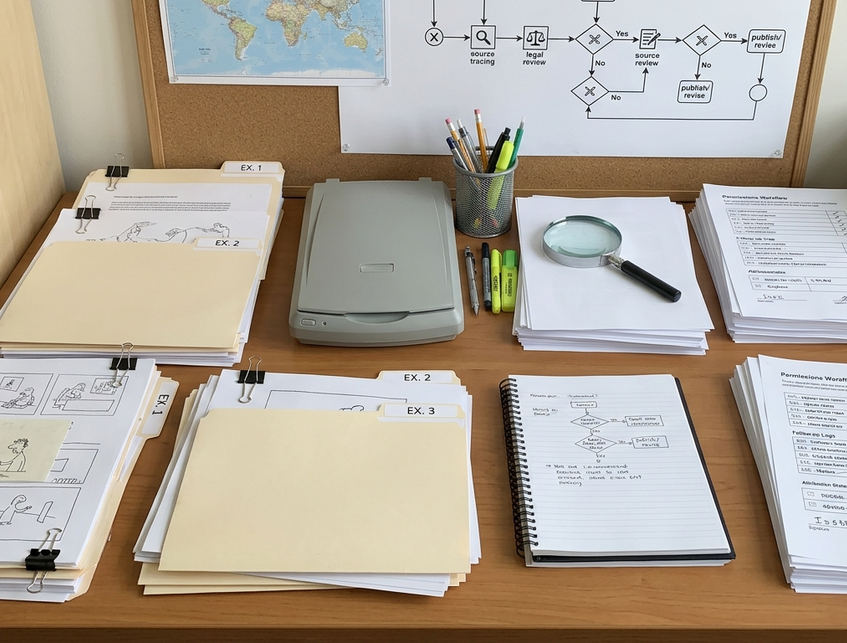
To see how source tracing, legal routing, and attribution interact in practice, examine three hypothetical worked examples. Each scenario follows the same operational sequence—identifying the work, defining the audience and format, establishing the reuse basis, and preparing the credit—without assuming automatic clearance.
Hypothetical Classroom Lesson
A secondary school teacher locates a cartoon featuring Vasco Pyjama in a collected anthology and wants to build a lesson around its visual metaphors. First, the teacher records the book title, publisher, edition, date, and page number, confirming that both the drawing and its hand-lettered caption are part of the planned reproduction. Next, the teacher separates three possible delivery methods: projecting the image on a screen during class, handing out thirty printed copies, and uploading a digital scan to the school’s password-restricted learning platform. Rather than assuming that classroom utility covers all three acts identically, the teacher contacts the school’s copyright administrator to verify which institutional educational licences apply to each format, what copying limits or statutory notices are required, and how the usage must be logged. Only after the administrator confirms the covered delivery format does the teacher prepare the final slide with its verified credit line.
Hypothetical Research Essay
A postgraduate researcher writing an analysis of melancholy in Australian cultural context selects a specific four-line stanza from one of Michael Leunig’s published poems & reflections to support a close semiotic reading. The writer records the exact anthology edition and page number, then defines the dissemination scope: is this essay strictly an internal university assessment submission, or is it a manuscript bound for a commercial academic journal? Recognising that selecting a passage for a critical argument is a separate decision from assuming that an academic footnote authorises reproduction, the writer assesses whether the use satisfies the statutory requirements for fair dealing for criticism or review (including sufficient acknowledgement) within the target distribution channel, or whether the journal publisher requires cleared written permission for complete short poems prior to press.
Hypothetical Public Post
An independent writer drafts an essay for an openly accessible website and initially proposes uploading a high-resolution scan of a complete newspaper cartoon at the top of the post. Upon reviewing the reuse routes, the writer notes that an unrestricted public upload reaches a global audience and falls outside institutional educational arrangements. Lacking express permission to host the image file, the writer changes the publication plan: instead of uploading the cartoon, the writer publishes original critical commentary and inserts a direct outbound hyperlink to an authorised publication page where the cartoon is lawfully hosted. Before linking, the writer checks the destination page’s provenance to ensure it is an authorised source, credits Michael Leunig and the original publication within the essay text, and notes that linking provides reader access without implying a blanket endorsement of the external site.
Keep the Permission Beside the Leunig Credit
Where archival clearance workflows hold up under audit, the credit line on the published page corresponds directly to a saved documentation file behind the scenes. Before releasing any slide deck, publication, or web post, run through this compact pre-publication verification:
- Exact work identified: The specific drawing, stanza, or interview extract is isolated from surrounding page elements.
- Source record complete: Title or opening words, publication, edition, date, and page are verified, with any unknown fields marked as unverified.
- Reuse basis documented: The applicable statutory exception assessment, institutional licence confirmation, or written permission grant is recorded.
- Agreed conditions met: Access restrictions, print quantities, fees, and layout rules match the authorisation.
- Credit accurate: Authorship and source fields are in place, and permission phrasing appears only if backed by an actual grant.
- Version matched: The file queued for release matches the exact version approved or assessed, with no unapproved cropping or caption removal.
Archive your sent permission request, the rights-holder’s written reply, the relevant institutional licence terms, the version submitted for approval, and the final published version in a single project folder. If your agreement includes a time limit or removal deadline, log the exact date ([YYYY-MM-DD]) in your calendar so that takedown or renewal obligations are met on schedule.
Treat your clearance record as format-specific. A permission email saved beside a Leunig lesson file does not establish that the same cartoon can later move onto an openly accessible website; any shift in platform, audience, duration, or cropping requires comparing the new plan against your recorded terms before acting. In her office before the morning seminar, the lecturer saves the confirmation email into the unit archive folder beside her slide deck, checks the publication date and page number in the credit line beneath the uncropped cartoon, and uploads the approved file to the password-protected classroom portal.