Why Leunig’s Cartoons Resist a Quick Read
A Leunig cartoon can be read in four seconds and misread in three. That is the trap. A duck, a moon, a small figure on a road, a handwritten line beneath — the whole thing looks artless, even slight, and the eye slides off it before the meaning arrives.
This guide is not a biography and not a definitive interpretation. It is a reading method. I want to slow the encounter down and show where the meaning actually lives: not in the drawing alone, and not in the words alone, but in the pause between them.
The distinctive thing about Michael Leunig is not simply that he draws and writes. Plenty of cartoonists caption their work. What sets these pieces apart is that each mode interrupts the other. The drawing softens you; the line sharpens the cut. The words promise tenderness; the figure’s posture withholds it. Read either half on its own and you lose the work.
The Cartoon Panel as a Small Poetic Room
Think of the panel as a compressed space — a small room rather than a stage. Inside it, very little appears: a teacup, a fragile domestic interior, a solitary walker beneath a moon. Yet that handful of elements can carry the emotional weight of a stanza.
White space does the heavy lifting here. The blank around a figure is not emptiness waiting to be filled; it is a poetic device. It slows the eye, forces a pause, and leaves room for your own moral or emotional response to gather. A figure stranded in white reads very differently from the same figure pressed into a crowded frame.
The spare line works the same way poetic economy does. Leunig draws little, and the omissions matter as much as the marks. A face reduced to two dots and a curve can hold more grief than a fully rendered portrait, precisely because you supply the rest.
A workable looking order helps before any interpretation starts:
- Identify the frame and what it includes.
- Count the main visual elements.
- Locate the blank space.
- Describe where the eye travels.
- Only then read the caption or verse.
How the Drawing and the Words Divide the Meaning
Once you have described the object, you can classify the relationship between image and text. This is where the work either opens up or stays flat. Three labels cover most cases.
Reinforcement, contradiction, delayed revelation
Reinforcement is when image and wording point the same emotional direction — the drawing is tender, the words are tender, and the pairing deepens a single note. Contradiction is when one undercuts the other, so a gentle scene turns barbed once you read the line beneath it. Delayed revelation is the most Leunig-like: the drawing reads as innocent until the caption arrives and reframes everything you just saw.
Often the drawing establishes vulnerability or absurdity first. You meet the figure, you feel the tenderness, and then the words reframe it — sometimes as comedy, sometimes as quiet accusation. A seemingly harmless image can become morally charged the instant the text lands.
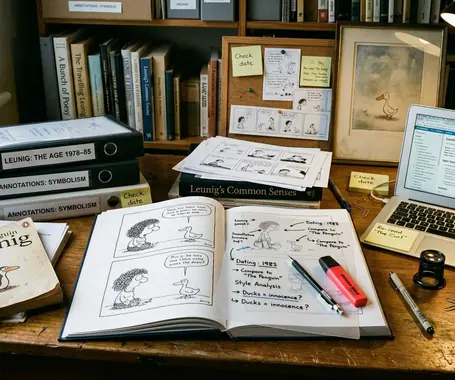
When you quote, preserve the source exactly: spelling, capitalization, line breaks, and the handwritten layout as closely as you can manage. Record the book title and page number, or the original newspaper date where it exists. A published book scan or an archived newspaper page beats an unattributed repost every time, because reposts strip away date, venue, scale, surrounding page context, and occasionally the caption itself.
The Poetic Techniques Hidden in the Cartoon Form
Once you trust that these are poems, the poetic toolkit becomes visible. Watch for rhythm, repetition, understatement, the tonal turn, metaphor, allegory, and prayer-like address. Each technique can be tested against the drawing rather than assumed.
The recurring motifs — ducks, moons, angels, children, lonely walkers, tables, trees, small houses, function like poetic symbols, but unstable ones. That instability matters. A duck may be comic company in one piece, a silent witness in another, and a moral counterpoint in a third. Treat it as a fixed emblem and you flatten the whole body of work.
A short annotation sequence keeps this honest: circle the repeated motif, underline repeated words or sounds, mark the tonal turn with a slash, and write one sentence on how the drawing changes the words. With prayer-like pieces, check for direct address, blessing, petition, lament, or confession before you call anything devotional. Handwritten text can feel like a blessing in one context and wounded or deliberately childlike in another, especially when paired with political absurdity or domestic fragility.
Humour and melancholy almost always coexist here. The joke opens the door; the poem keeps you in the room. That is the mechanism worth naming — the laugh lowers your guard so the feeling can stay.
A Practical Method for Reading a Leunig Cartoon-Poem
Here is a repeatable sequence. Look before you interpret. Describe posture before theme. Examine the empty space before the caption. Then ask what changes once the words arrive.
- Scene — name what you see, plainly.
- Figure posture, how the body holds itself.
- Object or motif, the duck, the moon, the teacup.
- Blank space, where the panel breathes.
- Wording and line breaks, read exactly as written.
- Emotional reversal, or the tension left unresolved.
For a classroom, a ten-to-fifteen-minute structure works well: a couple of minutes of silent looking, a few minutes of description only, a few minutes mapping image to text, a short stretch on the tonal shift, and a minute or two on context if you have reliable source information. The silent looking is not a ritual; it separates visual description from instant interpretation, which is where most misreadings begin.
Recommendation: Withhold the caption for the first couple of minutes. Let students exhaust what the drawing alone tells them before the words are allowed to close the meaning down.
The aim throughout is to avoid flattening the work into either a joke or a slogan. Both moves erase the vulnerability carried by posture, scale, blank space, and facial expression.
What This Reading Can and Cannot Prove
Now the narrowing. Everything above describes observable craft patterns in published cartoon-poems. It does not access the private psychology of the artist, and it should not pretend to.
So the wording matters. Prefer phrasings such as the panel suggests, the caption reframes, and the image-text relation creates over Leunig must have meant. The second formulation is only defensible when a dated, attributable public statement supports it — an interview, an author’s note, a verifiable source.
Risk Factor: Reading every duck, moon, or angel as a single stable symbol will mislead you. Require at least two pieces of evidence inside the work itself — the visual motif plus wording, placement, scale, posture, or tonal contrast, before fixing a meaning.
Where a political or cultural context seems relevant, record the publication date and the surrounding issue before connecting a cartoon to any public controversy. And accept that readers will respond differently. Leunig’s work tends to invite ambiguity rather than resolve it, which is a feature to preserve, not a problem to solve.
Critical Insight: This guide can support craft analysis of published cartoon-poems, but it cannot prove private intention unless that intention appears in an attributable interview, author note, or other verifiable public source.
How to Use This Guide as a Reader, Teacher, or Researcher
Turn the method into use. As a reader, slow down and reread; the second pass is where the tonal turn usually shows itself. As a teacher, use the timed sequence to structure discussion so description precedes interpretation. As a researcher, keep four columns apart — observation, interpretation, source context, and unresolved ambiguity, so a first impression never hardens into a claim of fact.
A comparison exercise sharpens all of this. Choose two works from different publication moments: one from a 1990s prayer-oriented collection and one from a later newspaper or book collection of the 2000s or 2010s. Set up a paired worksheet with two columns — meaning carried mainly by wording and meaning carried mainly by drawing, and require one quoted phrase and one described visual detail in each. Ground your examples in published material, from the early newspaper cartoons of the 1970s through the later collections, and verify attribution where you can; the National Library of Australia catalogue records for Michael Leunig are a useful starting point for dates and venues.
The central point holds across every use. The cartoon-poetry works because neither the picture nor the poem is complete alone. Read them apart and you get a sketch and a slogan. Read them together, in that order, with the pause intact — and the small room opens.