Why Leunig’s Poems Resist Simple Reading
Two reading habits flatten Michael Leunig’s poems before they have a chance to speak. The first treats them as comforting aphorisms, lines to be cross-stitched and hung on a wall. The second reads them as captions, mere verbal extensions of the cartoons. Both miss the point.
This is a review of voice, not a biography or a catalogue. I am interested in how the poems work on the page: the diction, the address, the tonal movement, and the way words sit against drawing and blank space. Claims about effect should be built from what is visible, not from what we assume Leunig intended.
His poems live in an unusual border country. They operate at once as page object, drawing, prayer, satire, and private reflection — and the meaning shifts depending on which of those registers you privilege. A close-reading claim should cite a textual or visual feature; an intention claim belongs to a documented interview, preface, or archival source. Keeping that distinction honest is the whole task.
For orientation only: Leunig’s public cartooning, writing, and illustrated book work runs from the late 1960s into the early 2020s. That long arc matters, because the voice is not fixed.
The Voice: Tenderness Under Pressure
Leunig’s tenderness is rarely uncomplicated. It is shadowed by grief, absurdity, and moral unease, and the gentleness is most affecting precisely when it refuses to console.
You can hear the recurring modes quickly enough. Plain diction. Short lines. A prayer-like address. Childlike wonder pressed against domestic images — a cup, a garden, a house, a road, and the familiar bestiary of ducks, birds, and moons under shifting weather. Silence recurs as a subject and as a structural device.
The mistake is to read that plainness as a lack of craft. Try the opposite test. Mark line length, sentence breaks, direct address, imperatives, and repeated concrete nouns across three to five poems or poem-cartoon pages before you say anything about the voice. What surfaces is deliberate exposure: the simple line strips away cover so that hesitation and vulnerability show through.
One more caution against generalising. The newspaper-era material from the late 1960s through the 1980s does not read identically to the collected, book-based work of the 1990s through the 2010s. Treat either period as the whole voice and you distort it.
Leunig’s poetic voice is strongest when plainness creates exposure rather than offering immediate consolation. Comfort, when it arrives, is earned through discomfort.
Where the Cartoon Line Changes the Poem
Read the words first. Then restore the page — and watch what the drawing does to what you just read.
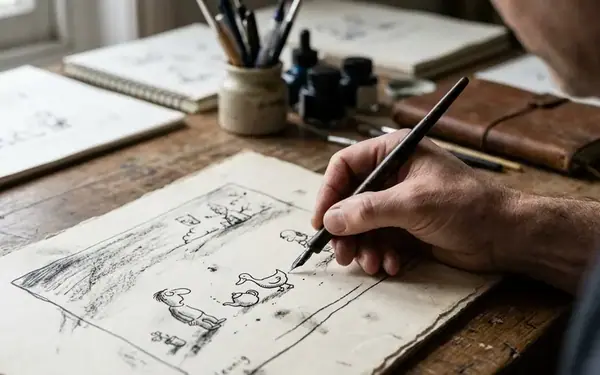
A poem on Leunig’s page is never only a verbal text. Handwriting, line weight, the placement of a small figure, the horizon, and the amount of white space all shape the timing of the reading. Inspect the page at normal size, then move close enough to register facial expression, posture, and lettering. A single human figure makes the poem feel dramatic; an animal companion turns statement into scene; an empty field can render the same lines lonely or prayer-like.
Here is the failure case worth keeping in mind. A line that scans as a comforting maxim can turn satirical or desolate the moment a small figure, a duck, a moon, or an empty landscape is restored beside it. Crop out the drawing or the margins and you remove the very timing that makes the poem work.
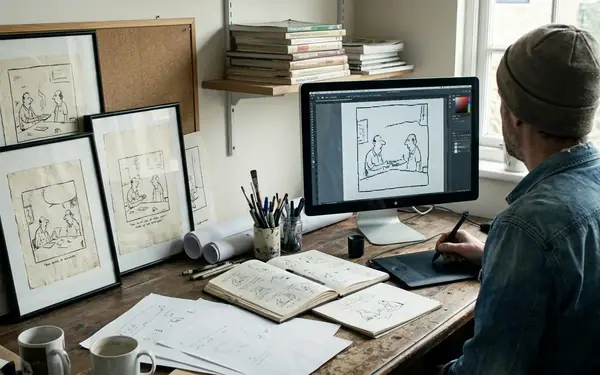
The reproduction conditions matter too. Broadsheet and print from the 1970s through the 2000s carry pale linework and handwriting differently than the screen-based archive reading of the 2000s through the early 2020s. The same poem can feel declarative on newsprint and tender on a backlit screen.
Satire, Spiritual Unease, and the Risk of Sentiment
Two facts have to be held together. The poems often gain their force by risking innocence — and that same innocence can harden into sentiment or aphorism once contradiction disappears.
The spiritual register is easy to identify and easy to mishandle. It shows up as prayer-like address, invocation, blessing, lament, gratitude for small things, and a recurring unease with noise, speed, machinery, and public hardness. Read carelessly, that register slides into the sermon. Read against its own grain, it stays alive.
Satirical pressure tends to arrive through pairing: a tender phrase set beside a ridiculous figure, a socially exposed body, or an over-serious moral pose that the drawing quietly destabilises. That tension is where Leunig is at his best. The strongest poems leave room for contradiction; the weaker moments feel closed, settled, a little too sure of their own decency.
Risk Factor: Do not teach these poems as simple moral lessons until irony, melancholy, persona, and image-text framing have all been checked. A poem read as doctrine loses the very ambivalence that makes it humane.
My own admiration, then, comes with a critique attached: reverence for small things is a genuine achievement when it stays unsettled, and a liability when it stops asking questions.
How to Read Leunig’s Poems in Classrooms or Archives
The method moves in stages: hear the words, restore the page, find the speaker, then test your first reaction against the evidence. It suits educators, researchers, and general readers equally.
- Read aloud once. For a short Leunig page this takes a minute or two. Listen for sound and pacing before meaning.
- Reread with the page visible. Allow three to five minutes of silent rereading with the drawing and layout in view, so the visual timing re-enters the poem.
- Identify the addressee before interpreting. Ask who is being spoken to: a child, the adult self, a stranger, the nation, God, an animal, the moon, a duck, an absent beloved, or an imagined companion. The address often carries the whole tonal weight.
- Separate narrator, persona, and author. Note these distinctly before making any claim about Leunig’s beliefs or his Australian cultural commentary.
Recommendation: Write your first emotional response in the margin, then test it against three pieces of evidence — diction, line breaks, and visual framing. If the response survives all three, it is probably reading the poem rather than your mood.
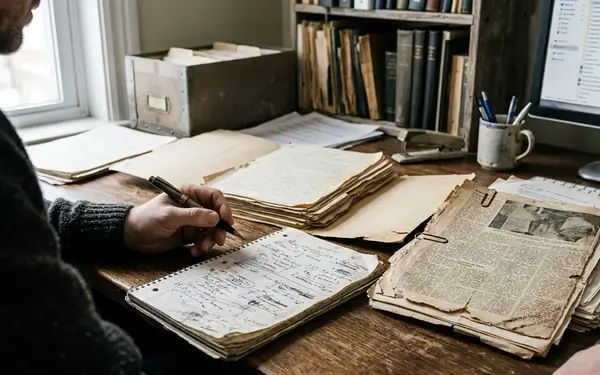
For archive work, record the edition title, page number, date or date range, image position, handwriting or typesetting, and any surrounding captions before you paraphrase. The same poem reads differently as a newspaper item, a collected book page, a gift-book spread, a classroom handout, or a digitised scan, and the context note keeps those variations legible.
Spend five to eight minutes on a single question — what does the image do to the apparent moral claim?, before inviting biographical or cultural interpretation. Readers wanting to work from primary material can begin with Michael Leunig’s official archive.
Scope, Limits, and Final Judgement
This review assesses poetic voice, page-based reading value, tone, and interpretive method across representative work. It does not attempt catalogue completeness, and it does not adjudicate every edition, public dispute, or phase of reception.
Archival appreciation does not require uncritical admiration. The point of sitting with the page is to respect artistic nuance while still naming unevenness where it appears. Curly Flat’s approach is interpretive and source-conscious: primary page or scan first, collected volume next, documented interview or preface after that, and secondary commentary only when clearly attributed. Where the evidence runs thin, the honest move is to make the point qualitatively rather than dress it as data.
A biographical anchor frames the reception fairly. Leunig’s life dates — 2 June 1945 to 19 December 2024, mean his readership crosses pre-digital newspaper circulation, book collection, online archive access, and a posthumous reassessment still underway. Each setting changes the encounter.
Critical Insight: Leunig’s poetic voice remains valuable when readers are willing to hold tenderness, discomfort, humour, spiritual unease, and ambiguity at once. Read for the consolation alone and the work collapses into greeting-card lines; read for the contradiction and it stays alive.
Take this as a review of voice and reading practice, not a catalogue record — a way of meeting the poems more carefully, with the drawing left in the frame where it belongs.