





Michael Leunig
Biographical, critical, and contextual material on Leunig as cartoonist, poet, illustrator, and public humanist.

ESC closes search
Curlyflat treats Michael Leunig’s cartoons, poems, books, interviews, and public legacy as a cultural record to be read carefully. The site is built for readers, educators, researchers, and admirers who want interpretation without flattening the work’s humour, unease, tenderness, or controversy.
Start with Michael Leunig
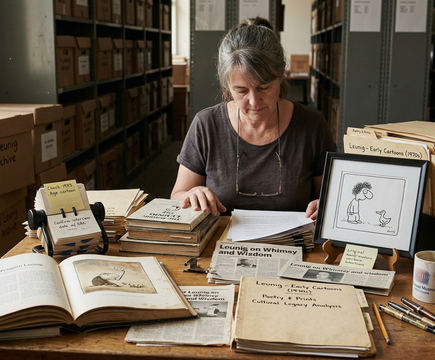
Leunig’s work asks for slow reading. A duck beside a teacup may look slight at first glance, then open into grief, comedy, politics, tenderness, or something less easily named. This site treats that ambiguity as part of the work, rather than a problem to tidy away.
Readers come here from different doors: a classroom discussion, a newspaper memory, a search for Mr Curly, a book found in a second-hand shop, or a question about why one cartoon provoked affection while another provoked argument.
Our task is simple in outline and demanding in practice: preserve context, explain references, and leave room for the strange weather that moves through Leunig’s drawings.
Use Curly Flat to place cartoons, poems, interviews, and books within Australian cultural history without flattening them into exam notes.
Follow recurring motifs, publication pathways, press debates, and adaptations across the wider Leunig world.
Curly Flat organises the archive around the kinds of questions readers actually ask. Who was Leunig as a public artist? Where do the ducks, moons, teapots, angels, and anxious little humans recur? How did newspapers, publishers, musicians, performers, and interviewers carry the work into public life?
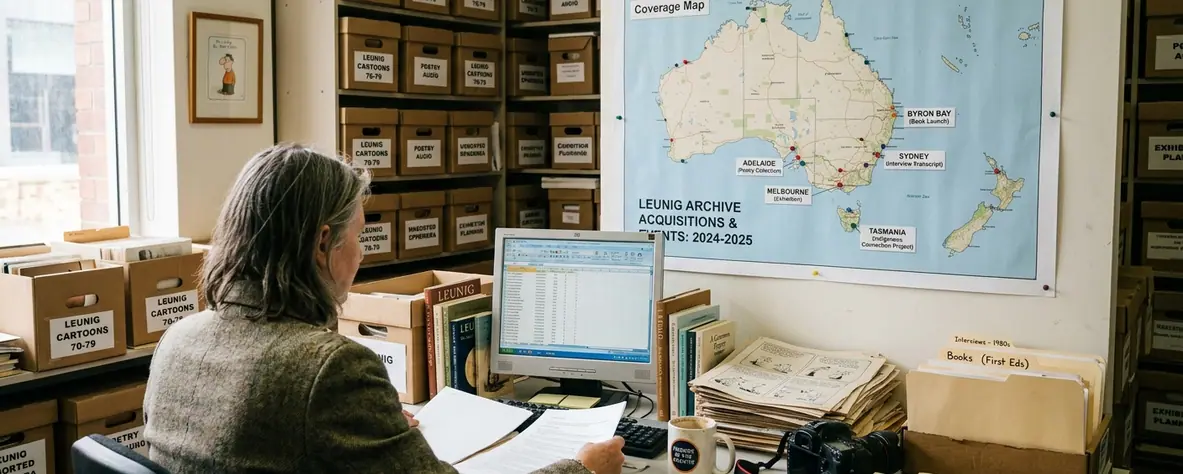
The six areas below form the main public pathways through the site. Two further areas, cartoons and poems, remain available through the site navigation for readers who want to move directly through image-based work or reflective writing.
Biographical, critical, and contextual material on Leunig as cartoonist, poet, illustrator, and public humanist.

Media-history guides to interviews, historical press references, public statements, and conversations around the work.

Commentary on Leunig books, collections, editions, publishers, and publication history.

Interpretive notes on Mr Curly, the duck, moons, tea, Vasco Pyjama, and other recurring forms.

Context for Melbourne, newspapers, humour, politics, public debate, and the Australian social imagination.
Coverage of music, theatre, animation, readings, and screen-related works connected to Leunig’s creative world.
Start with the surface, then resist the urge to solve it too quickly.
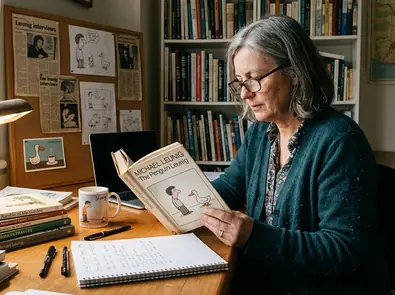
A small figure walking under a moon might carry a political sting, but it may also carry loneliness, religious feeling, or a joke about the ordinary fatigue of being alive. Leunig often works through compression: a few lines, a caption, a creature, a patch of sky. The power sits in the gap between innocence and unease.
That is why Curly Flat avoids treating the cartoons as riddles with one authorised answer. The better habit is to ask what the image notices, what it withholds, and what kind of reader it imagines. A classroom may need dates and publication context; a returning reader may need a thread through mood, motif, and memory.
When a cartoon seems too simple, look at the posture of the body before the caption. In Leunig’s visual language, a slumped shoulder or tilted head often does as much work as the written line.
You might also like How to Read a Leunig Cartoon if you want a practical entry point before moving through the wider archive.
Curly Flat works from a conservative editorial premise: context first, interpretation second, certainty only where the record supports it.
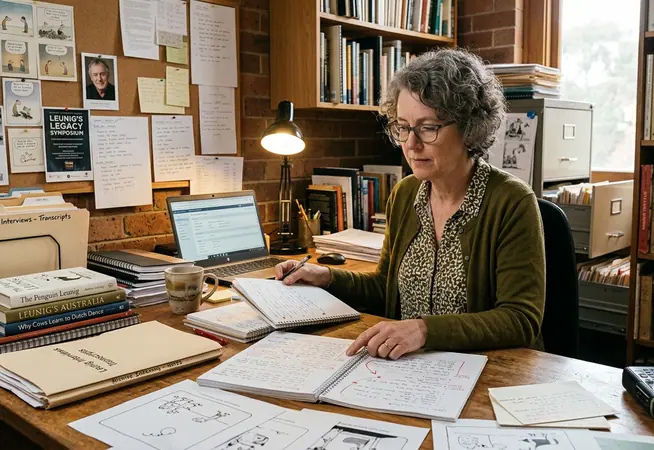
The site is directed editorially by Curly Flat’s lead editor, working with a small media archive team focused on Australian cartoon culture, publication history, literary interpretation, and performance context. Where a claim depends on a specific publication, interview, book, or public event, the article should make that dependency clear. Where the record is incomplete, we prefer plain limits over confident guesswork.
This matters because Leunig’s public life included admiration, controversy, devotion, impatience, and long memory. A respectful archive does not need to make every reader agree. It needs to keep the work legible.
Articles place individual works beside publication settings, recurring themes, and cultural conversations where those links can be made responsibly.
Curly Flat distinguishes description, inference, and critical reading so readers can see how an argument has been built.
The site welcomes researchers and casual readers alike, using clear language without treating artistic complexity as clutter.
Curly Flat exists to help readers meet Leunig’s work with patience: as art, cultural record, argument, consolation, and a distinctly Australian body of imagination.