A Quiet Cartoon Amid the Morning's Noise
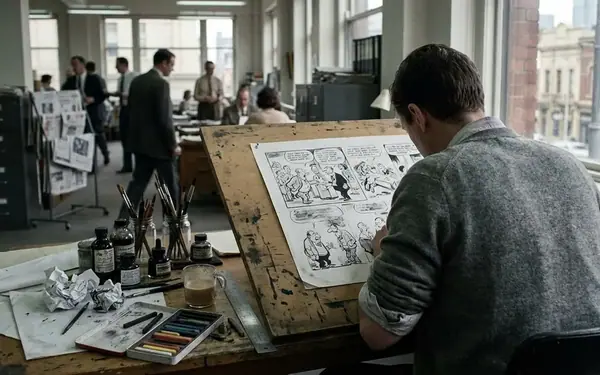
You turn a folded sheet and the ink comes off faintly on your thumb. Columns of type run past, a photograph of some public official, a department-store advertisement — and then, tucked into a corner, a small drawing of a figure looking upward, or a duck, or a teapot balanced against the weight of the news around it.
The encounter interrupts linear reading. Your eye, trained to move down a column, snags on a few lines of pen work that ask for something the rest of the page does not: a pause.
That interruption matters more than it first appears. I want to argue across this piece that the reflective power of a Michael Leunig cartoon depended partly on where it lived — inside a busy civic medium, sharing a sheet with headlines, commerce and routine public information. Leunig's sustained newspaper work extended from 1969 into the early 2020s, so this is a recurring mode of encounter rather than a single fixed layout.
Newsprint Made Private Reflection Public
The newspaper was a shared daily object. Political events, share prices, local sport, births and deaths, and the advertisement for a furniture sale all occupied the same folded paper, read at the same kitchen table.
Serial publication changed the relationship between artist and reader. A cartoon that returned day after day, or week after week, became part of an ongoing acquaintance rather than a ceremonious single viewing. Readers learned a visual handwriting over years, the way one learns a friend's turns of phrase.
The medium imposed its own conditions. Limited space, a modest area on a crowded page, and often monochrome reproduction shaped how a drawing could be read. When examining a serial run, it helps to inspect several consecutive available issues and record whether the cartoon held a fixed area, migrated between pages, or appeared irregularly.
One catch: formats, colour use, page dimensions and placement shifted across publications and decades. Monochrome reproduction and constrained space are conditions to verify in each surviving copy, not universal attributes of every appearance.
Why Leunig's Humanism Needed Friction
By "uneasy humanism" I mean a specific combination: sympathy extended to the vulnerable, the bewildered or the hopeful, held together with discomfort about institutions, conformity and confident public certainty. The tenderness rarely arrived alone. It came braided with absurdity and, sometimes, quiet accusation.
Reading that combination is a two-part decision. First, identify the figure receiving sympathy — the small person, the creature, the dreamer. Then identify what the drawing sets that figure against: an authority, a social habit, a loud public claim.
Four observable components deserve recording before any interpretation of tone: the depicted figure, the figure's action, any written text, and the object or authority against which the figure stands. Only then does the reading gain footing.
Proximity to hard news is what kept the reflective image from softening into decoration. A drawing about human fragility acquired a different charge when it sat beside a report on war, an election, or a corporate result. The page supplied the contradiction; the cartoon supplied the counterweight.
What Changes When the Cartoon Leaves the Page
Hold one cartoon constant and pass it through three settings. Each adds something and removes something else.
- The newspaper offers surprise and topical friction. The reading begins with page position and adjacent matter, the drawing arriving unbidden among the day's noise.
- The collected book enables sequence and return. Here the reading follows an editor's ordering; you can turn back, compare, and revisit at leisure. Record the volume's publication year and the earliest and latest verified cartoon dates gathered around the item.
- The gallery encourages sustained attention to line and object, often at enlarged scale, where the quality of the pen stroke becomes visible in a way newsprint never permits.
None of these ranks above the others. A three-record case file makes the comparison concrete: one complete newspaper page, one book spread containing the same cartoon, and one verified exhibition record. Log crop boundaries, caption changes, reproduction size, colour treatment and neighbouring works for each.
The newspaper's distinction is embedding contemplation inside ordinary public life. The same drawing may function one way beside current reporting, another when resequenced years later in a collection, and another again enlarged on a wall — so any claim about tone must stay tied to the documented viewing condition.
Read the Cartoon With Its Page Still Around It
For educators, researchers and archive readers, a disciplined method preserves the original encounter. Begin with the uncropped image and transcribe the printed date, caption and page number exactly as shown. Verify those against the masthead or catalogue record.
- Record the verified publication date and the publication title.
- Note edition, page number and page position.
- Describe the neighbouring material above, below and beside the drawing.
- Log the source location or a stable catalogue link.
- Distinguish topical references from broader recurring themes.
When reconstructing context, search the issue dated the same day first, then widen to a window of a week or so; extend to a month only when a reference remains unresolved, and label any proposed connection as interpretive rather than confirmed.
Handle Cropped Scans With Care: a cropped digital image can preserve the drawing while removing the headline, advertisement, page scale or facing-page report that created the original interruption. It cannot by itself establish newspaper placement, so check captions, dates and surrounding articles wherever surviving copies permit.
Return, then, to the folded sheet. A Leunig drawing about a small hopeful figure occupied the same paper as the day's reports, its advertisements and its public arguments — and it did so across more than five decades, from 1969 into the early 2020s. That span of shared column-inches is the plain fact that reframes his intimacy: it was made inside civic life, not held apart from it.