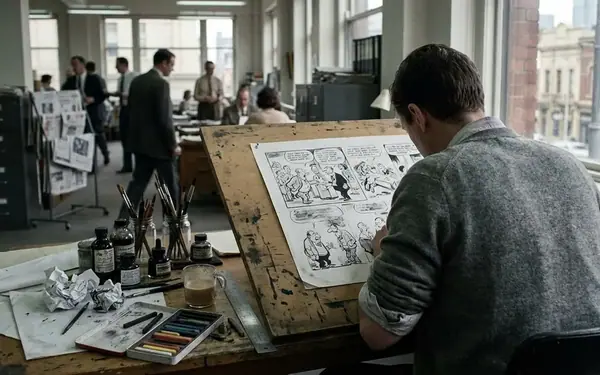
A cartoon by Michael Leunig, before it becomes anything else, is a printing event. It occupied a measurable rectangle on a numbered page, inside a dated edition, while the rest of that edition carried the news of a single morning. Everything a reader later feels about the drawing sits on top of that fact.
What's Inside
- Why the original page setting carries evidentiary weight
- Separating documented facts from plausible inferences
- A date-first archive search procedure
- Writing the context note in four bounded movements
One Cartoon, One Edition, One News Cycle
Reproduction is generous and forgetful. A drawing that ran beside a page-three report on drought relief reappears, decades later, as a framed print, a book plate, or a cropped image with no masthead at all. The drawing survives; its neighbourhood does not.
I therefore record the issue before I record an impression. Six fields go down first, where visible: newspaper title, calendar date, edition, page number, printed caption and section label. Only then do I look at where on the page the cartoon sits and what physically bordered it. Treat the publication date as day zero, read the complete issue from that day, then widen to issues published one to seven days before and one to seven days after.
This sequence keeps a later collection—say, a trade edition assembled years afterwards, from quietly becoming the source of the cartoon's supposed context.
Six Fields First
If you can capture only one thing from a fragile clipping, capture the identifiers, not the joke. Captions are memorable. Page numbers are not, and they are the part that cannot be reconstructed from memory.
Sorting Mastheads from Motives
Compare two findings. A legible masthead with a printed date is one kind of statement. The observation that a Leunig drawing about domestic quiet appeared directly beneath a parliamentary report is another kind entirely, because the second involves an editor whose reasoning left no record on the page.
Three ledger labels keep these apart, and they should never be merged: documented fact, supported inference and unresolved question. Every documented fact carries a scan frame, page reference or archive record. A possible relationship between the cartoon and neighbouring material earns the middle label only when the page arrangement and the issue-wide coverage make the comparison plausible. Unreadable text and missing page images stay in the third column, where they are visible rather than silently smoothed over.
Reader responses follow the same discipline. Search issues dated two to twenty-eight days after the cartoon appeared, and for each letter record its publication date, its page, and whether it names the cartoon or merely discusses a similar subject. Published letters document that particular readers reacted in particular ways; they do not measure a public.
The Adjacency Boundary
A report beside the drawing can support a contextual comparison. Page proximity alone cannot prove editorial coordination, authorial intention, or a reading shared by everyone who opened the paper that day. Where no page image or microfilm frame survives, issue-level metadata may support a provisional date record, but position, neighbouring content and relative size must remain unverified.
Working Backwards from the Clipping in Hand
The procedure is short and stubbornly ordered.
- Identify the strongest surviving clue on the object itself: printed date, newspaper name, caption wording, signature position, book credit, or a fragment of an adjoining column.
- Search the archive by publication and date. Keyword-first searching is ruled out at this stage, since optical character recognition frequently excludes drawings and misreads hand lettering.
- With a date clue only, search that date, then expand in windows of one day, three days and seven days on either side. Record the exact dates checked; "nearby issues" is not a record.
- Open the scanned page and confirm the result there. A search-result transcription is a pointer, not evidence.
- Build a reconstruction sheet holding the archive URL or catalogue path, access date, image or microfilm frame identifier, printed page number, displayed edition wording, and a transcription of no more adjacent text than identifies its subject.
Describe space operationally: same page, directly above, directly below, adjoining column, facing page. The phrase "near the cartoon" destroys the only spatial information you went to the archive to obtain. Where a Penguin Books Australia Ltd imprint credit supplies a first-publication line, that credit narrows the date window while leaving the page setting entirely open.
Before Reproducing a Page
Quote only the headline and the shortest passage needed to establish relevance, and log the archive's current access, citation and reuse conditions before you reproduce any image.
The Four-Movement Context Note
Write the note in four short movements rather than one blended paragraph: verified publication details; the measurable page setting; contemporaneous signals from that issue and the dated follow-up search; and, clearly labelled, the proposed reading. Bounded wording does the work here. "The placement may invite comparison" survives scrutiny; "the paper was answering the cartoon" does not. Date each later response by its interval from publication — "published close to eleven days later", and keep its own page reference.
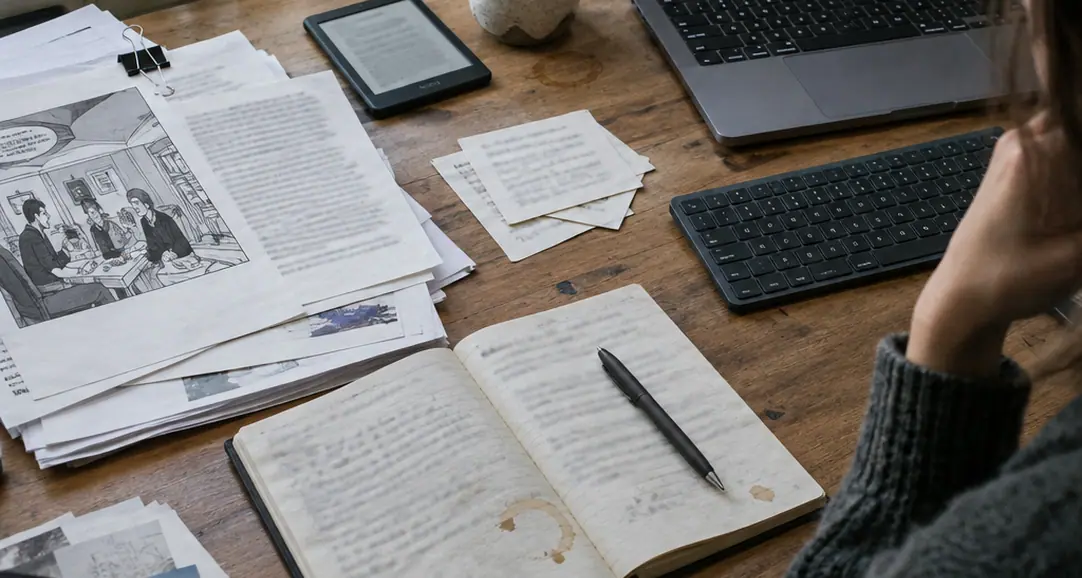
Picture the desk. An educator at a library microfilm reader winds forward to the issue, confirms the printed page number on the frame, notes the report occupying the adjoining column, then scrolls ahead and finds a letter published somewhere around eleven days afterwards that names the drawing. She types four short paragraphs, marks the last one interpretation, prints it, and clips it to the handout her students will read beside the cartoon on Thursday morning.