What's Inside
- A Leunig Career Read Side by Side
- The Date Beside the Drawing Matters
- When a Familiar Leunig Motif Changes Its Work
- Put Two Leunig Works on the Same Table
- Keep the Leunigs That Do Not Quite Agree
A Leunig Career Read Side by Side
Cross-decade reading sounds grander than it is. You take two individually dated works by Michael Leunig, a cartoon and a cartoon, or a poem and a cartoon, and you put them beside each other. Then you compare three things: the wording, the drawing, and the circumstances in which each one reached print.
That is the whole exercise. The difficulty lies elsewhere.
I want to test a question I suspect many longtime readers carry without examining it: does a recognisable artistic voice necessarily carry an unchanged argument? Leunig's voice is about as recognisable as Australian cartooning gets. The wobbling line, the small figure facing a large sky, the duck, the teapot, the plain-spoken caption that turns tender or sharp in the last few words. After enough years, you stop reading the individual work and start reading "a Leunig."
That shortcut is the problem this essay tries to solve. Familiarity with a recurring figure, mood or phrase invites us to flatten the differences between separate works, so that a drawing from one decade gets read as if it said exactly what a drawing from another decade said. The comparison unit here is deliberately small: one cartoon or one poem, identified by title or a short description, never an entire decade or an entire collection. Curly Flat is an independent appreciation site, and the readings below are mine. They should be kept apart from anything Leunig himself has documented about his intentions.
The Date Beside the Drawing Matters
Start with the publication record before choosing a pair. This order feels pedantic until you skip it.
Two collections make useful bibliographic starting points from different decades: The Prayer Tree, published in 1991, and The Essential Leunig, published in 2012. They sit roughly two decades apart, which makes them tempting as a ready-made "early versus late" pairing. Resist that.
A collection's publication year dates the edition. It does not date every drawing or poem inside it. A retrospective volume such as The Essential Leunig gathers material by design, so a work printed there in 2012 may have first appeared in a newspaper years or decades earlier. Even a devotional collection like The Prayer Tree may contain pieces written before it went to press. If you treat the 2012 volume as a window onto 2012 thinking, you may be comparing a work with an earlier version of itself and calling the result a change of heart.
Edition Year, Not Origin
When only the collection date is established, write "collected in 1991" or "collected in 2012." Do not claim the work was created or first published that year.
For each selected item, I now record four things: its identifying title or description, the edition consulted, its page or archive locator, and any documented first-publication date. Acknowledgements pages, dated archive entries and original newspaper records are where that last detail tends to surface. Where it cannot be found, the uncertainty belongs right next to the example, in plain words.
Context deserves the same restraint. Bring in only the Australian cultural or publication background a reader needs to follow the work. A drawing that resembles commentary on some public event is not, on resemblance alone, a response to that event. Without a dated record tying the two together, the connection stays a guess, and it should be labelled as one.
When a Familiar Leunig Motif Changes Its Work
Suppose you have a properly dated pair, and both works feature a solitary figure. What have you found?
Less than it first appears. Spotting the same lone figure, or the same animal, establishes a shared visual vocabulary. It tells you nothing yet about whether the two works make the same argument. Continuity of imagery and continuity of argument are separate claims, and the familiar-Leunig shortcut quietly merges them.
So the reading has to go further. I break each work into a set of questions:
- Who speaks? Through a caption, a speech balloon or a poetic voice, and does any other figure answer?
- Who receives sympathy? The solitary figure, the crowd around it, the reader, or nobody in particular?
- What does the caption ask the reader to accept? Every caption carries a proposition, even a gentle one.
- How does the drawing shape the feeling? Look at the distance between figures, their relative size, posture and gaze, the empty space around them, and any objects that matter.
Solitude makes a good test case because it can do opposite jobs. In one work, a small figure alone under a wide sky might register as peace, a deliberate retreat the caption endorses. In another, a near-identical arrangement might register as exclusion, with the caption directing sympathy toward the figure left out. Same motif, different work being done. One plausible counter-reading is that both express the same underlying melancholy. That reading has to earn its place by pointing to a particular detail, perhaps a matching gaze or a caption that echoes the earlier wording, rather than relying on the general mood.
Whatever you conclude, keep the claim attached to the two works in front of you. A pair can show that a motif behaves differently in two places. It cannot prove a career-wide development, and it certainly cannot reveal a private change of belief.
Put Two Leunig Works on the Same Table
Here is the practice in usable form.
- Choose two individually dated works from different decades that share a concern you can actually point to. Avoid picking only examples that confirm an opinion you already hold.
- Read each one on its own first. Note the speaker, the emotional register, how the words and image relate, and whatever context the publication record establishes.
- If you are comparing a poem with a cartoon, name the difference in form before interpreting anything else. A poem will usually be longer in words and lack a drawing; that is a property of the form, not evidence of a shift in outlook.
- Only then read them together, and write three short observations in prose: what remains recognisable, what changes, and what the evidence cannot settle.
Keep It in Sentences
Resist turning the three observations into a scorecard. A tick-box grid hides exactly the qualifications that make a comparison honest.
Two practical courtesies. Point readers to the full works in legitimate editions or archives, with page references or stable links once you have checked them. And describe only the details your argument needs. Reproducing complete poems or cartoons without permission does Leunig, author and illustrator, no favours.
Keep the Leunigs That Do Not Quite Agree
The expectation I started with was that a voice this distinctive must hold one fixed view. What loosens it, for me, is a specific kind of detail: a change in who speaks, or in who the drawing asks us to feel for, between two works that look almost alike. Once you notice the sympathy has shifted from one figure to another, the idea of a single settled Leunig gets harder to hold.
I no longer need each encounter with his work to confirm one account of it. That is a change in how I read. It says nothing about his private convictions.
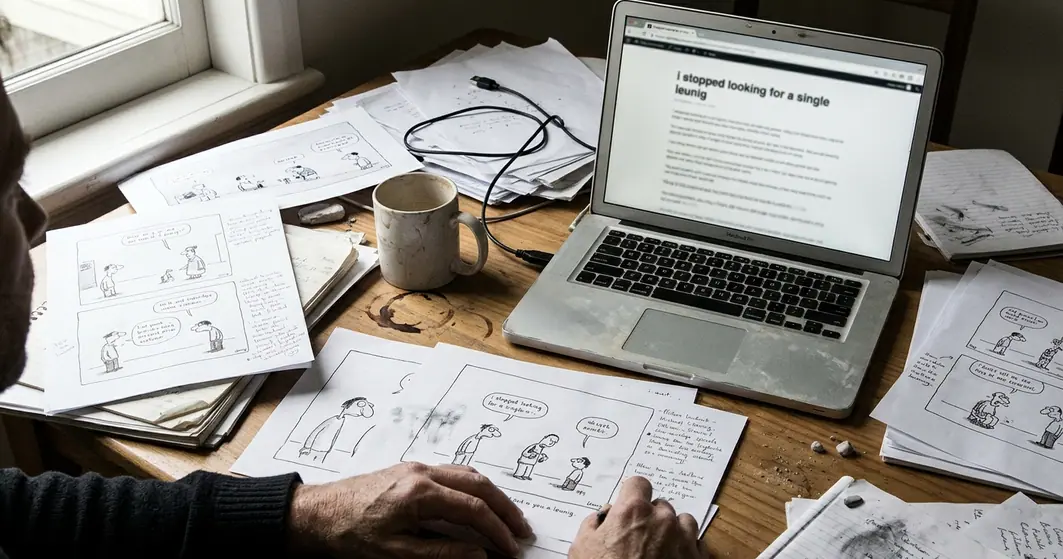
The gain for readers is room. Careful comparison lets affection, discomfort, recognition and disagreement sit inside the same reading without forcing a verdict on the whole career. You can love one drawing and argue with its neighbour.
Two Dates, Then a Claim
Before you write or say what Leunig always believed or represented, put two individually dated works from different decades side by side, and keep every difference you find.
That is my firm recommendation, and I would apply it to any "always" sentence about him, including my own. Read the pair first. Let the disagreement between them stand.