Why a Leunig Cartoon Rewards Slow Reading
Michael Leunig cartoons often present a deceptive visual simplicity. A sparse line drawing of a figure with a teapot might look like a quick joke, but these works routinely carry poetic, moral, comic, and civic meanings simultaneously. Treating Michael Leunig strictly as a cartoonist misses the breadth of his output. He operates as an author and illustrator whose public creative career, spanning from the mid-1960s onward, encompasses newspaper interventions, collected books, public artworks, and poetic prose.
Reading his work requires treating the drawing, caption, title, and surrounding white space as a combined verbal-visual object. The goal of this reading practice is not to decode a single hidden answer or extract a rigid moral. Instead, a disciplined approach preserves the ambiguity inherent in his work, allowing the image and language to alter each other before any thematic claim is made.
Begin With the Publication Context, Not the Punchline
Consider a cartoon encountered in Everyday Devils and Angels, published by Penguin Books Australia Ltd in 1992. Finding a drawing in this curated volume creates a fundamentally different reading frame than seeing the exact same image printed in a Tuesday morning newspaper. The book format places the cartoon inside a deliberate, reflective sequence.
Treating a 1992 collected-book appearance as if it were automatically a single-day newspaper intervention can distort the intended reading pace and tone. Before interpreting the joke, identify the format. Check whether the piece appears in a newspaper, a collected book, an exhibition catalogue, or a later digital reproduction. Record the date, the publisher, and whether the piece sits inside a named thematic section. These publication facts serve as anchors for the reading conditions. They establish the conditions in which the reader meets the work, shaping how quickly or slowly the image is meant to be consumed.
Map the Visual Grammar Before Interpreting the Message
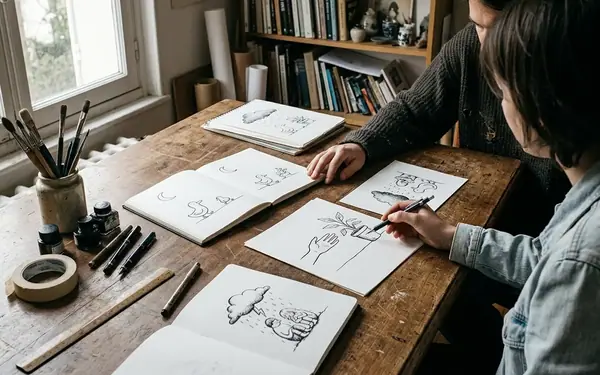
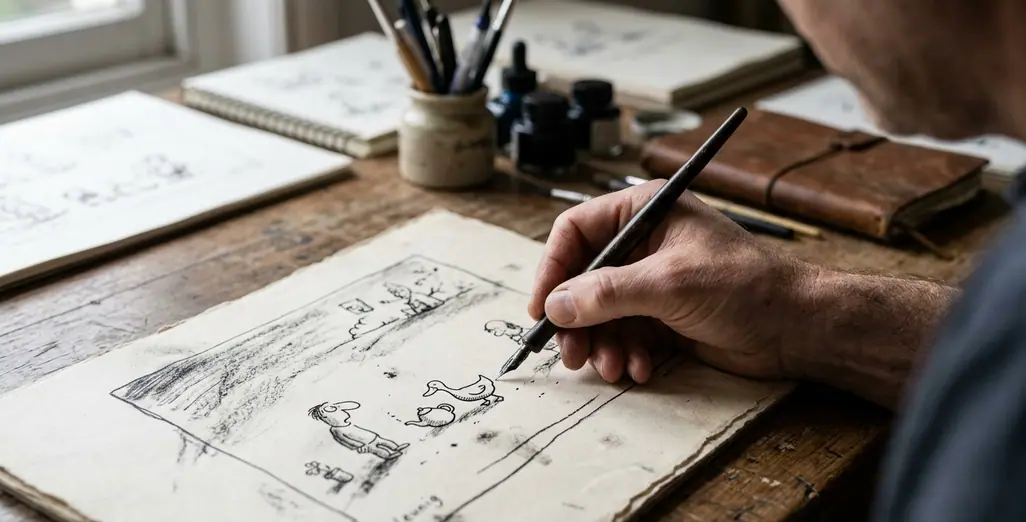
How do we look at a drawing without immediately deciding what it means? The most effective method is to separate observation from interpretation. Start by mapping the visual grammar: examine line weight, figure size, body posture, eye direction, object placement, and the distance between figures.
Write down five to ten plain nouns describing the image before reaching for interpretive words like grief, innocence, or satire. Notice any imbalance between small figures and large surrounding space. Ordinary objects such as ducks, teapots, domestic furniture, or small houses often sit beside spiritual suggestions without announcing a fixed meaning.
Critical Insight: List what is visible before deciding what it means. A teapot is just a teapot until its relationship to the surrounding space and text is established.
This visual modesty carries immense emotional weight. A sparse drawing may ask the reader to supply atmosphere, silence, or discomfort. The same soft line might support tenderness, irony, melancholy, or civic criticism depending entirely on the setting and the caption that accompanies it.
Read the Words as Poetry Under Pressure
Leunig’s captions and titles operate as compressed poetic language, not merely as explanatory labels attached to drawings. The reading process requires hearing the phrase, testing it against the image, and deciding whether the words clarify, complicate, contradict, or gently mislead.
Take the keyword phrase A Dusty Little Swag as a model reading prompt. Speak the title aloud and mark its rhythm and plain diction. What kind of burden, journey, humility, or cultural memory does the phrase invite? Paraphrasing A Dusty Little Swag as one fixed symbol would flatten its possible associations.
The words place the image under poetic pressure. Sometimes the text creates a second scene entirely, or undercuts the drawing to intensify pathos. The reader is often left suspended between the visual evidence and the verbal suggestion, a tension that should be maintained rather than resolved into a simple summary.
Place the Cartoon Beside Leunig’s Civic Imagination
On October 22, 1994, a 1958 Austin Lancer modified with a lawn and a palm tree appeared at the Car Park with a Difference protest. This pollen-powered car is a concrete manifestation of Leunig’s absurd civic imagination. Broadening the reading frame from the printed page to these public works provides a vital context for understanding his approach to public space, environment, and dissent.
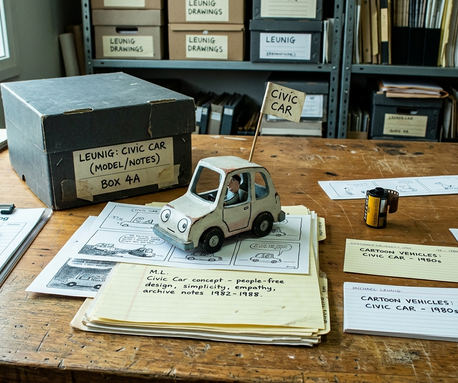
The Leunig tram, documented in photographs by Sarah Churchman for The Met (Melbourne's public transport authority), belongs to this same tradition. These civic interventions show how his visual vocabulary scales up from the intimate page to the noisy street.
However, using Sarah Churchman's photograph of the Leunig tram as proof of what a specific cartoon means would confuse documentation of public context with interpretation of the artwork. The civic works inform our understanding of his broader thematic concerns, keeping the focus firmly on interpretation rather than biography.
Know What the Archive Can and Cannot Prove
What exactly does a publication record tell us about an artist's intent? Archival facts can establish publication dates, settings, photographic documentation, or sequence, but they cannot automatically prove intention, emotional tone, or reader response. Evidence categories must remain distinct.
On-page visual evidence is different from publication metadata, which is different again from a documented protest date. We can confidently claim a publication year or a sequence within a book based on the National Library of Australia catalogue. We cannot invent reception claims, controversy levels, or broad cultural effects unless they are tied to named sources. While archival documentation provides essential grounding for comparative illustration analysis, historical metadata alone cannot resolve the inherent ambiguity of poetic visual works.
Risk Factor: Avoid inventing statistics or broad cultural conclusions. Archival facts establish where and when an item appeared, not how it was felt by its audience.
Use conservative formulations. Phrases like "the cartoon suggests" or "the sequence invites" accurately reflect the limits of the archive when intention is not directly documented.
Use a Five-Pass Method for Any Leunig Cartoon
Turning this interpretive approach into a repeatable practice requires a structured method. A five-pass reading sequence ensures that observation precedes conclusion.
- Pass 1: Describe the scene plainly, naming figures, objects, setting, and spatial relationships without thematic language.
- Pass 2: Track the emotional temperature, recording concrete candidates such as stillness, anxiety, tenderness, absurdity, melancholy, or comic relief.
- Pass 3: Read the image and words together, asking whether the caption, title, and drawing reinforce or disturb each other.
- Pass 4: Check the available context, including book placement, date, publisher, or documented civic event.
- Pass 5: Form a provisional reading.
This final step relies on cautious language, acknowledging that the interpretation is a proposal rather than a definitive ruling. This disciplined sequence prevents the reader from rushing to a punchline that may not actually exist.
Use Leunig in Classrooms and Research Without Flattening Him
When introducing these works in an educational setting, ask students to divide their analysis into three columns: observation, context, and interpretation. Require them to place every claim in one column before beginning the discussion.
A practical comparison task might pair a cartoon from Everyday Devils and Angels with the pollen-powered car from the 1994 civic protest. Ask how a small drawn figure, a poetic caption, and a public object handle humour, tenderness, and civic critique differently. This exercise demonstrates how Leunig’s visual imagination moves across formats, from the intimate pages of the State of Bewilderment era to large-scale public interventions.
Recommendation: Use a three-column framework (observation, context, interpretation) to force a slower, more deliberate engagement with the artwork.
The assessment standard should actively discourage yes-or-no moral summaries. When a cartoon depends on tension, unresolved discomfort, irony, or compassion, forcing a binary conclusion flattens the work. The goal of research and teaching is to sit with the complexity of the image, respecting the delicate balance between the drawn line and the written word.