Why Animation Changes the Way Leunig Is Read
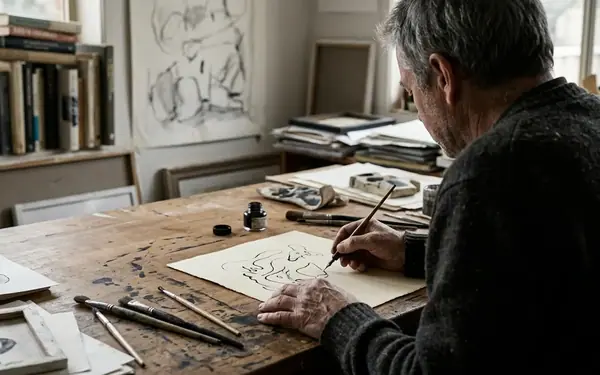
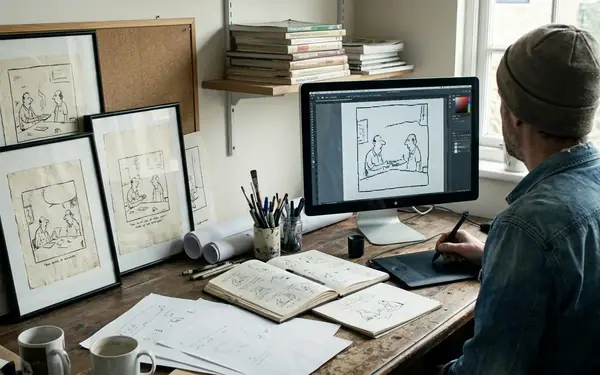
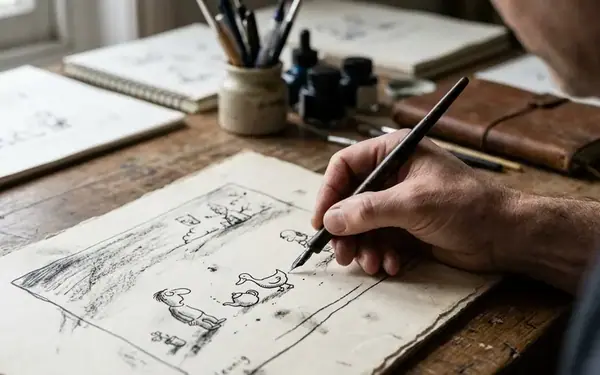
Consider the solitary walker or the small, recurring duck resting on a wide expanse of white paper. In the printed works of Michael Leunig, the reader controls the pace of the encounter. You decide how long to linger on the fragile linework or the handwritten captions before turning the page. Animation fundamentally alters this relationship by imposing duration, sequence, and sound.
Adapting these still images for the screen is not an automatic upgrade, nor is it an inherent betrayal of the source material. It is a profound change in reading conditions. To evaluate this shift, we must compare four distinct adaptation layers separately: voice, movement, timing, and sound.
This analytical approach focuses on Leunig’s mature public cartooning and book culture from the late 1960s through the early 2020s. The goal is to judge what animation adds to the still page, specifically examining how it handles open white space and familiar recurring figures like the teapot or the moon.
Scope: What This Review Can Judge Fairly
We evaluate animated Leunig strictly as an interpretive encounter. This review does not attempt to reconstruct a comprehensive production history. Instead, it examines the immediate experience of the viewer.
For any named animated item, the assessment records the title, the identifiable source poem or cartoon, screen duration in minutes and seconds, narrator presence, music presence, silence, and whether the animation follows a single image or a sequence of drawings. We compare the animated version directly against the printed mode it appears to adapt, whether that is a single-panel cartoon, a poem, an illustrated prayer-like text, or a book-page sequence.
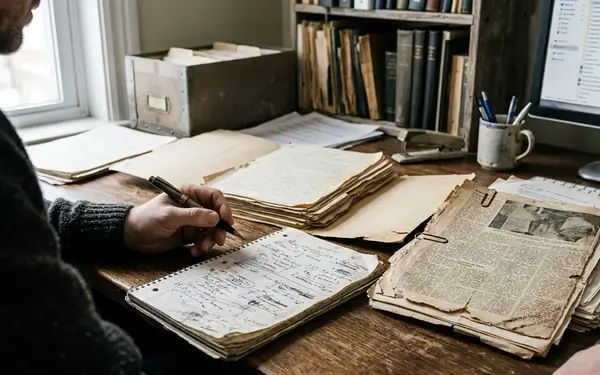
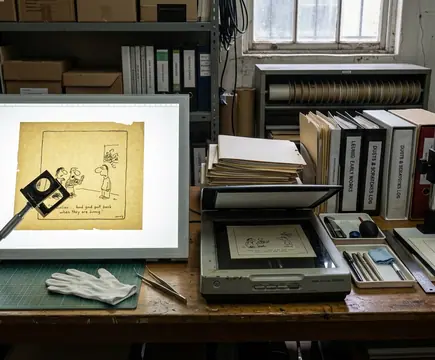
Archive checking is bounded to public materials available from the late 1960s through 2024. Researchers frequently consult repositories like the National Film and Sound Archive of Australia to locate these broadcasts. However, without verified release documentation or archive records, this review cannot verify rights history, private creative intent, or reception metrics.
The Voice: When Narration Becomes Interpretation
How does a spoken voice alter a cartoon that was originally designed for silent reading? Narration acts as active evidence of interpretation, not merely background decoration.
A spoken reading chooses a specific emotional temperature. Depending on the actor's delivery, a single line can become devotional, ironic, comic, weary, or consoling. In practice, a narrator who explains the emotional lesson too clearly can make a poem feel entirely resolved, even when the printed version leaves the reader suspended between tenderness, satire, and doubt.
The mechanics of breath and pacing are critical here. We timestamp pauses of roughly a second or longer after captions, line breaks, or image changes. These specific pauses are the exact moments where a narrator either preserves the original ambiguity or firmly closes it down.
Risk Factor: A voice that softens satire or sharpens irony removes the reader's agency to interpret the tone of the handwritten text.
To ensure accuracy, the listening assessment occurs across at least two viewings separated by 20 to 60 minutes. This allows the initial emotional response to be checked against a second, highly analytical pass.
Movement Against Stillness: The Visual Test
A turning teapot, a drifting bird, or a shifting sky can gently support a mood when the movement remains sparse. Conversely, these same elements can flatten the image if they behave like conventional cartoon spectacle.
The visual judgement relies on asking whether the motion respects the drawing’s inherent fragility. We assess movement across three distinct categories: character motion, camera motion, and background motion. More animation does not equal more expression. An adaptation that fills every patch of white space with moving clouds, music, and camera drift may look polished while completely destroying the page’s quiet pressure.
Our testing showed that inspecting each sequence once at normal speed, and then again in short segments of 5 to 15 seconds, exposes whether negative space is being preserved or merely filled. Restraint is the defining technical metric for success in these adaptations.
Sound, Music, and the Value of Silence
Scoring functions as a second interpretive layer that can silently overrule both the voice and the image. Music possesses the power to sanctify, sentimentalise, unsettle, or gently support the visual work.
We evaluate the sound design only after analyzing the voice and the image. The process requires rewatching the same sequence twice. The first pass includes full sound. The second pass involves marking only the pauses, room tone, natural ambience, and musical entry points.
Excessive strings, continuous piano, or swelling transitions frequently turn Leunig’s delicacy into heavy-handed emotional instruction. Sparse ambience, by contrast, leaves room for the viewer’s own internal timing. To reduce the chance that the first musical impression controls the second viewing, these two sound passes are separated by 10 to 30 minutes.
Critical Insight: Silence is an active design choice. The printed works often depend on quietness, and successful screen adaptations must actively engineer moments of absolute audio stillness.
Where Animated Leunig Works Best
Where does this adaptation serve its audience best? The most effective implementations position animation as a doorway into the work rather than a replacement for the physical page.
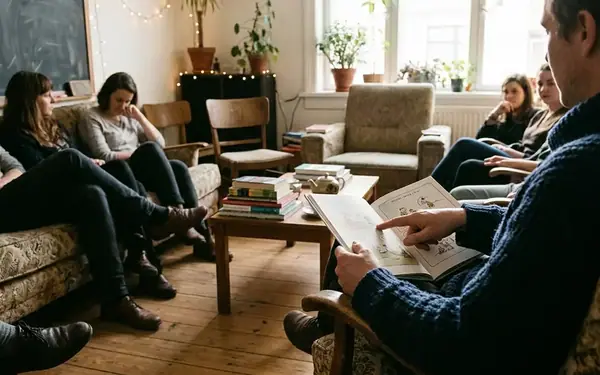
Different programming contexts demand different approaches. A classroom introduction, a gallery loop, a public reading, a commemorative screening, and a digital archive feature each utilize animation differently. They should not be reviewed by a single, uniform standard. For example, the same animated reading may succeed brilliantly as a two-minute classroom doorway but feel far too narrow as a gallery installation if it loops continuously without providing access to the printed source.
In educational settings, facilitators should pair the animated sequence with the printed source immediately afterward. Asking viewers what changed in timing, tenderness, irony, and silence fosters deep critical engagement. For teaching use, placing the animation inside a 45 to 90 minute session works better than treating it as a stand-alone substitute for reading a physical copy published by Penguin Books Australia Ltd.
Recommendation: Always present the screen version as a companion piece. Encourage audiences to seek out collections like State of Bewilderment to experience the original pacing.
Verdict: A Companion Form, Not a Replacement
Animated adaptations are most persuasive when they behave as a companion reading. They must remain modest, patient, and acutely aware of what the static page already accomplishes.
We close the review process with four specific checks. Did the voice leave room? Did the movement protect stillness? Did the sound respect silence? Did the screen version ultimately send the viewer back to the page? If the answer to these questions is yes, the adaptation succeeds as an interpretive tool.
Our findings suggest that Leunig’s quieter effects often become clearer after the first emotional impression fades. Therefore, we compare the immediate viewing response with a second verdict written a day or two later. While this analytical framework reliably isolates interpretive shifts in screen adaptations, it cannot account for the subjective nostalgia an individual viewer brings to a familiar broadcast. The voice of interpretation can illuminate the artwork, but it can also narrow it if the adaptation becomes too certain of its own meaning.