The Problem With Measuring Leunig by Ordinary Cartooning Rules
Michael Leunig matters because he expanded Australian cartooning beyond topical punchlines into moral fable, lyric unease, and civic reflection. Most readers approach the editorial page expecting a specific transaction. They look for party-political clarity, recognizable caricature, and an immediate joke. Leunig disrupted this habit entirely.
From the late 1960s through 2024, his public career offered something different: prayer-like language, vulnerable figures, silence, and unresolved moral unease. We treat Michael Leunig as an archival and cultural subject rather than an uncomplicated icon. Evaluating his impact requires looking at the habits his work changed, rather than judging whether each drawing delivers a quick laugh.
The evidence base for this shift exists in publication-facing material. Newspaper cartoons, image-text poems, book collections, calendar work, interviews, and public reader responses form the core of his archive. By examining these formats, we can see how he challenged the ordinary rules of editorial cartooning and demanded a different kind of attention from the public.
A Line That Made Inner Weather Public
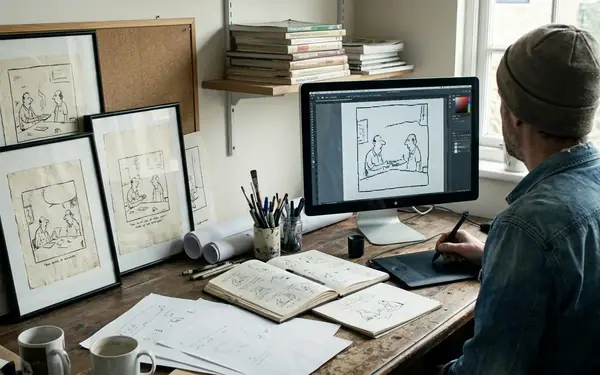
Look closely at a Leunig drawing from the 1970s. You will find spare human bodies with thin limbs and rounded heads, surrounded by ducks, birds, moons, and teacups. Handwritten captions sit in uneven lettering amidst large areas of open space. This simplicity is not naivety.
The reduced line creates room for melancholy, wonder, spiritual doubt, and private anxiety to enter the public newspaper space. Place one of these drawings beside a conventional political cartoon from the same era. The conventional work relies heavily on labels, recognizable public figures, speech balloons, and a rapid delivery of the argument. The joke or political stance becomes legible almost instantly.
Leunig slows the reader down. His recurring visual devices persist across formats, appearing consistently from his early newspaper work through to the collected editions of the 1980s and 2010s. The symbols recur across decades rather than belonging to one short phase, proving that his visual language was a deliberate, sustained method for making inner weather public.
Why the Work Belongs to Australian Public Life
How does a quiet, often melancholic drawing become a fixture of national conversation? The answer lies in circulation and memory. Between the 1970s and 2024, Leunig moved from a newspaper cartoonist to a widely recognized cultural reference point.
His work entered ordinary Australian reading habits through metropolitan newspaper pages, annual calendars, and collections published by Penguin Books Australia Ltd. The cartoons spoke directly to persistent cultural tensions. They addressed secular spirituality, suburban domestic life, suspicion of authority, ecological anxiety, family tenderness, loneliness, anti-war feeling, and a deep unease with modern bureaucracy.
Readers clipped these drawings, gifted them, taught them, and argued over them. The scale of this reach is best understood qualitatively, through the sustained reader debate and public criticism that followed his publications. His work became a shared vocabulary for expressing sentiments that rarely found space in traditional news media.
The Necessary Discomfort: Admiration Without Sanitising
Serious engagement with an artist requires acknowledging their friction. Some readers view Leunig as sentimental, evasive, or overly mystical. Others point to anti-modern rhetoric and troubling later public interventions. These objections are a documented part of the historical record.
While disagreements over sentimentality and spiritual vagueness predate his late-career controversies, the period from the 1990s to 2024 saw sharper public disagreement. Discomfort does not erase artistic significance. It makes careful reading more necessary. We must distinguish between documented published work, interpretive judgment, and reader response to avoid treating inference and evidence as the same kind of claim.
Risk Factor: Caveat: this argument supports Leunig's cultural and archival significance; it does not rank him above every Australian cartoonist, endorse every view he published, or reduce controversy to a minor biographical aside.
How to Read Leunig Now: Slowly, Comparatively, and in Context
Consider the experience of reading State of Bewilderment. To understand the mechanics of Leunig's work today, educators and researchers need a practical method. Start by reading across forms. Pair a cartoon with a poem, then read an interview, and finally examine a later collected version or calendar appearance where available.
Next, apply a comparative lens. Examine an early or mid-career Leunig cartoon beside a conventional Australian political cartoon from the same broad decade. Record the differences in caricature, labelling, topical reference, emotional tone, and ambiguity. This exercise highlights exactly how his approach diverges from traditional editorial expectations.
Finally, track the symbols. Follow one recurring object—a duck, a moon, a bird, a teacup, a road, a prayer-like phrase, or a fragile human figure, across works from at least two different periods, such as the 1970s and the 2000s. This structured approach reveals how the visual language evolves while maintaining its core thematic weight.
Recommendation: When exploring Michael Leunig’s official archive, isolate a single motif and trace its chronological development rather than attempting a comprehensive survey of a single year.
The Case for Lasting Importance
Why does this body of work still demand a serious response? The record points to a fundamental shift in the emotional register available to Australian cartooning. From the late 1960s through 2024, Leunig built a recurring visual language that sustained long newspaper and book circulation.
He entered the ordinary cultural conversation and generated both deep reader attachment and sustained objection. Claiming he defined Australian cartooning would overstate the case. The national tradition also includes sharper party-political caricature, newspaper gag traditions, comic-strip work, Indigenous visual satire, and contemporary digital cartooning. Yet, Leunig's specific contribution remains vital.
Context dictates the encounter. A reader finding his work in a small gift book may experience it as gentle and consoling. Another reader, facing a contested newspaper cartoon, may begin from irritation or distrust. His cartoons continue to matter precisely because they can still console, irritate, provoke, puzzle, and unsettle.
Critical Insight: The strongest case for Leunig is not that he was always right, but that his cartoons still require a serious response.