The Curly Pyjama Letters rewards a reader who refuses to stop at the bottom of a page. Its letters sit in a fixed order inside the volume, and that order is itself readable: an opening salutation, a drawing and a closing can acquire a different weight once the following letter has been read. Reading in sequence makes the relationships between pages available for interpretation, and those relationships are where most of the book's quiet work happens.
The Gap Between One Letter and the Next
Treating each page as a self-contained Leunig piece is a defensible habit. It suits the way his cartoons circulated in newspapers, one unit at a time, complete in themselves. Applied to this book, though, the habit costs something specific: changes in address, shifts in tone, and the contribution a drawing makes to the letter beside it all become invisible when every page is sealed off from its neighbours.
I would describe correspondence here as a reading method rather than a claim about events. The pages are arranged as an exchange; whether any exchange occurred outside the book is not something the pages can settle. What they can support is a comparison: carry one observation forward from a letter, hold it against the next, and decide afterwards whether it develops.
Everything that follows depends on the edition in front of you. Page boundaries, letter order and the placement of drawings differ between printings, and the Penguin Books Australia Ltd volume in your hands is the only evidence this method uses. Where your copy and mine disagree on where a letter ends, your copy wins.
What the Book's Presented Order Makes Visible
Does the order of the letters mean anything, or is it simply the sequence in which pages were bound?
The honest answer is that the second possibility cannot be ruled out, and the first can still be tested. Read an earlier letter for the expectation it creates: a form of address, a question posed, a complaint, a destination named. Then read the next letter against that expectation. Three outcomes are available. The expectation is sustained, in which case the second letter behaves like a continuation. It is complicated, in which case the second letter answers obliquely or shifts the terms. Or it is redirected, with the subject abandoned for something unrelated.
Recurrence is worth recording but proves little on its own. A repeated subject, a returning phrase, a destination such as the State of Bewilderment appearing more than once: note each instance as it occurs, then compare. Recurrence may indicate a developing thread, or it may indicate a motif Michael Leunig reached for often across many years of drawing and writing.
One distinction holds throughout. The book's presented order is observable. The chronology of composition is not, and neither are the editorial decisions that produced the arrangement. This method describes what the printed sequence does to a reader; it cannot recover what was cut, reordered or set aside before printing.
Boundary of the Comparison
A comparison that runs from the opening of the first letter to the closing of the third establishes relations on the page and nothing more. It does not establish when the letters were written, nor whom Michael Leunig, as author and illustrator, privately had in mind.
Tracing the Addressee from Letter to Letter
Consider a letter that opens with a named salutation and closes with a signature. The recipient is stated, the speaker identifies himself, and your position as reader is clear: you are looking over a shoulder at a message meant for someone else. Now consider a page where no salutation appears at all, where the voice simply begins. Your position has changed. You may be the implied recipient, or the address may remain open, waiting for a recipient you supply.
The method is to record only what the page supports. For each letter, copy the exact form of address, or write 'none stated'. Then describe, in one sentence, the relation the wording implies between speaker and recipient: friend writing to friend, traveller reporting to a correspondent at home, a voice addressing no one in particular.
These three positions - overhearing, being invited in, supplying a recipient - are not stable across the book, and the instability is the interesting part. A reader who is a bystander on one page and an addressee on the next has been moved, and the movement is a formal effect worth naming.
Keep the speaker on the page separate from the man who drew the page. Intimacy of voice is a feature of the writing. It is not evidence of an autobiographical event, and a letter's warmth tells us about the letter.
The Drawing Sitting Beside the Words
Three passes per letter, in a fixed order, produce more reliable notes than a single impressionistic glance.
- Words first. Read the letter through without looking across at the image. Record the address, the subject, the closing.
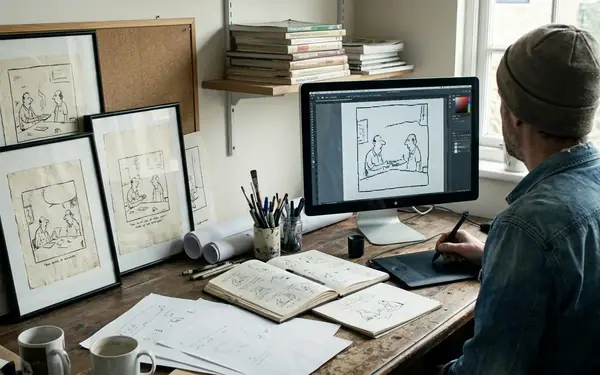
- Drawing second. Describe what is visible: placement on the page relative to the text, the gesture or posture of any figure, elements that have appeared earlier. Describe, do not interpret.
- Words again. Reread the letter with the drawing in mind, and decide whether the image reinforces the address, softens it, or unsettles it.
The comparative question matters more than any single verdict. Having run the three passes on one letter, run them on its neighbours and ask whether the word-drawing relation itself changes as the correspondence proceeds. A book in which every image reinforces its text behaves differently from one in which images progressively complicate what the words claim.
Describe only what appears in your copy. Motifs cannot be prescribed in advance, and a visual echo between two pages supports a reading without establishing intention.
Settle the Boundary First
Where typography or page arrangement makes it unclear whether a passage belongs to one letter or the next, fix that boundary before comparing recipients. A misplaced boundary corrupts every comparison built on it.
A Worked Reading of Letters A, B and C
Take the first three consecutive letters in your edition. Label them A, B and C. The case runs from A's opening to C's closing, and it needs roughly forty minutes.
Step 1. Mark each letter's opening and closing in pencil or on a separate sheet. Under each label, copy the exact form of address. If A begins with a salutation naming a recipient, copy it verbatim. If B begins without one, write 'none stated'. Do the same for C. You now hold three entries.

Step 2. Write one sentence on A's apparent speaker-recipient relation, using only A's wording. Something like: the speaker writes as a traveller reporting to a correspondent who is expected to reply. Hold that sentence beside B and record precisely what alters: does B read as a reply, does the address stay constant, does the speaker change footing? Repeat against C.
Step 3. Describe each accompanying drawing in plain observable terms. Where it sits, what the figure is doing, whether anything from the previous drawing returns. Then record, for each letter, whether the image echoes the words or complicates them.
Step 4. Compare the two transitions. For A to B, name one continuity and one shift. For B to C, do the same. Note the page references so the reading can be checked.
What you retain is modest and durable: three forms of address, three drawing descriptions, two transition comparisons, three citations. A's copied address, B's reply-like or altered positioning and C's word-drawing relation remain three separate observations. Set them side by side and the sequence begins to speak, without being asked to carry a plot it never promised.
What Three Letters Yield
A single worked trio gives you a repeatable template. Apply the same four steps to letters D, E and F, and the comparisons accumulate into a record of how the correspondence behaves across the whole volume.