Why These Figures Matter Before Any Single Cartoon
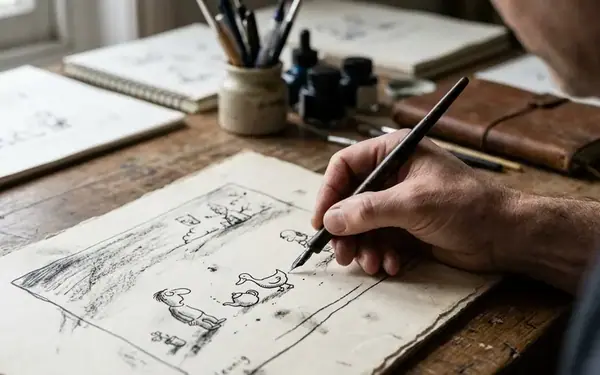
Open almost any collection of work by author and illustrator Michael Leunig, and you immediately encounter a familiar visual vocabulary. A small figure stands alone in a vast expanse. A duck sits quietly near a teapot. The rounded, gentle form of Mr Curly gazes outward. These are not characters with stable biographies or linear narrative arcs. They operate as recurring presences that move fluidly across single-panel cartoons, illustrated poems, collected books, and interview discussions.
Tracing Leunig's public cartooning from his student and alternative-press work in the late 1960s through to legacy discussions following his death in December 2024 reveals a distinct pattern. These motifs function as emotional instruments. They tune the reader toward wonder, awkwardness, dissent, or consolation. The National Library of Australia authority record for Michael Leunig anchors his extensive publication history, but understanding his cultural impact requires looking past the bibliography to the mechanics of his drawing.
This review serves as a guide to reading those visual patterns. We must avoid presenting Mr Curly or the duck as having a single canonical biography. Instead, the most productive approach is to identify the figure, observe its posture, measure the surrounding white space, and gauge the caption tone to understand the implied reader response.
Scope of This Review: Motif, Not Inventory
This article examines interpretive function rather than attempting an exhaustive chronological inventory. The rejected path is a strict publication timeline, because cataloguing every appearance flattens the emotional resonance of the work into mere data.
Drafting this analysis relies on three specific evidence categories: description of the drawn scene, interpretation of motif function, and reader-response language. Archival review indicates that references to Leunig's broader reception are best treated qualitatively. We draw on archived newspaper discussions, review essays, and interviews spanning roughly 1990 to 2024 to map how audiences engaged with these recurring figures.
We deliberately avoid reducing these motifs to a single moral position, political stance, or psychological diagnosis. Contextual Note: curlyflat reads Leunig archivally and critically, distinguishing what is visibly on the page from what readers may infer. A motif-level review cannot authenticate every first appearance, syndication date, or reprint history for Mr Curly, the duck, or each small-figure drawing.
Mr Curly: The Fool, the Pilgrim, and the Innocent Witness
How does a simple, rounded figure hold its ground against the weight of modern institutional machinery?
Mr Curly operates as a figure of profound vulnerability rather than naïve escapism. His childlike outline should not be read as childish politics. When placed near bureaucracy, noise, or moral exhaustion, his gentle posture and apparent simplicity actively intensify the critique. He serves as an innocent witness to modern alienation and spiritual hunger.
The Curly Pyjama Letters, published by Penguin Books Australia Ltd in 2001, gives Mr Curly an extended named presence beyond an isolated cartoon panel. However, comparing early collected cartoons from the 1970s with later books from the 2000s shows a remarkable continuity in his visual economy. The rounded body shape, the direction of his gaze, and his degree of stillness remain consistent markers of his presence.
Mr Curly may console readers, but his vulnerability also makes ordinary adult seriousness look evasive or morally depleted. He exposes the absurdity of the systems built around him simply by refusing to adopt their rigid geometry.
The Duck: Companion, Comic Weight, and Moral Counterpoint
Consider a panel where a duck sits slightly behind a human figure on a shared ground line, entirely silent. A duck beside a human figure does not automatically mean loyal companionship. In a harsher caption, it may operate as comic interruption, a stubborn witness, or an absurd weight.
Across the collected work from the 1970s through 2019, the duck provides a bodily counterweight to Mr Curly's openness and drift. It grounds the scene. Whether placed near a domestic object or isolated from human action, the duck's bluntness contrasts sharply with the ethereal qualities of other motifs.

Animal companionship in Leunig's work resists modern alienation without dissolving into sentimental decoration. In image-text analysis, checking whether the duck acts, watches, or simply occupies space is crucial. Its silence often matters as much as any visible movement, supplying stubbornness in scenes that might otherwise float into pure sentiment.
Risk Factor: Do not assume the duck is merely a comic accessory. Its placement often dictates the emotional gravity of the entire panel.
The Small Figure: Scale, Solitude, and the Vast White Page
Page geometry dictates meaning before the caption resolves anything. The small human figure is one of Leunig's most important visual strategies, rendering a person physically modest against emptiness, weather, landscape, or social machinery.
Scale functions as a primary emotional device. A small figure in open white space can suggest freedom in a walking or pilgrimage scene, but abandonment in a scene shaped by weather, machinery, or social indifference. The figure often navigates a literal or metaphorical State of Bewilderment, where the vastness of the page threatens to swallow them entirely.
Sparse line, modest human scale, and exposed bodies recur across Leunig collections from the 1970s through late-career republication and memorial discussion in 2024. White space and sparseness become active parts of the motif, not merely background. The emptiness presses against the figure, demanding that the reader acknowledge the solitude.
How to Read the Trio Together Without Flattening Them
What happens when we encounter these figures in the same space, or attempt to teach their function across different decades?
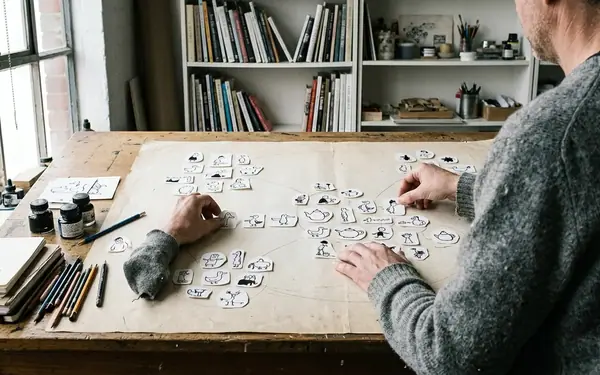
Educators and researchers require a practical reading method. The sequence is straightforward: identify the motif, observe posture and scale, then examine caption tone. We can compare tendencies without claiming absolute definitions. Mr Curly often carries innocence or exposed trust. The duck often anchors absurdity or bodily stubbornness. The small figure often measures vulnerability against space, weather, or social systems.
Pairing cartoons from different publication periods tests whether the motif changes with context. A 1970s-1980s example placed alongside a 1990s-2000s example reveals how the surrounding social machinery evolves while the core visual function remains stable.
- Log the specific motif and its posture.
- Measure the scale and distance from other figures.
- Evaluate the caption tone independently of the drawing.
- Determine the first emotion the image requests.
Recommendation: Ask what the cartoon asks the reader to feel before asking what it argues. Never treat the motifs as a rigid codebook where each figure always means exactly the same thing.
Review Verdict: A Gentle Grammar for Serious Questions
Mr Curly, the duck, and the small figure form a loose grammar of Leunig’s imagination rather than a cast of conventional characters. They are readable together because all three rely on minimal lines, visual recurrence, and a deliberate gap between apparent simplicity and adult consequence.
From the mid-1960s to 2024, this visual modesty, repetition, and silence created profound cultural meaning. The distinctive value of studying these motifs lies in noticing how sparseness invites reflection. Admiration, debate, affection, and criticism can and do coexist in serious readings of his legacy.
Critical Insight: Slower looking is essential. Scale, placement, silence, and caption tone must be read in concert before extracting a single moral or political message from the page.