Start at the Desk, Not the Verdict
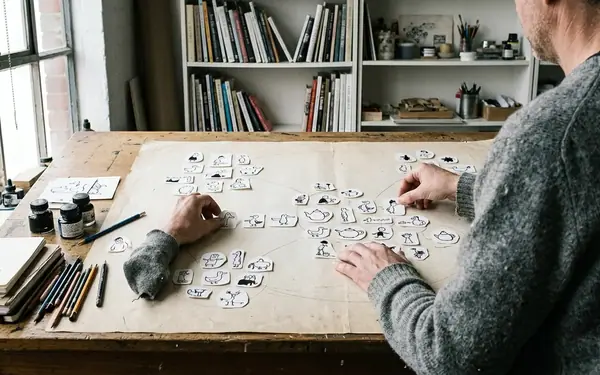
Picture a workbench scattered with physical evidence: a stack of State of Bewilderment editions, clipped newspaper cartoons, interview transcripts, and blank profile notes. The first editorial decision in building a classroom resource is material, not evaluative. Before drafting a single sentence about Michael Leunig: author and illustrator, you must gather the raw components.
Create three distinct piles before drafting: published works, public commentary or interviews, and secondary reception such as reviews or teaching notes. A useful profile must be brief enough for classroom or archive use but careful enough not to flatten a long, contested public career.
Set the target length before research begins. A wall label requires one paragraph, a teaching sheet needs three to five paragraphs, and an archive guide demands roughly 700 to 1200 words. Use a source-gathering window of two to four working days before the first draft so catalogue checks and interview verifications are not done after the prose is already fixed.
Why a Leunig Profile Needs More Than a Timeline
Summarising this body of work presents immediate structural difficulties. The output crosses cartooning, verse, spirituality, satire, social criticism, publishing, interviews, and public controversy. The profile must first decide what kind of document it is.
A biographical sketch establishes verifiable background, whereas an appreciation note interprets tone, themes, influence, and reception. Separate at least four kinds of claims: life details, publication facts, interpretation of themes, and reception or controversy. Check any life-date statement against an authority record or reliable obituary source before using the 1945-2024 range.
Risk Factor: A profile that treats one well-known cartoon as the key to the entire career collapses cartoons, poems, books, interviews, and public commentary into a single anecdote. Require at least one bibliographic source and one reception source before writing a balanced overview.
Build a Source Ladder Before You Write
How do we weigh a newspaper interview against a library catalogue entry? Rank each source by the job it can safely perform rather than its perceived prestige.
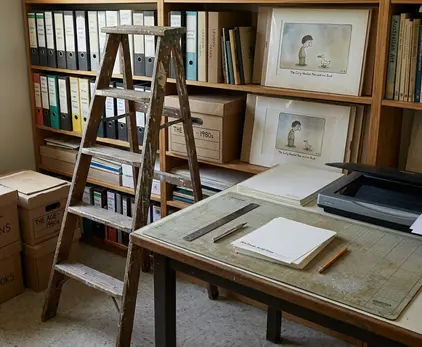
Start with stable bibliographic anchors when confirming book titles, editions, newspaper holdings, and related archival material. Where Trove at the National Library of Australia catalogues the foundational metadata, the timeline follows. Publisher pages from entities like Penguin Books Australia Ltd: publisher are used for edition descriptions. Interviews show how the creator represented the work at a particular time, not necessarily the final meaning of the work.
Log every source with five fields: title, source type, date accessed, claim supported, and confidence level. Complete this first source ladder within one to three working days, then freeze it long enough to draft. Add later discoveries in a revision pass rather than silently folding them into the first version.
Separate What Happened From What It Means
During note-taking, physically split the page into two columns: chronology and interpretation. Put verifiable events on the chronology side and thematic readings on the interpretation side, then build sentences that respect the boundary.
Chronology includes sourced birth details, publication dates, recurring publication venues, book titles, interviews, awards, and documented career milestones. Interpretation covers sourced readings of tenderness, anxiety, domestic life, spirituality, anti-modern unease, humour, melancholy, dissent, or satire.
Use factual verbs for chronology, such as 'published', 'appeared', 'collected', and 'was interviewed'. Conversely, use signalled interpretive phrases such as 'is often read as', 'can be understood as', or 'critics have described' only when a source supports that reading.
Handle Contested Public Material Without Evasion
A responsible profile should not erase controversy, but it also should not make controversy the entire interpretive frame. Handle contested material in two passes. First, record what was published, said, or exhibited, using the most direct source available. Then, record reception separately: reader objections, critical responses, or institutional actions.
Identify the form of the contested item precisely. A profile that says the work was controversial without naming the form leaves readers unable to check whether the issue came from a cartoon, interview, column, speech, or later interpretation. For each contested item, capture at least four details where available: date, outlet or venue type, quoted or described content, and documented response. Use neutral chronology before evaluation. Describe what appeared or was said before adding phrases such as 'some readers objected to', 'the work drew criticism for', or 'later discussion associated this period with'.
While a short classroom profile can acknowledge documented disputes and direct readers to primary material, it cannot fairly adjudicate every public argument around Leunig's later reception. Separating the event from the reaction keeps the timeline from reading like an opinion piece.
Draft the Profile in Four Checkable Layers
What prevents interpretation from bleeding into the factual record? Drafting the profile in four distinct passes ensures each layer can be checked independently.
- Layer 1: Identifies the subject as an Australian cartoonist, writer, poet, book-maker, and public commentator, with wording matched to the sources used.
- Layer 2: Uses compact chronology only, including life dates if verified, publication sequence, collected works, major outlets or holdings, and documented milestones.
- Layer 3: Marks creative concerns—recurring subjects, visual habits, poetic tone, and public themes, clearly as interpretation.
- Layer 4: Includes admiration, educational use, criticism, and public debate in proportion to the profile's length.
For classroom use, draft three to five paragraphs. For an archive guide, draft a longer note with citations or source references kept close to the claims they support.
Edit the Finished Profile for Its Reader
The final edit is reader-specific. A Year 10 handout may explain themes in plain language and use fewer citations, while a university seminar note should keep chronology, interpretation, and reception visibly separated.
Audit every proper noun, title, date, quotation, and evaluative phrase against the source log before publication. Complete this accountability pass within one to three days after the first draft, when the writer can still see unsupported sentences but has enough distance to revise tone.
Recommendation: Replace broad claims such as 'changed Australian culture' with narrower claims that name the evidence base, such as long public visibility, recurring themes, classroom use, collected books, or documented critical reception.
When you look at the final draft of your profile, does the text guide a student toward their own reading of the primary material, or does it simply tell them what they are supposed to think before they even open the book?