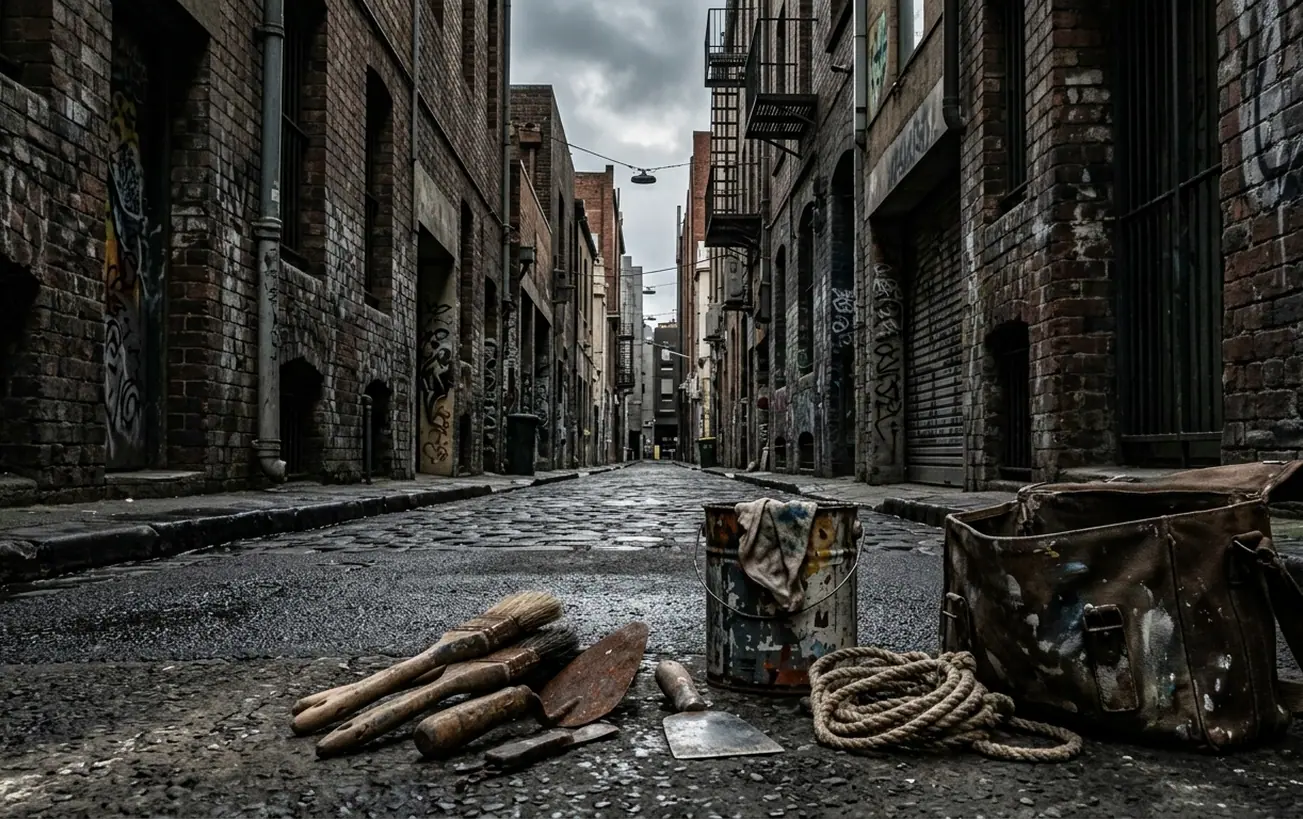
Melbourne Was Never Just Leunig’s Backdrop

Michael Leunig (1945–2024) drew a city that functioned as a moral and emotional climate, not merely a geographical location. Readers often approach his work by looking for the familiar. They scan the frame for ducks, teapots, moons, and solitary figures. The city quietly structures these encounters.
Melbourne emerges as a lived system of tram stops, wet pavements, small domestic rooms, park benches, and low urban light. While the symbols themselves travel easily beyond city limits, the anchor remains this specific civic space. The drafting decision is clear. We must frame the city as a lived civic climate before decoding individual symbols.
The Problem with Reading Leunig as Merely Whimsical
Consider a solitary human figure standing near a park bench or looking out a window. This visual arrangement resists the common reduction of Leunig’s work to gentleness or decorative whimsy. The whimsy actually functions as a pressure valve. It makes civic loneliness, institutional coldness, and spiritual fatigue visible to the reader.
Many argue that Leunig’s symbols feel universal rather than specifically Melbourne-based. If we read the duck or the moon as purely universal, we miss the street-level estrangement that gives the image its weight. We test the symbol set against the setting.
Critical Insight: A duck, moon, or teapot should not be treated as automatically Melbourne-specific when the surrounding frame gives no civic cue, weather cue, domestic cue, or newspaper-context cue.
The Inner Weather: How a City Becomes a State of Mind
How does a physical city transform into a psychological state? The analytical process begins by observing surface weather before moving to moral weather. We record the size of the figure relative to the frame, the amount of empty white space, and the presence of rain or cloud marks.
We note the direction of the figure’s gaze and whether the setting is a public street, a tram-adjacent space, or a domestic room. These elements draw heavily on Melbourne’s cool-season cultural imagery from June through August. The city becomes an inner landscape—a literal State of Bewilderment, where external conditions mirror private consciousness. We use the 1965–2024 public-record window to compare whether the same visual atmosphere appears in different periods without asserting a single linear development.
The Newspaper City and the Public Conscience
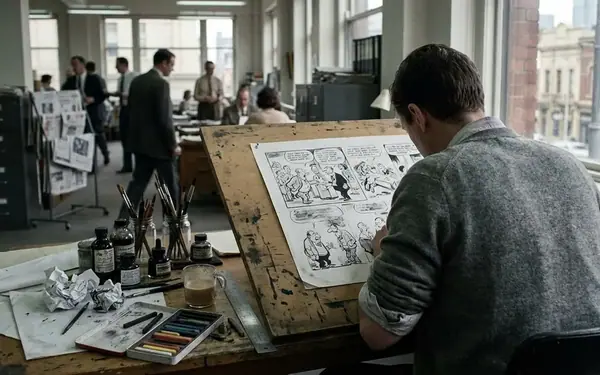
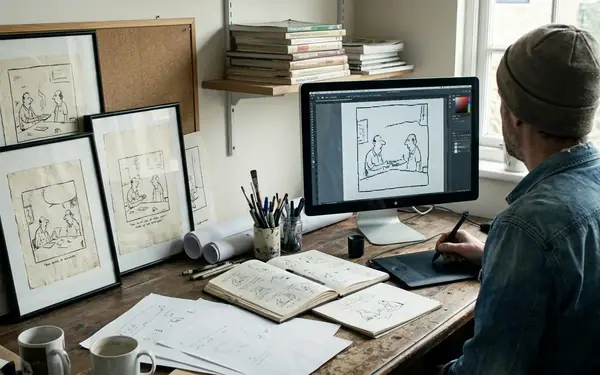
Leunig’s cartoons were fundamentally a newspaper phenomenon. A private spiritual unease becomes a public conversation when encountered at breakfast tables, on trams, and in clipped columns.
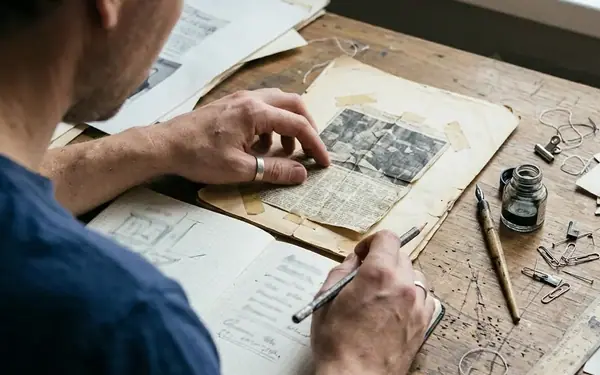
Archival traces in the National Library of Australia’s Trove map this public emergence. We search Leunig-related terms, filter by newspapers, and sort by date. The search bands reveal distinct phases: 1965–1979 for early public emergence, 1980–1999 for established cultural presence, and 2000–2024 for late-career reception.
We must distinguish digitised page evidence from catalogue metadata. Trove search-result counts should not be converted into claims about readership, popularity, or influence, as OCR variation, duplicate records, and syndication distort raw numbers.
Scope: What This Reading Can and Cannot Prove
Finding a tramline in a 1980s cartoon provides a specific visual-textual feature for analysis. This reading method maps recurring moral atmospheres, but it cannot prove that Melbourne explains every image, poem, or book published by Penguin Books Australia Ltd. We separate the visual evidence in the cartoons from later cultural commentary.
The year 2024 serves as the endpoint for legacy framing because Leunig’s death changed the reception context from living-career commentary to posthumous cultural assessment. While this semiotic framework reliably maps the civic atmospheres in Leunig’s published cartoons, it cannot account for the private, unrecorded intentions behind his non-urban or purely abstract works.
Risk Factor: Avoid unsupported numerical claims about publication frequency, total readership, or national influence unless a dated source directly supplies them.
How to Read Leunig’s Melbourne Without Flattening It
What is the practical method for reading these images without reducing them to simple geography? The sequence requires discipline. Identify the setting cue first. Look for tramlines, rain, domestic rooms, park benches, newspaper culture, street solitude, windows, paths, public squares, and kitchens.
Ask what emotional or ethical pressure that setting creates. Only then should you decode the symbol's behavior. Compare at least two works from different points inside the 1965–2024 public-record window before describing a symbol as stable. The same symbol carries comfort in a kitchen scene, estrangement in an empty street, or public conscience when printed inside a newspaper setting.
Recommendation: Begin with the city’s mood before decoding the symbols.
Why Leunig’s Melbourne Still Feels Unsettlingly Current
Leunig’s Melbourne endures because it names a civic loneliness that modern cities still struggle to admit. The late-reception frame from 2020 to 2024 shows that his moral register remains highly contested.
Some readers find this register uncomfortable, sentimental, or uneven. The curlyflat editorial standard requires us to treat Leunig as culturally significant and contested, keeping admiration, discomfort, and disagreement visible in the same frame. The city remains an inner landscape, a public space where loneliness and tenderness become visible.