Why Interviews Are Clues, Not Blueprints
Michael Leunig's cartoons and poems carry the appearance of instinct. A duck, a teapot, a small figure under an enormous moon — the work seems to arrive whole, as if it bypassed deliberation entirely. Interviews promise a way behind that surface, into the place where instinct becomes a finished page. They deliver only partial access.
This article reads the interview record carefully rather than reconstructing the studio in full. The distinction matters. An interview is not a window onto the working hand; it is a retrospective account, produced for a particular occasion, shaped by whoever was asking the questions.
I hold to one editorial standard throughout. Three layers of evidence must stay separate: Leunig's own words, the interviewer's framing, and the interpretation that readers and critics added later. Collapsing them produces a tidy narrative that the sources do not support. Keeping them apart is slower and far more honest.
One biographical anchor helps here. Leunig was born on 2 June 1945 and died on 19 December 2024. We are reading the records of a completed career, not promotional material attached to a current release — which changes how much weight retrospection should carry.
The Public Voice Behind a Private Practice
Leunig's interviews occupy an awkward middle ground. They are public commentary and personal reflection at once, which makes them useful evidence and complicated evidence in the same breath.
Consider what the role itself contains. Across his career Leunig was a newspaper cartoonist, a poet, a maker of prayer-like texts, a social commentator, and a recurring user of visual fable. Each of these roles answers different questions and rewards different framing. A profile that treats him primarily as a provocateur will surface different material than one approaching him as a poet of domestic tenderness.
The setting shapes the disclosure. A newspaper interview pegged to a contested cartoon tends to foreground argument and defence; a literary or arts conversation more often draws out craft, faith, childhood, and symbolism. Read in isolation, either would distort the picture.
My practical recommendation is to tag every interview by its occasion before using a single line from it. Useful categories include book release, cartoon controversy, retrospective career profile, arts conversation, religious or spiritual discussion, and obituary-era reassessment. The tag does interpretive work: it tells you what kind of answer the question was likely to produce.
It also helps to compare across decades. Set the public-facing material from 1990 to 2024 beside the earlier career interviews from 1970 to 1989. Where later explanations appear only in the recent material, treat them as retrospective rather than as evidence of how the early work was actually made.
What He Suggests About Starting: Image Before Argument
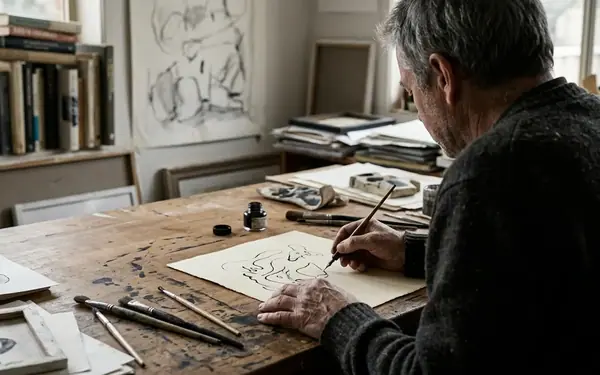
A pattern recurs in the interview record. Leunig frequently describes cartooning as a process of receptivity — image, mood, and feeling arriving first, rather than as the construction of an argument that is later decorated with pictures.
Record that as a claim about starting conditions, then test it against the finished work. The claim is interesting precisely because it can be checked.
Certain motifs serve as entry points worth tracking in both the talk and the drawings: ducks, teapots, moons, small solitary figures, handwritten captions, simple horizons, spare domestic settings, and childlike or vulnerable bodies. For each one, the source log should note who supplied the meaning. Did Leunig explain the motif himself, did the interviewer offer the symbolism, or is the reading an inference drawn from repeated use?
An interviewer's summary — "he says he works intuitively", is not the same as Leunig's own wording. Treat the paraphrase as framing unless a transcript or recording confirms the exact phrasing.
I avoid inventing quotations and recommend the same restraint to anyone working this material. Where verified wording exists, use it; otherwise paraphrase cautiously and say so. And examine motif discussion across at least two separated periods, such as 1980-1999 and 2000-2024, before claiming that a method held steady across the years.
How Words and Lines Appear to Work Together
Leunig's practice is hybrid by design. Cartoon, poem, prayer, aphorism, and social comment overlap inside a single small panel. The interesting question is how the verbal and visual decisions meet — and the interviews can be made to speak to it if approached in the right order.
Start from the visible evidence
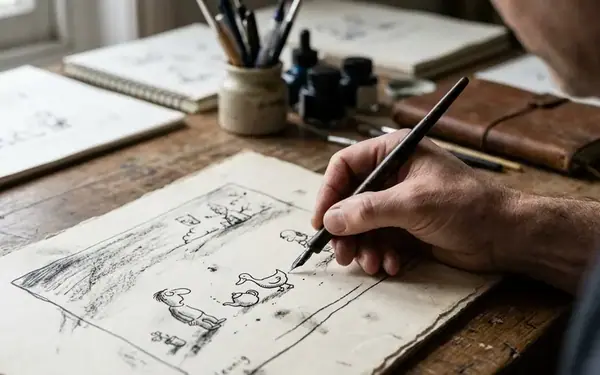
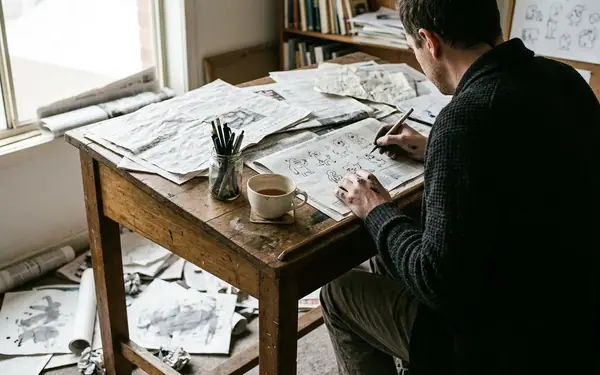
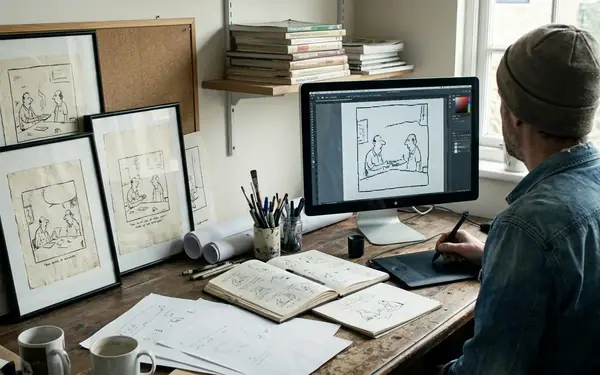
Document the formal features first, because they are stable and independent of any later explanation. The recurring signatures are easy to list: handwritten text instead of typeset captioning, uncluttered panels, modest line weight, short aphoristic phrasing, and compositions that leave open space around the figure. These are choices, not accidents of style.
Move next to confirmed interview wording, then back to the artwork. That sequence — work, statement, work again, keeps the drawing as the anchor and the interview as commentary, rather than letting a quotable line dictate what you claim to see.
Where an exact answer is available, one paraphrased question and one short verbatim reply can illuminate a point, provided the citation metadata stays in the log. The aim is to show that simplicity here is deliberate. The open space, the wobbling hand-lettered line, the refusal of visual clutter — these read as craft decisions rather than as naïveté, and the works published across 1990 to 2024 supply ample material for the comparison.
What Interviews Reveal When the Work Becomes Contested
Why does an artist of such evident tenderness attract discomfort and dispute? Because the same body of work that offers gentleness also delivers moral judgment, and readers do not always agree on where one ends and the other begins.
The reception record holds admiration, unease, and outright disagreement, particularly around cartoons read as social or political comment. This article describes that controversy as part of the record rather than taking a side. The archival task is to arrange the evidence, not to adjudicate it.
A reliable sequence keeps intention visible without letting it settle the matter: the work as published, the public response, Leunig's interview explanation where one exists, and the later interpretation. For any disputed cartoon, the log should hold the publication date, the publication context, the subject matter, Leunig's later explanation if available, and at least one documented reader or critical response.
It helps to separate the kinds of reaction rather than lumping them together — admiration for moral seriousness, discomfort with social judgment, disagreement over political implications, and criticism of perceived insensitivity are distinct responses. Situate each controversy in its original publication window, then compare it with commentary from 2000 to 2024, since retrospective readings often shift the emphasis.
Risk Factor: A controversial interview given in direct response to public criticism should not be used as proof of Leunig's ordinary creative starting point — unless that same interview also contains a clear process statement. Defensive talk and method talk are not interchangeable.
Stated intention is genuine evidence. It is simply not the final word. An artist's account of what he meant cannot close down how the work reads to others, and a careful method holds both in view.

How Readers, Teachers, and Researchers Can Use the Interviews
The analysis becomes useful once it turns into a repeatable practice. Here is the method I recommend, reduced to three steps.
- Identify the occasion. Establish when and where the interview happened and what prompted it — a book release, a controversy, a career retrospective.
- Extract the claim. Record what Leunig says about process, intention, or feeling, in his own wording wherever a transcript or recording allows it.
- Compare with the work. Set that statement beside the line, caption, motif, tone, and composition of the relevant cartoon, poem, or book, and note where they agree and where they diverge.
In the classroom
Assign one interview excerpt next to one cartoon or poem. Ask students to mark which details come from the artist, which come from the interviewer, and which are their own interpretation. The exercise teaches source criticism more effectively than any lecture on it, because the three layers become visible on the page.
In research
Build a motif timeline across 1970 to 2024. Tracking a duck or a moon from the early newspaper work through the mid-career book collections to the late retrospective commentary lets you compare reception across decades and, just as importantly, separate documented method from biographical speculation.
Recommendation: A single motif rarely carries a fixed meaning. A duck, moon, teapot, or fragile figure may signal tenderness in one work, satire in another, and spiritual unease in a third. Check the surrounding text and the publication context before assigning a symbol any settled significance.
The Limits of Reading a Working Method from Interviews
This method leans on several authority signals at once: interview records, editorial interpretation, and publication context. That makes its boundaries worth stating plainly.
Interviews are retrospective, situational, and shaped by the questions asked. They show how Leunig described his own making; they are not transparent access to the making itself. Late-life interviews from 2010 to 2024 should be marked as retrospective whenever they explain work first published decades earlier.
A source hierarchy keeps the weighting honest. Verbatim interviews carry the most weight, then recorded audio or video, then carefully attributed profiles, and finally later commentary by readers or critics. I do not claim a studio routine unless a named primary source — a direct interview, a diary-like document, a documentary record, supports it.
Critical Insight: This approach is strongest for interpreting stated intention, recurring motifs, and reception history. It is weakest for reconstructing the private daily habits that Leunig never committed to a primary source. Where the record is silent, the responsible conclusion is to leave the silence intact rather than fill it with plausible invention.