Why Leunig’s Small Symbols Carry So Much Weight
I often watch students encounter Michael Leunig’s drawings for the first time. They see a sparse landscape, a solitary figure, perhaps a bird, and assume the work is merely whimsical. Yet, as they read further into his catalogue—spanning publicly circulated newspaper-era cartooning and later cultural reception from 1969 to 2024,those repeated small objects gather immense emotional and cultural force. This article serves as an interpretive guide rather than a definitive key to every panel.
We must approach his work context-first. Repetition matters deeply in his cartoons, poetry, newspaper commentary, and illustrated books. Archival commentary confirms that before we can name a symbol, we must understand how its recurrence builds a visual lexicon over decades. My analysis relies on published cartoons, book collections, interviews, and archival commentary available to us, rather than claiming a complete catalogue of every drawing he ever produced.
Criteria for Selection: What Counts as Recurring Here
Consider a drawing where a character holds a specific, oddly shaped wrench to fix a machine. If that wrench only appears once to serve the immediate joke of the caption, it remains a one-off prop. I exclude purely decorative details and objects whose meaning depends entirely on a single caption.
Instead, the motifs selected for this framework must recur visibly across Leunig’s visual language. They must help readers interpret emotional or cultural patterns. Finally, they need to remain relevant to educators and researchers studying his Australian cultural legacy. Applying these three criteria filters out the noise. It leaves us with symbols that carry recognizable interpretive weight across works circulated over five decades.
A Practical Method: Read Symbol, Setting, Caption, and Mood Together
How do we actually read these recurring elements without flattening their nuance? The most effective approach is a four-step close-reading method. First, identify the object. Next, locate where it sits within the frame. Third, observe who or what interacts with it. Finally, test the caption’s effect on the image.

Leunig’s line work relies heavily on spare settings. Blank space, small figures, thin horizons, and isolated domestic objects carry disproportionate interpretive weight precisely because the surrounding visual noise is stripped away. We must recognize the difference between a symbol functioning as a recurring motif and a symbol acting as a rigid code. A motif breathes and adapts to its setting; a code demands a strict, unchanging translation.
Recommendation: For classroom or archival use, ask readers to compare at least two examples of the same motif with different captions or moods before forming a reading.
Nine Recurring Visual Symbols to Watch
The following interpretive patterns offer a starting point for semiotic analysis, rather than fixed translations.
1. The Duck
The duck frequently appears as a small companion animal or a silent witnessing presence. Its emotional range spans tenderness, conscience, absurdity, and comic counterweight. Calling the duck a mere mascot flattens scenes where it functions as a vital conscience or a comic interruption beside a distressed human figure.
2. Mr Curly and the Curl
The curl shape operates as a visual shorthand for innocence, eccentricity, vulnerability, and resistance to hard-edged modern seriousness. We see this most prominently in the figure of Mr Curly, though the motif extends beyond him. It is crucial to avoid reducing Mr Curly to a single emblem; the curl represents a broader philosophical stance against rigidity.
3. The Teapot and Cup
Treating the teapot as mere domestic furniture misses panels where the act of making tea creates pause, hospitality, or emotional repair. Tea-making in these drawings functions as a ritual action. It offers domestic grace and consolation within an otherwise bewildering world.
4. The Moon and Night Sky
The moon acts as a distant witness. It is inextricably linked to solitude, longing, the dream life, and spiritual distance. When a character looks up at the night sky, the composition invites us to consider the vastness of their internal landscape.
5. The Flower
A flower near a bureaucratic or brutal setting can read as a gentle protest against institutional coldness. Conversely, a flower in a quiet domestic scene may invite a softer reading of fragility or hope. It consistently represents fragile beauty and exposed life.
6. The Thin Horizon
Leunig’s spare line work frequently employs a thin, unbroken horizon line. This deliberate emptiness forces the viewer's attention onto the few elements present, giving them disproportionate interpretive weight.
7. The Small Figure
The solitary, small figure emphasizes the scale of the surrounding environment. Whether navigating a vast blank space or confronting a towering structure, the figure's size dictates the emotional vulnerability of the scene.
8. Blank Space
Blank space is not merely the absence of drawing; it is an active compositional choice. It isolates the subject, removing background context to amplify the internal emotional state of the characters.
9. Isolated Domestic Objects
Beyond the teapot, other isolated domestic objects appear stripped of their usual cluttered environments. Placed in spare settings, these items transform from everyday tools into concentrated symbols of domesticity and grounding.
How Educators and Researchers Can Use the List
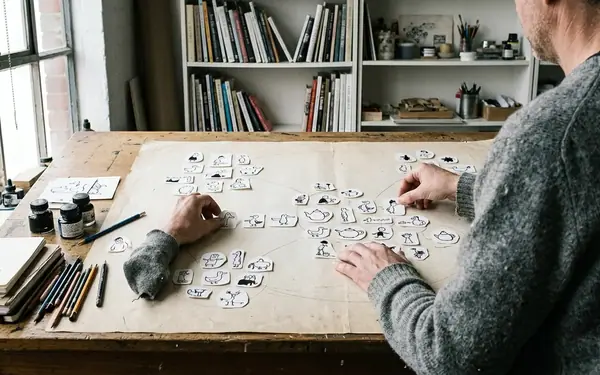
Moving from interpretation to implementation requires a structured approach. Educators can transform this list into a worksheet for close reading or a framework for archival annotation. Feedback from classroom use suggests that the preferred decision path prioritizes comparison over counting.
- Choose two cartoons featuring the same motif.
- Remove any immediate claim of meaning.
- Record the object's placement and the caption's tone.
- Compare the resulting emotional effect.
For rigorous research use, track changes across dated material from 1969 to 2024 where publication dates are available. Mark undated items strictly as undated rather than guessing their origins. Archival annotation fields should include the motif, setting, scale, interacting figure, companion objects, caption tone, publication context, and your provisional reading.
Risk Factor: Counting appearances without tracking changes in setting, scale, and companion objects strips the motifs of their context and leads to shallow analysis.
Scope and Limitations: This Is Not a Fixed Codebook
This article offers interpretive guidance, not an official dictionary of Michael Leunig’s imagery. Meanings shift constantly across publication context, historical moment, caption, composition, and reader experience. A motif published in a daily newspaper carries different immediate weight than the same drawing collected years later in a volume published by Penguin Books Australia Ltd, such as State of Bewilderment.
I deliberately avoid claims about exact frequency, influence, or audience response unless a named catalogue or dated archive index supports them. We do not reproduce protected cartoons or book pages here; instead, we describe motifs, composition, and reading strategies in original prose. While this framework supports close reading and classroom discussion, it should not be used as a complete inventory of Leunig’s imagery or as definitive proof of authorial intention.
Closing Note: Let the Symbol Stay Alive
We must allow the symbol to stay alive. Leunig’s recurring motifs endure precisely because they remain open, tender, comic, and unsettled. They resist being turned into rigid slogans.
I invite you to return to the drawings with patience. Slow down, compare repeated objects, and apply visual attention to the shifting contexts. The point of semiotic analysis in this context is not to solve the drawings like a puzzle, but to see more of the humanity within them.
Critical Insight: The enduring power of these motifs lies in their context-sensitive nature; they invite ongoing interpretation rather than final resolution.