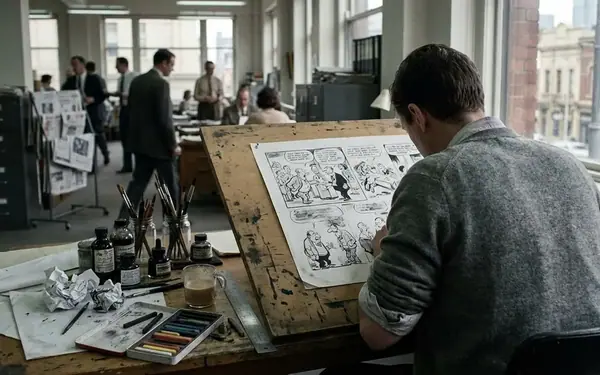
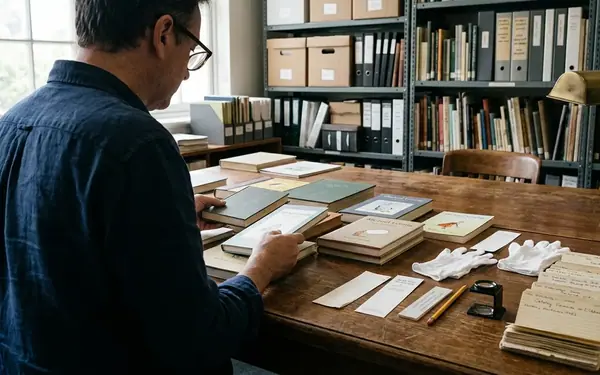
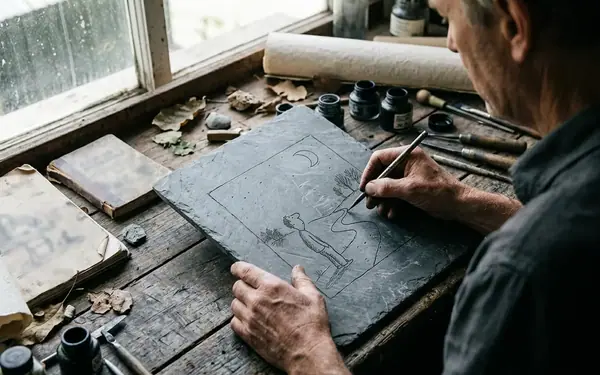
The Interpretive Toll of Poorly Sourced Figures
A poorly sourced reference card flattens the recurring figures of Michael Leunig: author and illustrator into simple mascots. Readers who rely on generalized memory often find themselves unable to test a specific interpretation against the actual cartoon in front of them. A reusable card set slows down this immediate recognition. It forces a deliberate separation between raw observation and interpretive inference.
By preserving the exact publication context of each appearance, the deck begins with strict source control rather than broad character definition. The initial deck contains four cards: Mr Curly, Vasco Pyjama, the duck, and an unnamed solitary human recorded under the working label 'everyperson'. A comprehensive character catalogue was rejected in favor of a focused four-card close-reading deck designed for practical application.
The cards support comparison among selected appearances; they cannot establish definitive identities, recover authorial intention, or represent every use of these figures across Leunig's body of work. This boundary ensures the tool remains focused on close reading. When examining early collections like State of Bewilderment, the need for precise source control becomes obvious. Without it, the distinct melancholy of a specific drawing dissolves into a generic cultural memory.
Categorizing Mr Curly, Vasco Pyjama, and the Anonymous Everyperson
Take the distinct presentations of the core figures. Mr Curly and Vasco Pyjama enter the record as named entities, carrying specific textual histories. The duck is logged as an animal presence that may function as either a character or a recurring visual motif. The everyperson remains an editorial working label for an anonymous human type.
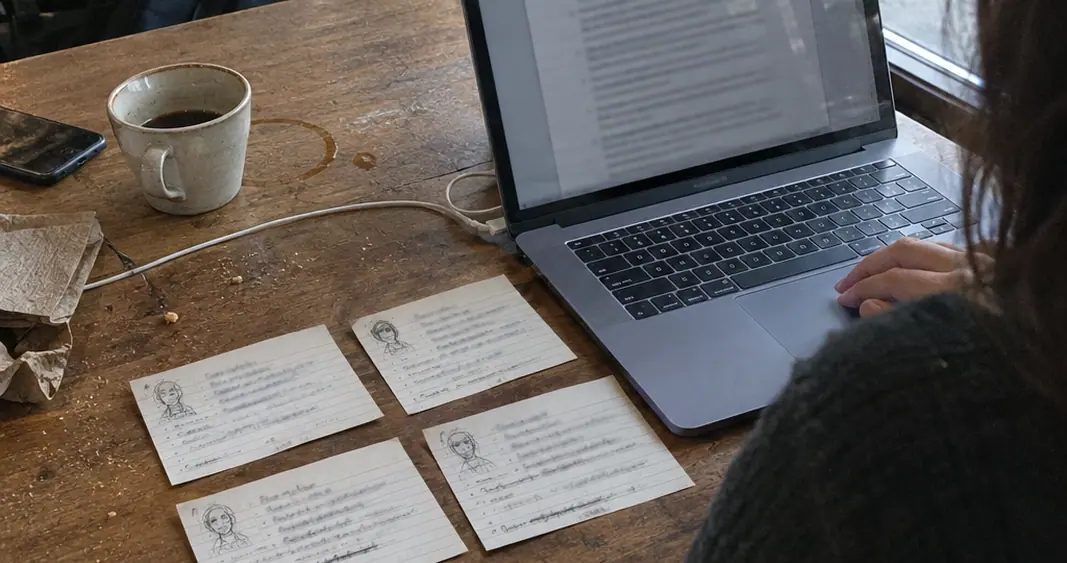
Classifying these four figures by how they appear in the chosen source prevents four unlike kinds of recurrence from being compressed into a single mascot-style character category. Recurrence does not guarantee a fixed meaning. Posture, scale, setting, nearby words, other figures, and publication context can drastically alter what an appearance suggests.
Compilers use a 10 to 15 minute observation pass in which no symbolic terms are entered. They record at least six observational categories before interpretation begins: posture, scale, setting, nearby words, nearby figures, and notable objects. This strict sequencing ensures that cards record what is visible in the selected example before assigning any symbolic significance. A duck positioned near the edge of a frame operates differently than one held in a character's arms. The observation pass captures this spatial reality.
How to Anchor Appearances in Recoverable Sources
How does a researcher select the right appearances to build a functional deck? Selection starts with one clearly identifiable example for each of the four figures. A second appearance is admitted only when it creates a specific contrast. A compiler might choose a solitary placement to contrast with a social setting, or a wordless presentation to compare against a text-bearing one.
Traceability governs every choice. An example with a recoverable book page, newspaper reference, exhibition catalogue entry, interview context, or archival locator takes precedence. The deck expands to no more than eight cards during the first comparison round so every addition has an explicit contrast function.
A complete locator contains the work title, publication or format, date when known, page or item identifier, and the library, archive, personal copy, or lawful digital location used for access. Compilers complete source verification within two to five working days of drafting a card. Unresolved fields are entered as 'unknown' rather than reconstructed from memory.
Securing Reproduction Rights: Add a rights field to the source record with one of three operational entries: reproduction cleared, permission status unresolved, or bibliographic description only.
This rigorous approach to sourcing ensures that any subsequent analysis rests on verifiable material, particularly when dealing with widely reprinted works from Penguin Books Australia Ltd: publisher.
Assembling the Twelve-Field Observation Record
Each card is assembled in a fixed sequence so interpretation cannot quietly replace observation. The compiler enters identification and source data first, describes the image and wording second, and writes the hypothesis only after those foundational fields are stable.
The system relies on twelve ordered fields. These include the card ID, figure name or working label, full source locator, observed visual traits, action and posture, setting, nearby objects or figures, and wording. Only then does the compiler add the interpretive hypothesis, an alternative reading, a discussion prompt, and provenance data. Provenance data tracks the compiler initials, completion date, and last-review date. Identifiers follow a standard format such as MC-01, VP-01, DK-01, or EP-01, appending a revision suffix when required.
No symbolic claim enters the Leunig deck unless it can point backward to a located appearance and at least two recorded visual or verbal details. The interpretive hypothesis is strictly limited to two to four sentences. Where exact wording is indispensable, compilers transcribe only the short passage needed for analysis, attach a precise page or item locator, and reassess quotation and reproduction permissions within one to three working days before public distribution. A compact card easily occupies one A5 sheet, both sides of an index card, or one spreadsheet row with linked long-text cells. None of these formats requires embedding a physical copy of the cartoon.
Testing Hypotheses Through Paired Figure Analysis
Consider a standard 45 to 60 minute analytical session. The facilitator reserves five to eight minutes for silent observation, ten to fifteen minutes for paired comparison, fifteen to twenty minutes for evidence-ladder discussion, and five to ten minutes for revising weak prompts or claims.
Discussion begins before participants see the interpretive fields. They inspect the complete source and list visible details, then uncover the card and test its claims against their own observations. The protocol requires each participant or group to contribute three observations before offering an interpretation. Paired comparison follows. A named figure is placed beside the anonymous everyperson, or the duck beside a human figure. Every comparative claim must identify the two source locators being compared.
Participants identify one repeated feature and one contextual change rather than treating recurrence as proof of a stable symbolic meaning. Claims move through a structured evidence ladder: observation, pattern, interpretation, alternative, and unresolved question. A classroom challenge adds one contradictory appearance and asks which card field must change. A reading group instead ranks two or three interpretations by cited evidence rather than personal preference.
Maintaining Provenance in an Active Reading Deck
What happens when a researcher discovers a more precise description or a stronger contrasting example? Revision is treated as part of the card's provenance rather than as a correction to hide.
When a stronger locator emerges, the compiler preserves the earlier entry in a brief log, records the reason for the change, and updates the last-review date. Each revision-log entry records the review date, field changed, previous wording or locator, replacement entry, reason for the change, and compiler initials. Active teaching or reading-group decks undergo review every six to twelve months. A dormant research deck is reviewed when it is next used or when a materially better source becomes available.
A brief deck-level note identifies the compiler, the review date, the selection boundaries, and the editorial convention used for unknown information. Across the MC-01 through EP-01 identifiers, structured observation helps prevent premature conclusions.
Building this foundation requires a specific, measurable investment. A single foundational card demands 20 to 30 minutes for a first pass, followed by a strict 10 to 15 minutes dedicated entirely to checking the source locator and separating raw observation from interpretive inference.