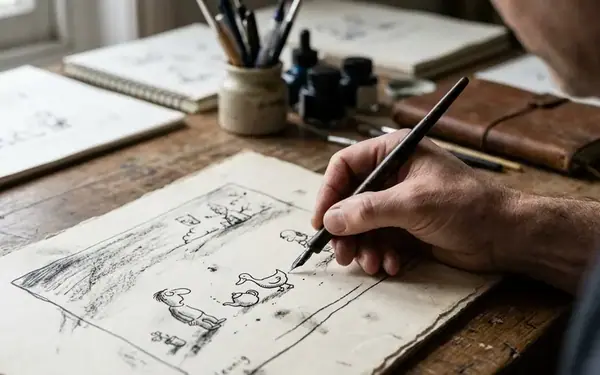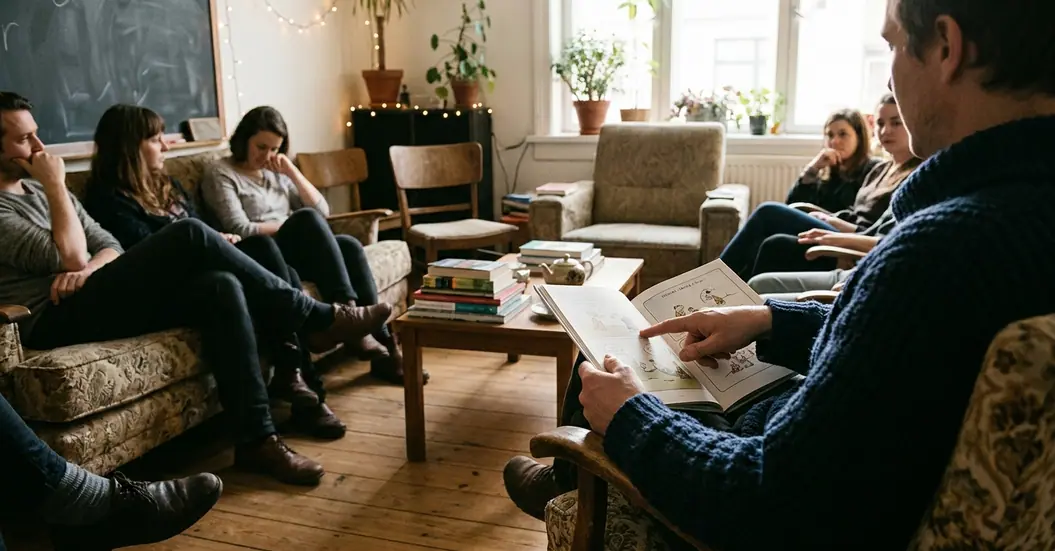
Transforming a Public Room into a Reflective Space
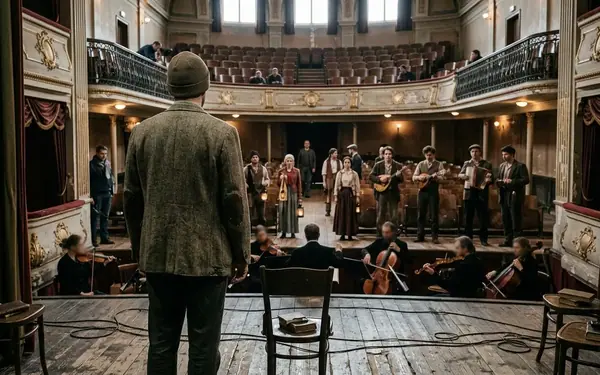
A librarian lowers the overhead lights just enough to focus attention on the front of the room, leaving enough illumination for printed pages to remain legible. A designated reader opens a collection at a wooden lectern. Nearby, a musician waits beside an unplayed acoustic instrument while the audience settles into a semicircle of chairs. The quiet works of Michael Leunig: author and illustrator demand this kind of deliberate physical staging. His poems, cartoons, and reflections appear simple on the page. Voicing them aloud requires immense restraint to preserve their inherent pauses, tonal shifts, and unresolved imagery.
Seat the front row 1.5 to 2.5 metres from the lectern where the room permits. Test whether the smallest programme type remains readable under the performance lighting. Open the room 15 to 25 minutes before the reading begins so staff can check lighting, access routes, background noise, and the audience's sightline to any authorised image.
Libraries, schools, bookshops, and community groups all approach this material differently. A format that captivates an adult evening crowd will require adjustment for a daytime school group. The physical environment dictates the audience's capacity to absorb the subtle melancholy and sudden playfulness characteristic of the work.
Auditioning the Material for Spoken Delivery
Every candidate piece requires a private, spoken audition before earning a place on the schedule. The curator reads the text aloud, marking the page for speaker changes, shifts in emotional temperature, rhythmic turns, and implied silence. A poem might carry an entire segment through its rhythm alone. A cartoon caption often depends entirely on a visual relationship that collapses if someone attempts an elaborate verbal explanation.
Create one record per item detailing the work or collection title, publication or edition details, page location, proposed excerpt boundaries, intended use, selection reason, and attribution wording. Complete the first private read-through 14 to 21 days before the event. Review the marked selections again 7 to 10 days before the technical rehearsal.
Choose pieces that remain intelligible when heard once. Productive uncertainty holds immense value—retain ambiguous pieces as long as the audience can grasp the literal words on the first pass. The goal involves finding texts that breathe well in a shared space. Some deeply moving private reading experiences become flat or overly sentimental when projected across a room. The spoken audition filters out pieces that rely too heavily on the private, solitary relationship between a reader and a printed page.
Determining the Event's Artistic Framework
How will the audience interact with the material? The organiser must classify the proposal as a plain reading centred on voice, a reading with moderated discussion, or a small performance incorporating movement, music, projected material, or multiple speakers. Each added element fundamentally changes the event. Music imposes specific emotions on quiet text. Projection competes with the spoken line. Dramatisation risks turning an ambiguous voice into a fixed, rigid character.
Write a one-sentence artistic intention to guide these choices. An intention might focus on presenting several contrasting moods without explaining them into a single message. Venue conditions change the appropriate delivery. An unamplified reader may be perfectly clear in a closely seated bookshop but difficult to hear in a library room dealing with ventilation noise, a longer audience arc, or listeners using assistive devices.
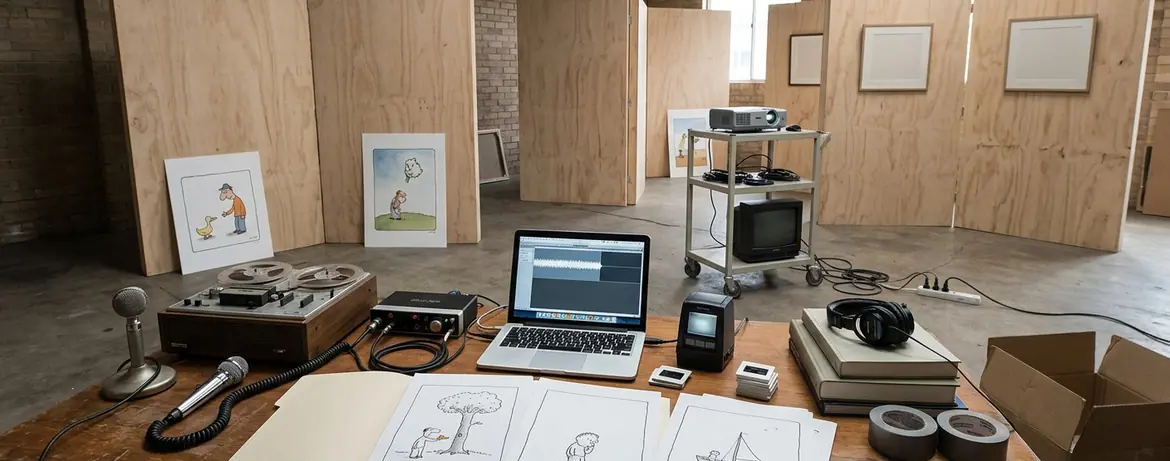
For a small bookshop, test close seating and one reader with minimal amplification. For a library, assign visible transitions and accessibility support. For a school, prepare age-appropriate context and define discussion vocabulary in advance. Freeze the basic format 21 to 28 days before the event, then allow 7 to 14 days for performers and access staff to test transitions before the final rehearsal.
Securing Permissions for Public Presentation
A community group plans to project a drawing from State of Bewilderment while reading the accompanying text and streaming the audio online. The permissions review separates this single proposal into distinct uses: public reading, adaptation, projected image, printed handout, recording, online transmission, and music. Staff enter each specific use on a permissions sheet. Owning a physical book or holding a free event in an educational setting rarely resolves copyright questions automatically. Applicable exceptions depend entirely on the specific purpose and circumstances of the gathering.
Record the excerpt or image, source, rightsholder or publisher contacted, requested use, event date, anticipated audience, admission arrangement, distribution method, recording plan, contact date, response, and any conditions. Begin rights enquiries 6 to 10 weeks before promotion where possible. Set an internal go-or-remove decision 14 to 21 days before the event. Consult current Australian Government copyright guidance for baseline definitions.
This planning framework does not determine whether a particular reading, educational use, adaptation, display, recording or stream is legally permitted; uncertain or consequential uses should be confirmed with the relevant rightsholder or a qualified adviser.
Pre-Publicity Rights Checklist
- Write the event's one-sentence artistic intention.
- Record full source and edition details for every selected item.
- List reading, display, adaptation, handout, recording, streaming and music uses separately.
- Confirm permission status and attribution wording before printing programmes.
Structuring the Emotional Arc of the Programme
The curator lays the authorised items on a running order to construct a deliberate emotional arc. Each piece receives a specific function: arrival, contrast, deepening, release, or an open ending. Alternate the forms where permissions allow. A sequence might move from a short poem to a restrained contextual introduction, followed by a prose excerpt, a visual encounter, and a final poem.
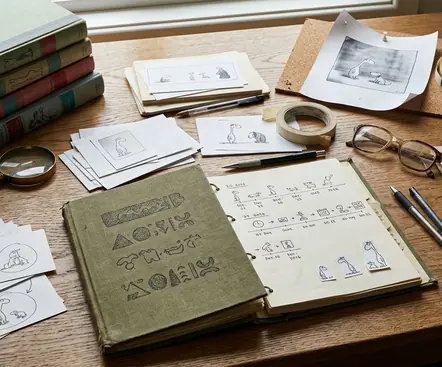
Print a running order containing start and finish times, reader names, pronunciation marks, source details, permission status, visual-handling instructions, and one explicit pause cue after every item. Keep routine introductions within 20 to 45 seconds. Limit these introductions to information the audience genuinely needs, such as the source, verified date, speaker identity, and why the next form differs from the previous one.
Use pauses of 5 to 12 seconds between substantial items. Permit 45 to 90 seconds of quiet viewing for a single authorised visual work. A common failure occurs when a projected cartoon is treated as decoration: the host speaks through the viewing period, the audience cannot inspect the relationship between caption and drawing, and the image disappears before discussion begins.
Testing the Physical and Acoustic Environment
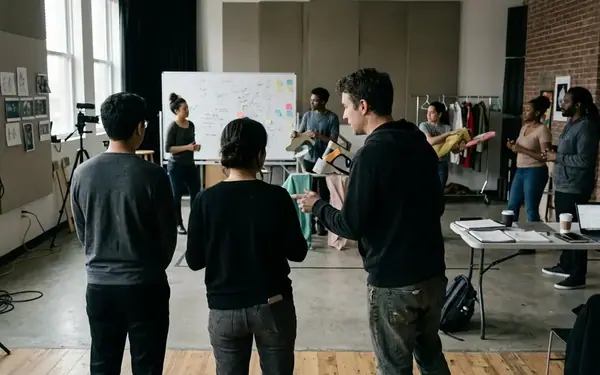
What happens when the planned rhythm meets the reality of the physical space? The first rehearsal establishes pronunciation, breath, and operative words around a table. The subsequent room rehearsal tests lectern height, page turns, microphones, chairs, lighting, sightlines, and access routes in sequence. Direct readers away from exaggerated whimsy, forced melancholy, or comic voices unless the chosen piece and approved adaptation clearly support that specific treatment.
Ask performers to underline operative words and mark breaths. Test whether a slower pace clarifies the language or makes it overly solemn. Schedule a table rehearsal 7 to 12 days before the event and a complete technical run in the venue 1 to 3 days before it. Allow 45 to 75 minutes to rehearse a 35-minute programme.
Assign named responsibilities for the welcome, reading, music, image handling, timekeeping, questions, and accessibility support. Test the microphone position at both normal and quiet speaking levels to ensure the equipment captures the natural dynamics of the voice. The physical rehearsal reveals where transitions drag or where a reader needs more light to navigate a complex stanza.
Guiding Audience Reflection Without Forcing Conclusions
The moderator opens the post-reading segment with observational prompts. They ask which specific image, phrase, silence, or tonal shift remained with listeners. Interpretive questions follow only after participants have identified something concrete in the text or drawing. Let contrasting responses coexist in the room. Distinguish personal readings from verified biographical context or publication history provided by Penguin Books Australia Ltd: publisher.
Prepare three prompts in order: an observation question, a question comparing tone or form, and a question about what remains unresolved. Give listeners 10 to 20 seconds to think before taking responses. For school audiences, provide concrete entry points and vocabulary support without prescribing the emotional conclusion students should reach.
Request accessibility information at registration. Confirm seating, lighting, sound, and printed-support arrangements with attendees or support staff 3 to 7 days before the event. A successful discussion allows the audience to sit with the ambiguity of the work. The moderator acts as a guide to the text, pointing back to the specific lines or visual details that sparked a reaction, rather than acting as an authority who holds the definitive meaning of the piece.
A Complete 35-Minute Library Running Order
The library team selects two short poems, one brief prose or interview excerpt, and one visual work. They record their sources and request permission for every proposed reading, display, or recording use, removing any element that remains uncleared. They lock the authorised running order 14 to 21 days before the programme, complete the full room rehearsal 1 to 3 days beforehand, and place the lectern, small table, and semicircle before the audience enters.
At 0 to 3 minutes, the host welcomes the audience, identifies the sources, and explains that the discussion will leave room for different readings. From 3 to 8 minutes, the first reader delivers the opening poem, followed by ten seconds of silence. Between 8 and 14 minutes, the host provides verified context before the second reader delivers the prose or interview excerpt.
Minutes 14 to 18 are dedicated to quiet viewing of the authorised visual work and initial observations. An optional cleared instrumental transition plays from 18 to 20 minutes. The final poem is read between 20 and 25 minutes. The moderator leads three structured questions from 25 to 34 minutes. At minute 35, the host delivers the final thanks and concludes the event.