From Published Cartoon to Collected Sheet
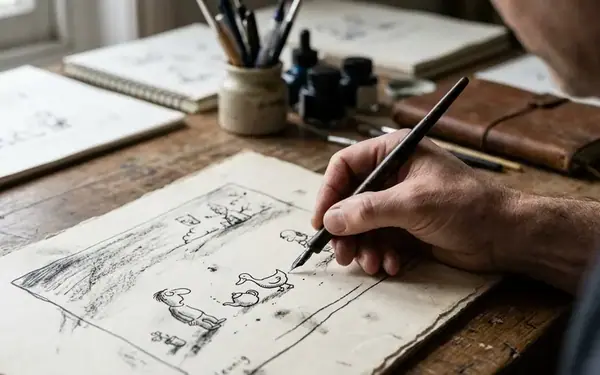
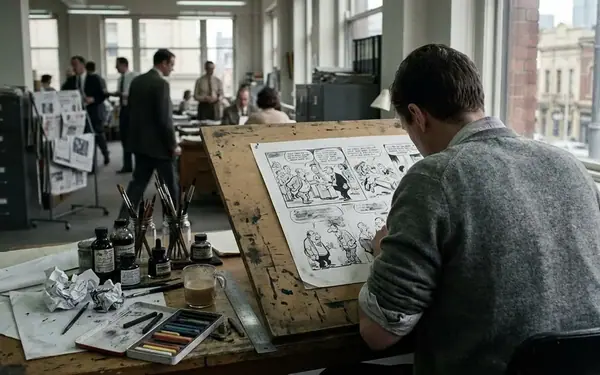
A familiar Michael Leunig figure—perhaps a small person leaning into the wind beside a teapot, or a solitary duck contemplating the moon—often enters a household as a clipping from a newspaper column or a cherished page in an illustrated anthology. Years later, that exact visual composition can reappear on a dining table or an auction table as a standalone sheet of paper. Publication reproduces an image across thousands of copies, whereas the sheet on which the artist originally drew remains a singular physical object. When an admirer decides to bring a loose Leunig work into a personal collection, identifying the exact nature of that physical sheet comes before choosing a timber moulding or a place on the living room wall.
Every work on paper carries a distinct biography. A collector who treats a loose cartoon primarily as wall decor risks sealing unstable materials, undocumented history or misunderstood reproductions behind glass. Establishing what the object actually is changes how it should be handled, insured, mounted and lit.
Before any framing order takes place, four separate enquiries need clear answers: what the physical object is, how its ownership history is documented, what condition the paper and media are in, and how the sheet should ultimately be housed. Recording those four findings separately prevents a broad phrase like "signed Leunig" from standing in as a complete description. A precise record describes the support and the image independently, using wording such as "printed image on a book leaf with an inscription" or "ink drawing on heavy wove paper." That initial discipline protects both the artwork and the collector.
An Original Drawing, a Print or a Signed Book Page?
Consider a loose leaf removed from a mid-career Leunig book, bearing a warm felt-tip dedication and an authentic signature beneath a printed cartoon of Vasco Pyjama. The ink of the dedication sits vividly on the surface, showing slight pooling where the pen paused. Despite the undeniable presence of the artist's hand in that inscription, the cartoon above it was laid down by a commercial printing press. A genuine Leunig signature on a printed book leaf does not turn the reproduced cartoon beneath it into an original drawing.
Image-making marks and signatures answer two completely separate identification questions. A drawing carries ink, graphite, watercolour or wash applied directly to its paper support by the artist. A reproduction carries a mechanically or digitally printed version of an image. Even the trade phrase "signed print" simply describes a printed sheet bearing a handwritten signature; it does not by itself confirm an original drawing or an artist-made fine print. Similarly, an edition notation such as "12/100" conventionally identifies a numbered impression within a stated edition, and a careful buyer records that notation verbatim without treating it as automatic proof of authenticity, rarity or value.
Separate Autograph From Image
Drawn marks, printed cartoon lines, added signatures and bound-page evidence must be recorded as distinct features before the object receives a catalogue or framing description.
Examining the unframed or framed work under diffuse light with a handheld magnifier reveals how the image arrived on the support. Comparing those physical clues against the seller's description establishes a reliable baseline, even though magnified line edges, dot patterns and ink variation serve as identification clues that require assessment alongside the particular sheet's documentation to settle attribution.
- Line edges and ink density: Hand-drawn ink lines typically show subtle variations in fluid density, tiny pooling at the ends of strokes, and distinct tonal overlap where one line crosses another.
- Printed dot patterns: Commercial offsets and photomechanical reproductions frequently reveal regular halftone dots or uniform micro-patterns under magnification, with flat, even ink coverage right to the edge of each line.
- Page typography: Printed page numbers, typeset captions, running headers or registration marks around the border indicate a published leaf or press proof.
- Binding edges: One vertical edge showing uniform adhesive remnants, stitch perforations or a clean guillotine trim often points to removal from a bound publication.
- Accessible reverse marks: Text or illustration bleeding through or printed directly on the reverse confirms a publication source, while pencil framing notes, editorial stamps or gallery labels offer clues to past circulation.
Photograph every accessible reverse-side detail, inscription and label during this visual check. If the sheet sits inside a sealed mount or remains glued to a backing board, leave those attachments completely intact rather than prying them open to inspect the back.
Build a Paper Trail Before Agreeing to Buy
How does a buyer connect a loose cartoon on a table to the decades of studio work, newspaper syndication and gallery exhibitions behind it? Provenance provides that bridge. It is the documented ownership and transfer history of that particular physical object, linking invoices, letters and exhibition labels directly to observable features on the sheet.
Verbal assurances fade quickly once a transaction concludes. Before agreeing to purchase a Leunig piece, separate the seller's conversational statements from verifiable documentary evidence. A structured set of pre-purchase questions clarifies what can actually be proven.
- How and when was the work acquired by the current owner?
- What original invoice, receipt, gallery catalogue or correspondence accompanies the sheet?
- What specific evidence supports the stated medium, creation date and attribution?
- Has the sheet ever been cleaned, restored, trimmed, attached to a backing board or previously framed?
Alongside these answers, request clear, uncropped photographs of the entire front, the accessible reverse, all four paper edges, the signature, any inscriptions and any attached frame or gallery labels. Ask the seller to provide the exact sheet height and width in millimetres, accompanied by a written condition description.
When the documents arrive, match them detail for detail against the photographs. A robust record connects an invoice or letter to the exact millimetre dimensions, the specific cartoon subject, the wording of an inscription or the text on an old gallery label. Keep the original wording of both the sales description and the supporting records intact in your files; never rewrite a cautious archival note into a stronger attribution. If identity or provenance remains unresolved after reviewing the paperwork, seek an independent specialist assessment before committing funds. Once a purchase goes ahead, store the initial enquiry, the written description and the pre-purchase photographs securely, adding every subsequent treatment report or framing invoice to that same permanent file.
Read the Paper Before Choosing the Mount
Paper records its environment silently over decades, absorbing ambient moisture, reacting to poor-quality backing boards and shifting under daylight. Before discussing timber mouldings or wall hooks, lay the supported sheet flat on a clean, dry surface under even, diffuse light. Handle the paper as little as possible, keeping it fully supported from beneath so that flexing does not stress fragile fibres.
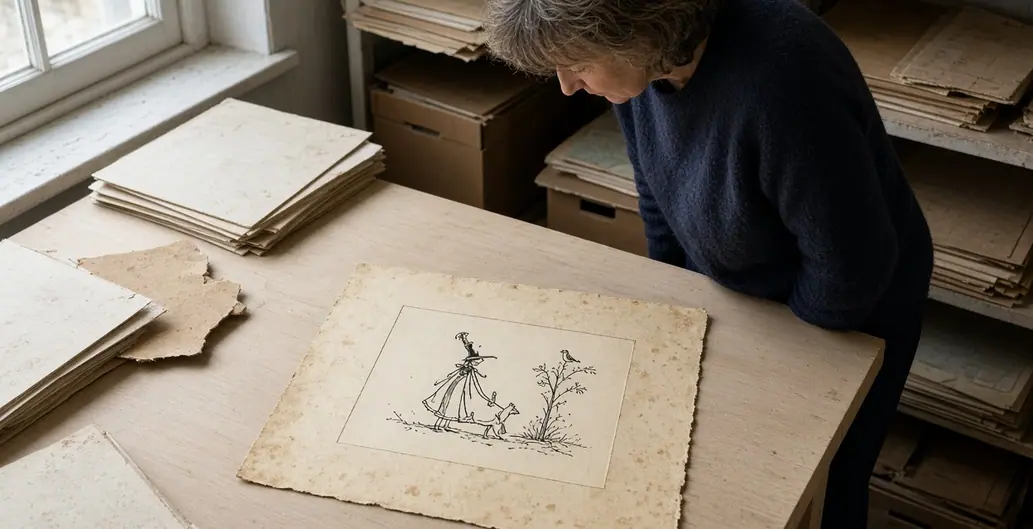
Grouping visual observations into three distinct categories keeps the inspection thorough and objective:
- Paper changes: Look across the sheet under raking and flat light for overall yellowing or discolouration, scattered brown spots, edge tears, planar creases or brittle corners. Compare the visible centre of the sheet with any exposed edges near a window mount to see if light has darkened or bleached the exposed area, taking care never to lift concealed attachments.
- Image changes: Check the drawn or printed lines for fading, water smudging, or loose and flaking media where thick pigment or correction fluid may be lifting from the fibres.
- Mounting problems: Note any darkened adhesive residue, yellowed tape strips, tideline staining beside hinge points, cockling or wave distortion across the sheet, and full or partial adhesion to an older backing board.
Record the exact position and visual appearance of each issue in plain language rather than attempting a technical diagnosis. Writing "scattered brown spotting along the lower edge" or "planar crease forty millimetres from the top right corner" gives a conservator or framer reliable facts without guessing whether a mark comes from iron impurities, adhesive burn or biological growth. Photograph the full sheet alongside closer views of each area of concern, noting the exact inspection date and stating clearly whether the examination took place through existing glazing.
Pause When Paper Resists
Stop handling immediately and arrange specialist conservation advice if the inspection reveals flaking media, dampness, suspected mould, brittle paper edges or physical resistance at an old mount attachment.
Preservation needs stand entirely separate from purchase price or sentimental value. Even a modest inscribed clipping requires stable support if its ink and paper fibres are going to survive long-term display.
Leave Tape, Stains and Flattening to a Paper Conservator
A crumpled corner or a strip of darkened pressure-sensitive tape on the edge of a newly acquired cartoon often tempts an enthusiastic owner to tidy the sheet before taking it to the framer. Home repairs consistently cause irreversible damage to works on paper. Domestic interventions disturb fragile drawing media, abrade the surface texture of the paper, drive soluble stain components deeper into the fibres and strip away pencil annotations or documentary stamps that validate the work's history.
Treat conservation as a completely separate decision from framing, and exclude every domestic repair method from the preparation routine:
- Peeling or scraping adhesive tape from the front or reverse of the sheet
- Rubbing surface dirt or pencil marks with household erasers
- Washing, sponging or applying liquid bleach to discoloured areas or brown spots
- Applying a household iron or stacking heavy weights over damp or dry creases to flatten cockling
- Forcing or peeling a drawing away from an old cardboard backing
When a sheet carries old adhesive, planar distortion, tears, staining or uncertain mounting adhesives, take it directly to a qualified paper conservator. Prepare a clear consultation brief containing the sheet dimensions in millimetres, the condition photographs, the known ownership history, notes on observed damage and a description of the room where the work will be stored or displayed. Photograph all inscriptions, collector stamps and old frame labels prior to delivering the work, and discuss the explicit retention and documentation of those historical markers with the conservator.
Before authorising any physical work, review the conservator's written proposal. That assessment should distinguish necessary structural stabilisation from appearance-led cosmetic treatment, while identifying proposed materials, specific treatment risks, the intended visual outcome and ongoing aftercare requirements. File the pre-treatment condition record, the signed treatment proposal and the final treatment report together as successive chapters in the object's archival dossier.
Specify a Frame That Protects the Sheet
Imagine a delicate Leunig ink-and-wash study arriving at a framing counter after a thorough condition check. Without clear technical instructions, a standard commercial package might press the drawing directly against ordinary glass or secure the corners with pressure-sensitive masking tape against wood-pulp card. Within a few Australian summers, heat and trapped humidity can transfer acids into the sheet, cockle the support and fuse water-soluble lines to the inside of the glass.
Translating the identification and condition notes into a written framing brief prevents those defaults. Discuss the paper support, the drawing or printing medium, any existing attachments and the intended hanging location with the framer before choosing decorative mouldings. A protective housing relies on stable, reversible materials throughout the assembly.
Mount and Backing Composition
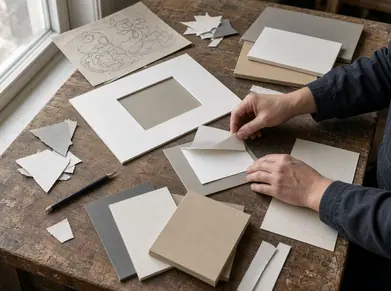
Specify conservation-quality window mounts and solid backing boards suited to the weight of the paper and the sensitivity of the media. Ask the framer to name the exact board composition—such as pure cotton rag or alpha-cellulose conservation board—rather than relying on a generic "acid-free" trade sticker, which can still describe lignin-heavy boards whose buffering diminishes over time.
Reversible Hinges and Separation
Ask the framer to explain the exact mounting method and demonstrate how the sheet could later be released without cutting or tearing the support. Keep all adhesives off the image area. Exclude pressure-sensitive tapes, dry mounting presses and heat lamination entirely. Use a deep window mount or hidden conservation spacers to keep the paper well clear of the glazing surface, and isolate the outer edges of the sheet from direct contact with the timber frame rebate. When a sheet consists of exceptionally fragile paper or carries powdery, sensitive media, refer the mounting specification to a paper conservator first.
Glazing and Display Environment
Specify ultraviolet-filtering glazing to reduce photochemical degradation of both paper fibres and drawing inks. Remember that all light exposure is cumulative, including ordinary indoor visible light. Hang the finished frame well away from direct sunlight, radiant heaters, air-conditioning vents and damp external masonry walls.
Keep Paperwork Separate
Store original invoices, letters of provenance and condition photographs in an archival folder kept in a separate filing cabinet, never taped or tucked inside the back of the picture frame.
Not every work belongs on the wall permanently. When an original sheet is highly sensitive or the intended hallway receives strong afternoon light, display a clearly labelled facsimile reproduction in the frame and house the original flat inside a conservation-quality folder within a rigid protective box. Store that box in a stable indoor cupboard away from concrete floors, uninsulated roof spaces and household plumbing.
Choose Between Display, Storage and Assessment
Protecting a Leunig work on paper follows a deliberate sequence: establish the exact physical object type, organise and verify its ownership records, inspect its physical condition under diffuse light, and only then select its long-term housing. Rushing straight to the framing bench skips the very steps that preserve both the line work and its documentary truth.
Each observable situation points to its own practical pathway:
- Stable paper and a calm indoor environment: Proceed to a conservation-framing briefing using verified board compositions, reversible hinging, glazing separation and ultraviolet filtration.
- Visible condition or mounting concerns: Pause framing plans and commission a written assessment from a paper conservator to separate structural stabilisation from cosmetic alteration.
- Unresolved attribution or gaps in provenance: Hold off on purchasing or framing until an independent specialist evaluates the physical sheet alongside its supporting records.
Make a dated baseline condition record before the work enters the frame shop, and photograph the completed frame assembly front and back upon its return, filing both sets of images with the work's permanent records. A frame is an ongoing stewardship arrangement rather than a sealed vault. Revisit the display setup promptly after a household move, a seasonal shift in sunlight angles, a nearby roof or pipe leak, visible condensation inside the glazing, or any newly noticed change in the paper tone or ink density.
Given this sheet’s condition and the place you want to display it, should you frame the original, display a reproduction or seek an assessment first?