What Counts as a Leunig Contribution?
A contribution is an identifiable piece of Michael Leunig’s creative or editorial work credited within a volume containing work by others or assembled by another editor. When mapping his cartoons and visual works or poems and reflections across shared books and publications, I establish the qualifying evidence before gathering titles, because the core bibliographic task is to locate a credited contribution in a retrievable edition.
The containing book’s title and principal catalogue entry routinely foreground its editor or broader Australian cultural context rather than listing every contributor. Consequently, a research target always consists of three distinct components: an identifiable contribution, its containing volume, and the exact edition through which a reader can retrieve it. Without all three elements verified, a bibliographic lead remains incomplete.
Qualifying material encompasses several distinct forms of credited work:
- Credited cartoons and standalone visual material
- Poems and reflective prose pieces
- Forewords, introductions, and afterwords
- Explicitly credited editorial contributions
A passing reference to Michael Leunig, a critical review of his characters and motifs, or a brief quotation inside another author's essay does not by itself establish a contributed piece. Those items belong to secondary press and commentary rather than the primary bibliography of shared volumes.
Separate Leunig’s Piece from the Book That Contains It
Consider a researcher who locates a multi-author collection featuring a single foreword or a reproduced drawing of a familiar duck and teapot. If the researcher logs Michael Leunig as the book's primary author, the archival record becomes distorted, merging a single piece with the editorial responsibility for the entire book. Accurate cataloguing requires linked but separate descriptions for the individual contribution, the containing volume, and the consulted edition.
I preserve the exact printed role wording—such as contributor, foreword writer, or credited artist—at the contribution level, and I record responsibility for the volume separately under its named editor. Responsibility for an individual piece never automatically establishes co-authorship of the whole book. Furthermore, I record the anthology’s publication year separately from any documented earlier appearance of the piece, since a newly edited collection frequently reprints a familiar poem or cartoon from decades earlier.
To keep these layers distinct during an investigation, I track every candidate through four research-trail fields:
- Search lead: The initial catalogue record or bibliographic hint that surfaced the book.
- Inspected contribution: The verified piece, its printed title or visual description, and its exact page range.
- Publication-history assessment: The relationship between the volume's release date and the piece's earlier appearances.
- Retrieval details: The edition-specific identifiers that allow another reader to locate the exact physical or digital copy.
Each entry advances through three strict inspection statuses: catalogue record inspected, inspection requested, or book pages inspected. I advance an entry from a catalogue lead to a checked contribution only after physically or digitally inspecting the relevant pages.
Search Catalogues Beyond the Main Author Field
How do we surface shared volumes when the main author field names only an anthology editor? The process begins by entering Michael Leunig in a library catalogue’s all-fields search, then comparing those broad results against dedicated author or contributor searches where the system supports them.
Because search syntax varies across institutions, I check the catalogue’s own search help to determine phrase-search punctuation and available contributor-field operators before running targeted queries. Three starting queries are:
Michael Leunig anthologyMichael Leunig forewordMichael Leunig contributor
Rather than relying on the brief result heading, I open plausible records to inspect the contributor fields, contents notes, edition statements, and publication details. When a promising volume appears, I run a follow-up search combining its exact title with Leunig’s surname, then repeat the query pairing the volume title with the editor’s name or an identified contribution title.
Every plausible hit goes into a candidate log capturing seven specific elements: volume title, editor, publication year, catalogue location, permalink or record identifier, reason for inspection, and inspection status. Retaining the edition statement and publication details alongside each candidate ensures that records for different editions remain distinguishable. I also make the reason for inspection explicit—recording model log descriptions such as "contents note attributes a foreword to Michael Leunig" or "contributor field names Michael Leunig"—so I know exactly what claim requires verification when the book arrives.
Check the Contents, Credit and Contribution Pages Together
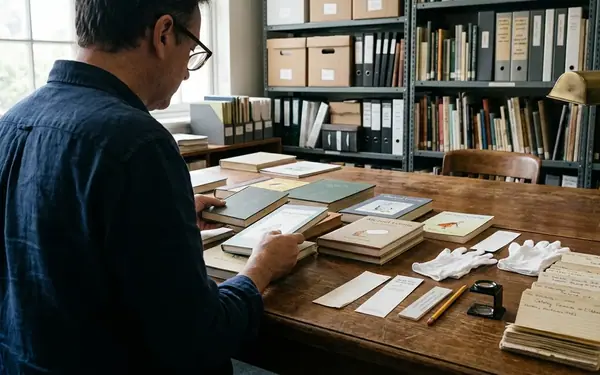
A catalogue hit for Michael Leunig still lacks a checked contribution until the inspected edition connects a specific poem, cartoon, foreword, or other piece to his printed credit. Once the physical volume or a complete digital scan is in hand, I follow a fixed six-step inspection sequence to establish the volume and edition first, locate the piece next, and then connect the printed attribution to the material it credits.
- Title page: Transcribe the exact volume title and stated editorial responsibility.
- Publication-details page: Capture the publisher, publication place if printed, year, edition statement, and ISBN where present.
- Contents page: Record the listed contribution title, page location, and stated attribution.
- Contributor notes: Check biographical notes at the front or back of the book for role confirmation.
- Contribution pages: Inspect the actual heading, byline, printed page numbers, and total extent of the piece.
- Acknowledgements: Read the permissions and source notes for publication-history clues.
Transcribing Titles and Pagination
Precision matters when recording what appears on the contribution pages. For a poem or prose piece, I transcribe its printed title exactly as typeset. Cartoons and visual works frequently appear without captions or titles; for an untitled cartoon, I supply a clearly bracketed descriptive label, such as [Untitled cartoon: description of visible scene], rather than presenting an invented title as printed wording. At the same time, I identify the exact scope of each credit, noting whether the attribution covers the text, a reproduced image, or an editorial role. When working with digitized books, I record the printed pagination separately from the digital viewer’s image counter, retaining both as separately labelled locators when useful.
Remote Verification Enquiry Template
When a volume resides in a distant collection, send a focused request to the holding library or archive: "Could you inspect [volume title, editor, year, edition or ISBN] and confirm the wording of Michael Leunig’s contributor credit, the contribution’s printed title or whether it is untitled, and its printed page range? Please identify the page carrying the credit and transcribe any source or reprint statement."
Trace Whether the Contribution Is New or Reprinted
Consider a reading exercise involving two hypothetical anthology entries: in the first, the acknowledgements page explicitly credits an earlier collection for a cartoon; in the second, a note on the contributor page states that a poem was written specially for the volume. For an entry explicitly acknowledged as a reprint, the researcher transcribes the acknowledgement and pursues its named source as a new search lead. For an entry explicitly described as first published in that volume, the researcher records the statement and its page number as the primary evidence for that designation.
An anthology’s recent publication year dates that containing edition, while an acknowledgement naming an earlier source supplies a separate date for tracing the Leunig piece. To prevent chronological confusion, I maintain three separate date fields in my notes:
- Containing volume publication date: The year the consulted edition was released.
- Documented appearance of the inspected version: The date attached to the specific version in hand.
- Identified earlier appearance: The date of prior publication named in permissions or source notes.
An individual work’s copyright date records a rights-related date, whereas the anthology’s publication date identifies the containing edition; I keep both with their printed labels. When expressing a publication-history range, I use documented endpoints formatted as [identified earlier-publication date]–[consulted edition publication date], preserving the source’s exact date precision and distinguishing those endpoints from evidence of continuous publication.
Whenever an earlier-publication reference appears, I transcribe the named publication, date, and locator exactly as printed. Similarly, I treat a statement that a piece was specially commissioned as commissioning evidence, assessing any claim of first publication strictly from the wording actually printed. If the publication history remains uncertain after checking all credit pages, record earlier publication unverified rather than assuming the piece is an original contribution. Finally, when two versions of a piece become available across different books and publications, I compare the title, wording, image composition, and accompanying text before recording whether any observed change concerns layout presentation or substantive content.
Build an Entry That Leads Back to the Exact Edition
How do we structure all of these verified details so another researcher can find the exact same page years later? I build the final archive entry directly from the consulted book, keeping catalogue-supplied discovery information separate from publication facts transcribed from the physical pages. I also preserve a separate edition record for each edition inspected, linking those records through the identified contribution and recording any observed differences between versions.

A complete record splits the data into four structured groups: contribution fields, containing-edition fields, retrieval fields, and an evidence note.
{
  "type": "reusable_record_template",
  "title": "One contribution, one consulted edition",
  "fields": {
    "contribution": {
      "creator": "Michael Leunig",
      "credited_role": "",
      "printed_title_or_bracketed_description": "",
      "linked_contribution_record": ""
    },
    "consulted_edition": {
      "volume_title": "",
      "editor": "",
      "publisher": "",
      "publication_place_if_printed": "",
      "year": "",
      "edition": "",
      "contribution_page_range": ""
    },
    "retrieval": {
      "isbn_where_present": "",
      "catalogue_permalink_or_identifier": "",
      "holding_location_and_shelfmark": "",
      "consulted_digital_copy_location": ""
    },
    "evidence_note": {
      "inspected_credit_page": "",
      "attribution_wording": "",
      "inspected_contribution_pages": "",
      "printed_reprint_or_first_publication_statement_and_location": ""
    }
  }
}
For prose bibliographies and footnotes, these structured fields compress into a clean citation pattern: Michael Leunig, [contribution title], in [volume title], edited by [editor] ([publication details]), [pages]. Whether stored in a database or written as a citation line, the completed entry identifies both Leunig’s contribution and the exact volume and edition through which a reader can retrieve it.
Choose Which Leunig Lead Deserves the Next Check
Accumulating dozens of unverified catalogue hits creates an unusable backlog unless the candidate log converts into a disciplined inspection queue. Completing one fully traceable entry always yields more archival value than expanding a list of loosely associated titles.
When reviewing a candidate log, I prioritise items in three distinct tiers:
- Unexamined volumes with explicit credits: Books where a catalogue contents note or contributor field directly names Michael Leunig.
- Earlier-publication references: Specific newspapers, magazines, or earlier books named in the acknowledgements of a checked entry.
- Incomplete verified entries: Checked contributions that still lack retrieval fields such as a shelfmark, ISBN, or page range.
I assign each queued item a concrete next action: inspect attribution pages, request contribution details from a library, locate the named earlier publication, or complete the edition’s retrieval information. I carry the candidate’s saved permalink or record identifier directly into that next action so that the enquiry remains tied to the exact same edition.
Recording the surrounding volume’s editor and overall subject does more than tidy up a bibliography; that editorial setting helps readers interpret the cultural conversation surrounding Leunig’s work when the piece appeared. Which candidate will you inspect next to turn a possible Leunig credit into a retrievable contribution?